Overcoming Worry: A Guide
A complete client guide to understanding and reducing excessive worry, drawing on Wells's metacognitive model and Dugas's intolerance-of-uncertainty model. Covers what worry is, why it persists, worry postponement, beliefs about worry, tolerating uncertainty, problem solving and cognitive restructuring.
About this resource
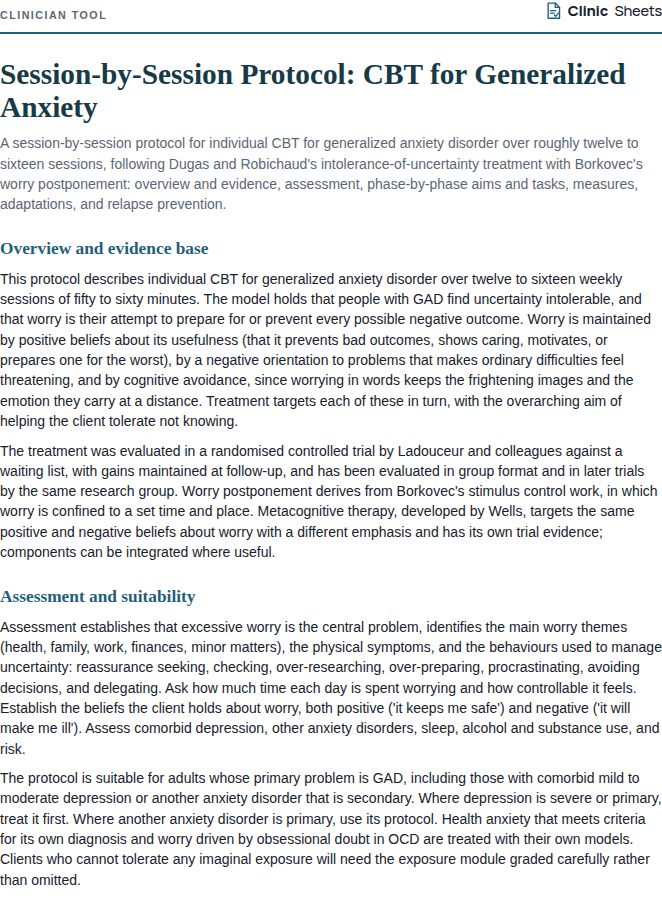
Excessive worry is the defining feature of generalised anxiety disorder and a common component of most anxiety and depressive presentations. Two cognitive models have shaped its treatment. Wells's metacognitive model distinguishes worry about everyday events from worry about worry itself, and proposes that positive beliefs ('worrying keeps me prepared') and negative beliefs ('worrying is uncontrollable and harmful') together keep the process going. Dugas and colleagues' intolerance-of-uncertainty model proposes that worry is driven by a difficulty tolerating not knowing, which leads to reassurance seeking, over-preparation, avoidance and a sense that worry is the only way to be safe.
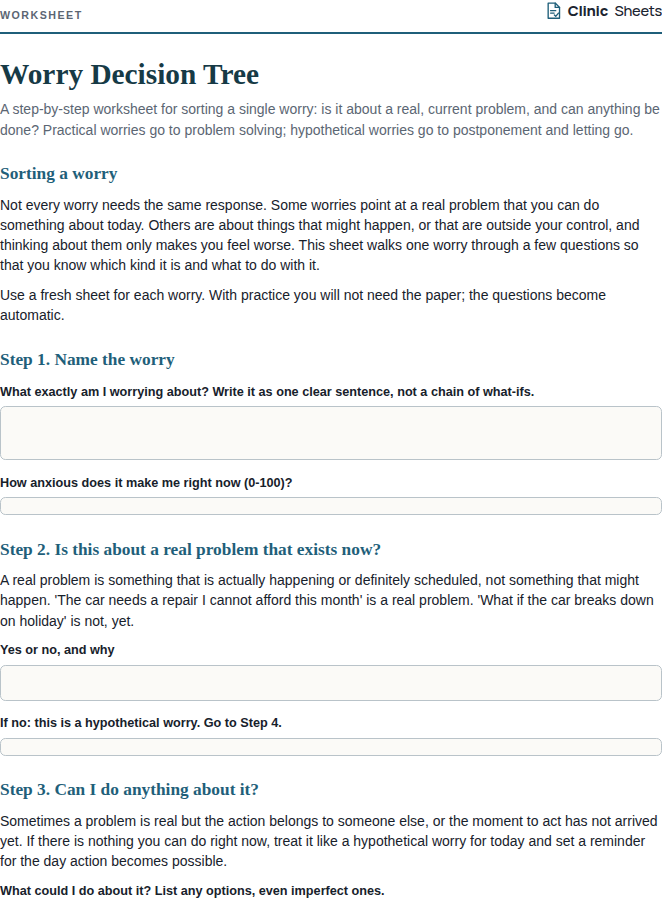
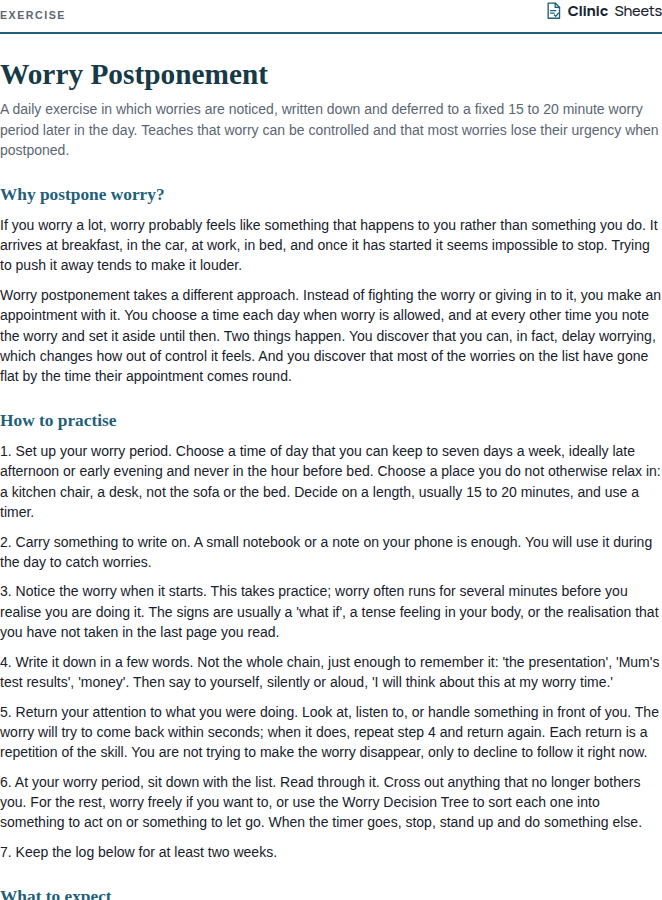
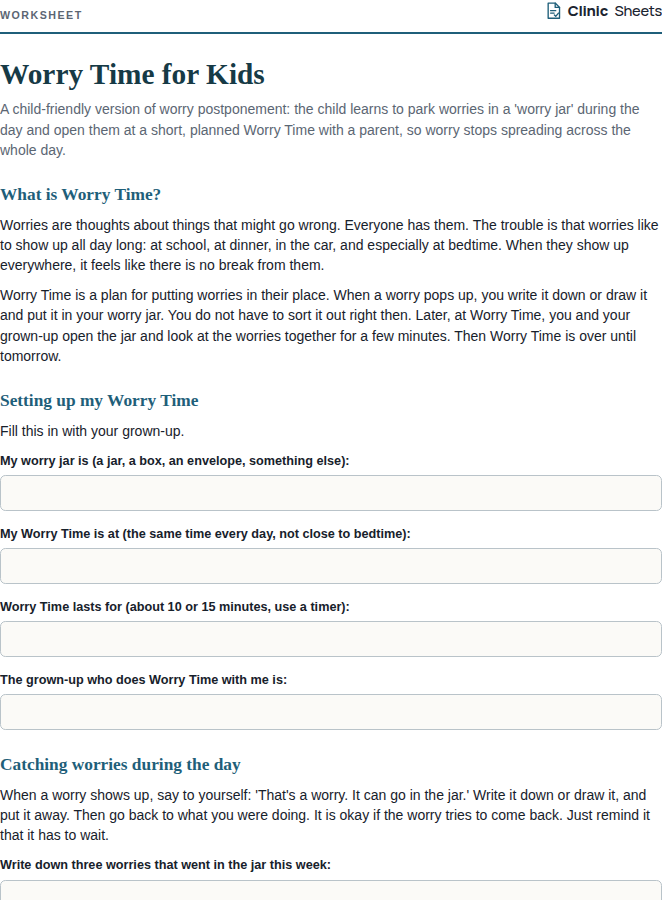
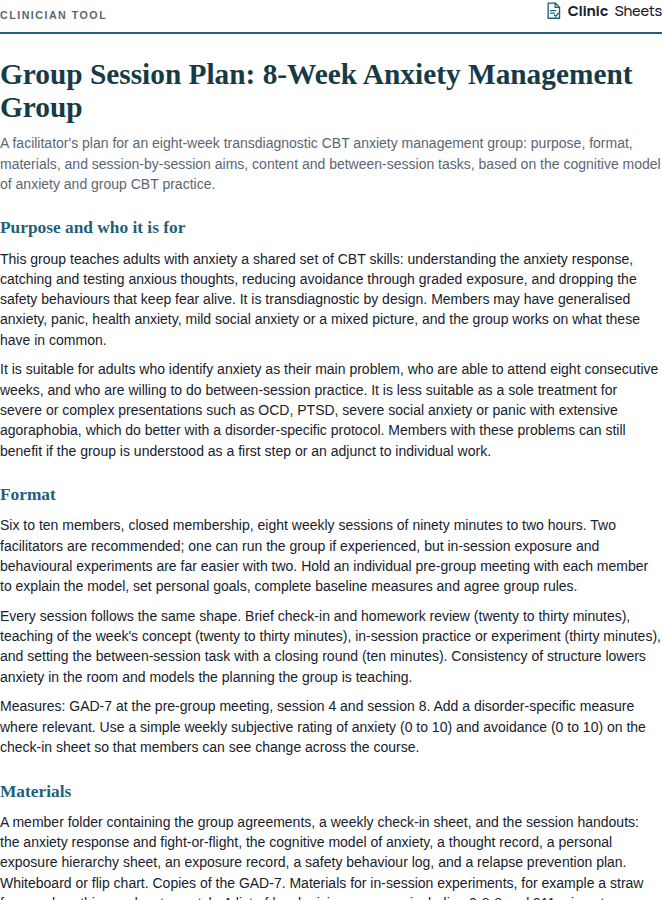
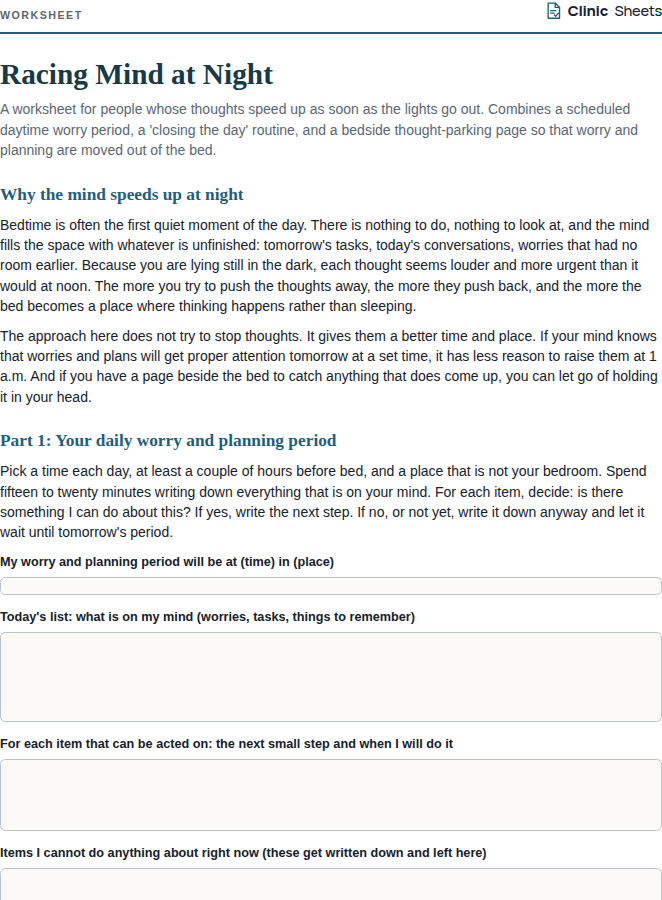
This guide draws both models together into a client-facing programme that can be worked through over six to ten sessions or used as a structured self-help companion. It begins with psychoeducation about what worry is and how it differs from problem solving, then moves through worry postponement (Borkovec's stimulus-control technique), examining beliefs about worry, testing whether worry is controllable, practising tolerance of uncertainty, structured problem solving for worries that can be acted on, and cognitive restructuring for catastrophic predictions. Each skill has a short practice field.
The professional version adds notes on sequencing, on the difference between challenging worry content and challenging beliefs about worry (the latter is generally more productive), and on common obstacles such as clients who postpone worry but then use the worry period to ruminate without limit.
How to use it
- Assign the first two sections as reading between the first and second session, and review the client's answers to the 'What worry does for me' fields together.
- Introduce worry postponement early, in session two or three, and keep it running throughout treatment. It is the backbone practice and produces data for everything that follows.
- Work through beliefs about worry and the controllability experiment before moving to intolerance of uncertainty. Clients who still believe worry is uncontrollable will not engage with uncertainty practice.
- Use the problem-solving and cognitive restructuring sections for specific worries the client raises, rather than as generic exercises.
- Return to the 'Keeping it going' section in the final two sessions and build the relapse prevention plan around it.
References
- Wells, A. (1997). Cognitive Therapy of Anxiety Disorders: A Practice Manual and Conceptual Guide. Wiley.
- Dugas, M. J., & Robichaud, M. (2007). Cognitive-Behavioral Treatment for Generalized Anxiety Disorder: From Science to Practice. Routledge.
- Borkovec, T. D., Wilkinson, L., Folensbee, R., & Lerman, C. (1983). Stimulus control applications to the treatment of worry. Behaviour Research and Therapy, 21(3), 247-251.
- Leahy, R. L. (2005). The Worry Cure: Seven Steps to Stop Worry from Stopping You. Harmony Books.