Session-by-Session Protocol: CBT for Generalized Anxiety
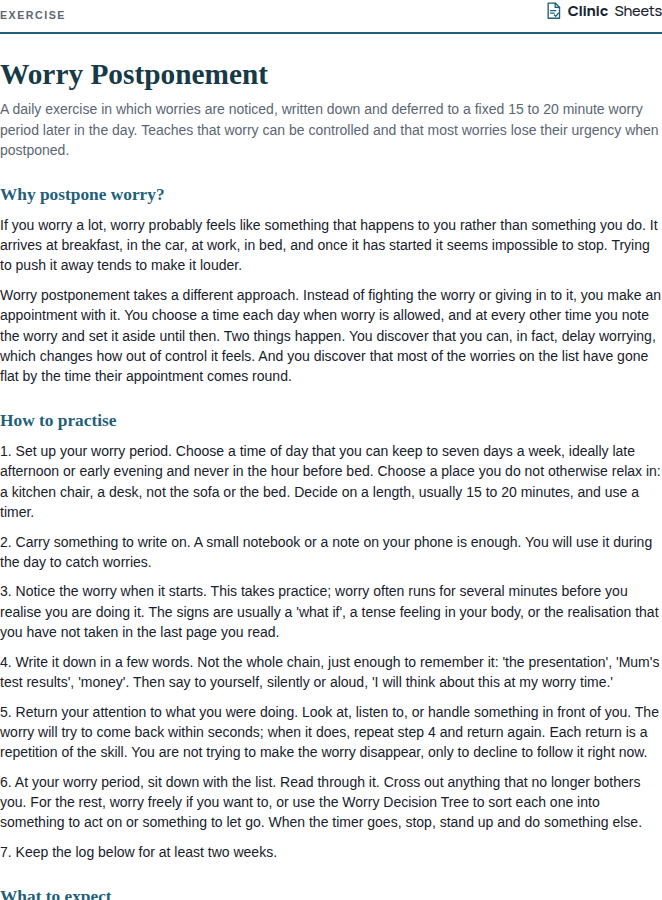
A session-by-session protocol for individual CBT for generalized anxiety disorder over roughly twelve to sixteen sessions, following Dugas and Robichaud's intolerance-of-uncertainty treatment with Borkovec's worry postponement: overview and evidence, assessment, phase-by-phase aims and tasks, measures, adaptations, and relapse prevention.
About this resource
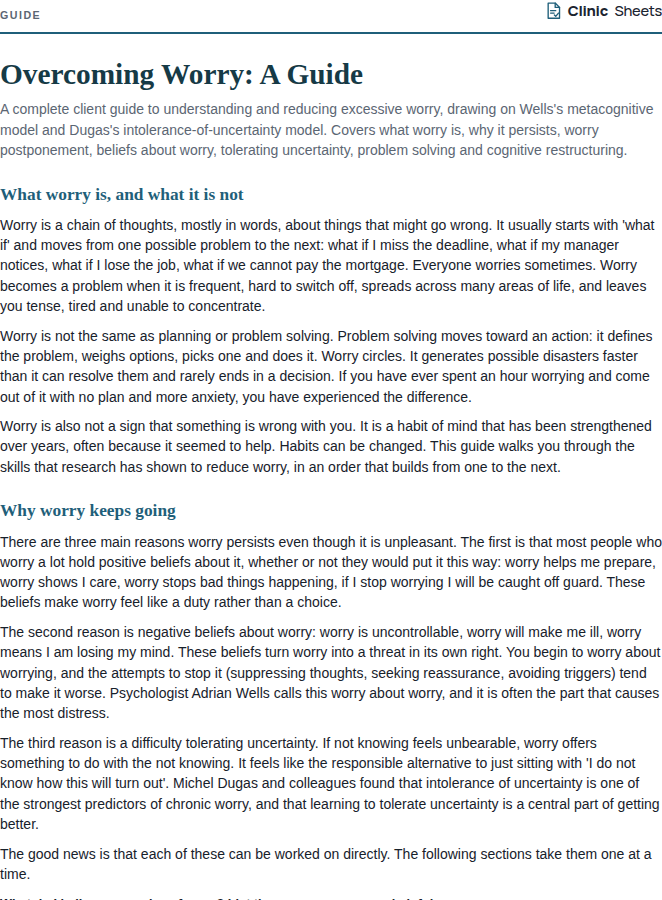
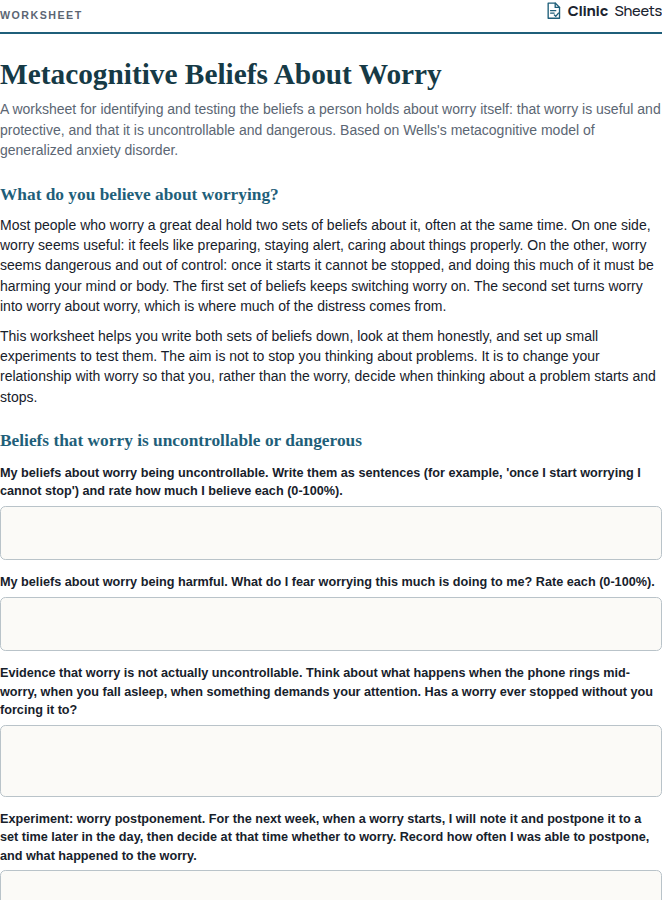
Generalized anxiety disorder is defined by excessive, uncontrollable worry across many areas of life, with accompanying tension, restlessness, fatigue, poor concentration, irritability and disturbed sleep. Several CBT protocols exist, and they share core components: understanding worry and monitoring it, learning to postpone and contain it, examining the beliefs that make worry feel necessary, treating current problems with problem solving rather than worry, and confronting feared outcomes in imagination rather than avoiding them. The protocol here follows the treatment developed by Dugas, Ladouceur and Robichaud, which organises these components around intolerance of uncertainty, the tendency to find not knowing unbearable and to respond with worry, reassurance seeking, over-preparation and avoidance. It incorporates Borkovec's stimulus control approach to worry, known as worry postponement, and notes where Wells's metacognitive work on beliefs about worry can be drawn in.
The protocol proceeds through six modules over twelve to sixteen weekly sessions: psychoeducation and worry awareness; recognising intolerance of uncertainty and testing it through behavioural experiments; re-evaluating the usefulness of worry; problem-solving training for worries about current problems; written imaginal exposure for worries about hypothetical outcomes; and relapse prevention. Each session uses the standard CBT structure of measure and mood check, agenda, review of between-session work, work on agenda items, new between-session work, and summary and feedback.
The professional version is the full protocol with sections on assessment and suitability, adapting to comorbidity, severity and setting, and relapse prevention and ending. It assumes training in CBT and access to supervision.
How to use it
- Assess in the first session or two, confirming that worry is the central problem, establishing the main worry themes, and screening for comorbid depression, other anxiety disorders and substance use. Administer the GAD-7 and the Penn State Worry Questionnaire at baseline, and the Intolerance of Uncertainty Scale if available.
- Administer the GAD-7 at every session and the worry measure at least every four sessions. Review scores with the client and use them to time transitions between modules.
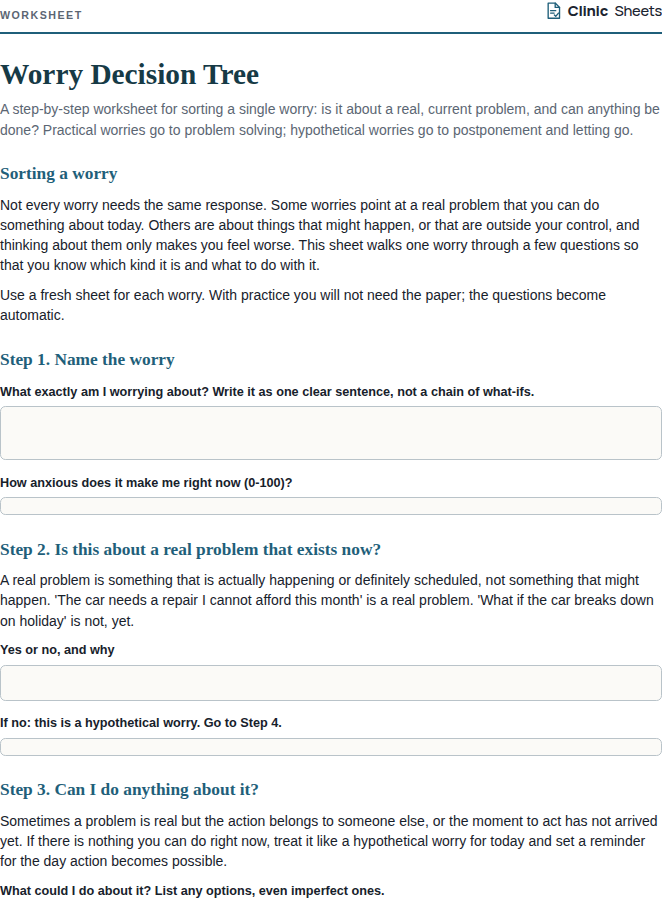
- Keep the two kinds of worry distinct from the first session: worries about current problems that can be acted on, and worries about hypothetical situations that cannot. The two later modules treat them differently, and clients need to be able to sort their worries before those modules begin.
- Frame every intervention as a way of increasing tolerance of uncertainty rather than of achieving certainty. Reassurance, including reassurance from you, reinforces the problem.
- Set written between-session work each session and review it at the start of the next. Worry diaries, uncertainty experiments, problem-solving sheets and exposure scripts are the substance of the treatment.
- Plan the ending from around session 10, taper the final sessions, and complete a written relapse prevention plan.
References
- Dugas, M. J., & Robichaud, M. (2007). Cognitive-Behavioral Treatment for Generalized Anxiety Disorder: From Science to Practice. Routledge.
- Ladouceur, R., Dugas, M. J., Freeston, M. H., Léger, E., Gagnon, F., & Thibodeau, N. (2000). Efficacy of a cognitive-behavioral treatment for generalized anxiety disorder: Evaluation in a controlled clinical trial. Journal of Consulting and Clinical Psychology, 68(6), 957-964.
- Borkovec, T. D., Wilkinson, L., Folensbee, R., & Lerman, C. (1983). Stimulus control applications to the treatment of worry. Behaviour Research and Therapy, 21(3), 247-251.
- Wells, A. (2009). Metacognitive Therapy for Anxiety and Depression. Guilford Press.