Mood Disorder Questionnaire (MDQ)
The Mood Disorder Questionnaire (MDQ), the brief self-report screen for lifetime manic or hypomanic symptoms, reproduced in full with its three-part positive screen criteria, interpretation notes and attribution.
About this resource
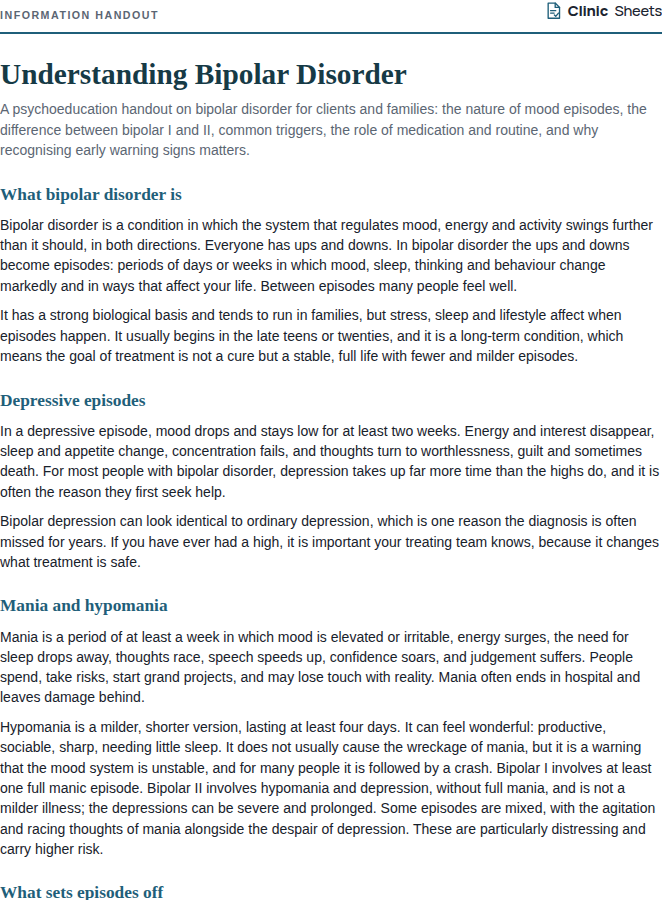
The Mood Disorder Questionnaire was developed by Robert Hirschfeld and colleagues and published in 2000 as a quick screen for bipolar spectrum disorders in outpatient settings. It has three parts. The first is a list of 13 yes/no questions asking whether there has ever been a period when the person was not their usual self and experienced a symptom of mania or hypomania, such as elevated mood, decreased need for sleep, racing thoughts, increased activity or risky behaviour. The second asks whether several of the endorsed symptoms occurred during the same period of time. The third asks how much of a problem those symptoms caused.
A positive screen requires all three: seven or more 'yes' answers in part one, a 'yes' to the co-occurrence question, and a rating of moderate or serious problem. In the original validation in psychiatric outpatients, this rule had a sensitivity of about 0.73 and a specificity of about 0.90 for a bipolar spectrum diagnosis. Sensitivity is considerably lower in general population and primary care samples, and lower for bipolar II than bipolar I, so a negative screen does not rule out bipolar disorder.
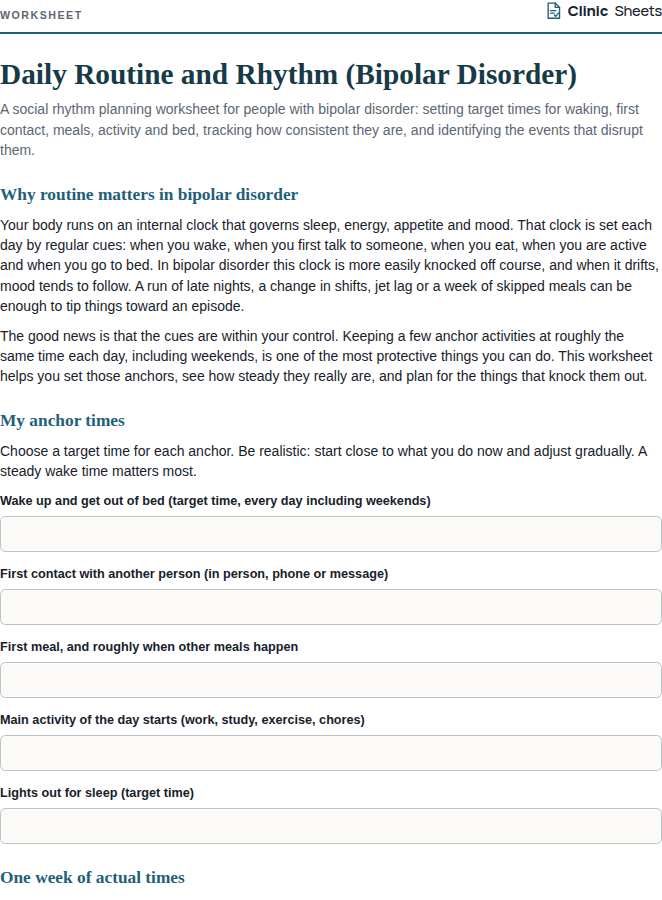
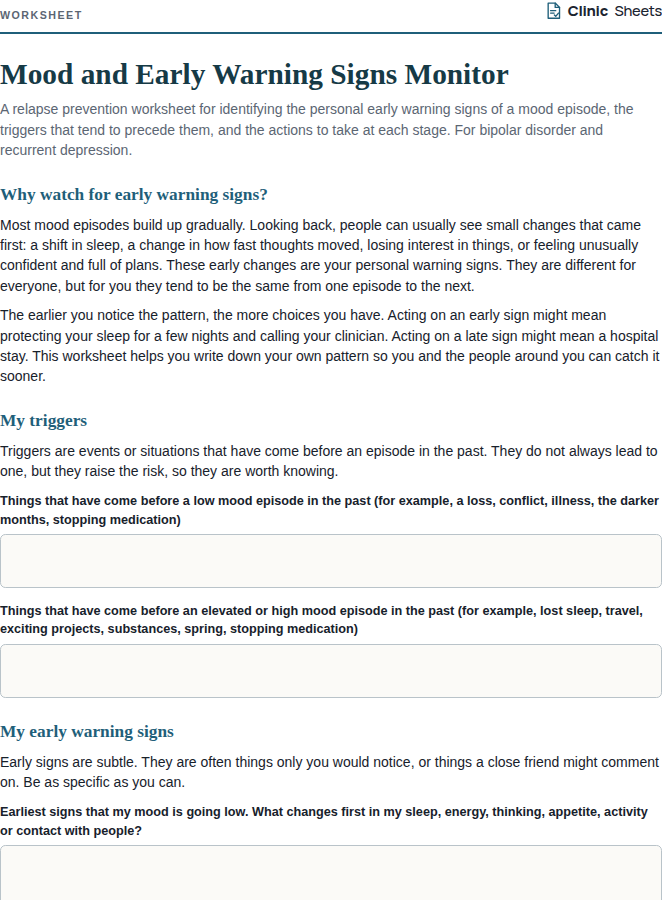
The MDQ is most useful in therapy when a client presents with recurrent depression, an unusually early onset, a family history of bipolar disorder, or a history of poor response or agitation on antidepressants. A positive screen is a reason to arrange a psychiatric assessment, not a diagnosis, and it should be discussed with the client calmly and without alarm. The professional version adds the screening rule, interpretation guidance and limitations.
The instrument is reproduced here with attribution. The MDQ is copyrighted by Dr Robert M. A. Hirschfeld and is available for use without charge provided the source is credited. Item wording follows the published instrument.
How to use it
- Offer the questionnaire when the history raises the possibility of a bipolar spectrum disorder: recurrent or early-onset depression, a family history of bipolar disorder, periods of unusually high energy or reduced need for sleep, or an atypical response to antidepressant medication.
- Count the number of 'yes' answers in part one (0 to 13). Check the answer to part two and the rating in part three.
- Apply the screening rule: seven or more 'yes' answers, plus 'yes' to part two, plus a rating of moderate or serious problem, is a positive screen.
- Discuss a positive screen with the client as a reason for a fuller assessment by a psychiatrist or physician, and share the result with the prescriber where the client consents. Do not present it as a diagnosis.
- Do not rely on a negative screen to rule out bipolar disorder, particularly bipolar II. If the clinical picture still suggests hypomania, pursue a clinical interview and collateral history.
References
- Hirschfeld, R. M. A., Williams, J. B. W., Spitzer, R. L., Calabrese, J. R., Flynn, L., Keck, P. E., Lewis, L., McElroy, S. L., Post, R. M., Rapport, D. J., Russell, J. M., Sachs, G. S., & Zajecka, J. (2000). Development and validation of a screening instrument for bipolar spectrum disorder: The Mood Disorder Questionnaire. American Journal of Psychiatry, 157(11), 1873-1875.
- Hirschfeld, R. M. A., Holzer, C., Calabrese, J. R., Weissman, M., Reed, M., Davies, M., Frye, M. A., Keck, P. E., McElroy, S., Lewis, L., Tierce, J., Wagner, K. D., & Hazard, E. (2003). Validity of the Mood Disorder Questionnaire: A general population study. American Journal of Psychiatry, 160(1), 178-180.