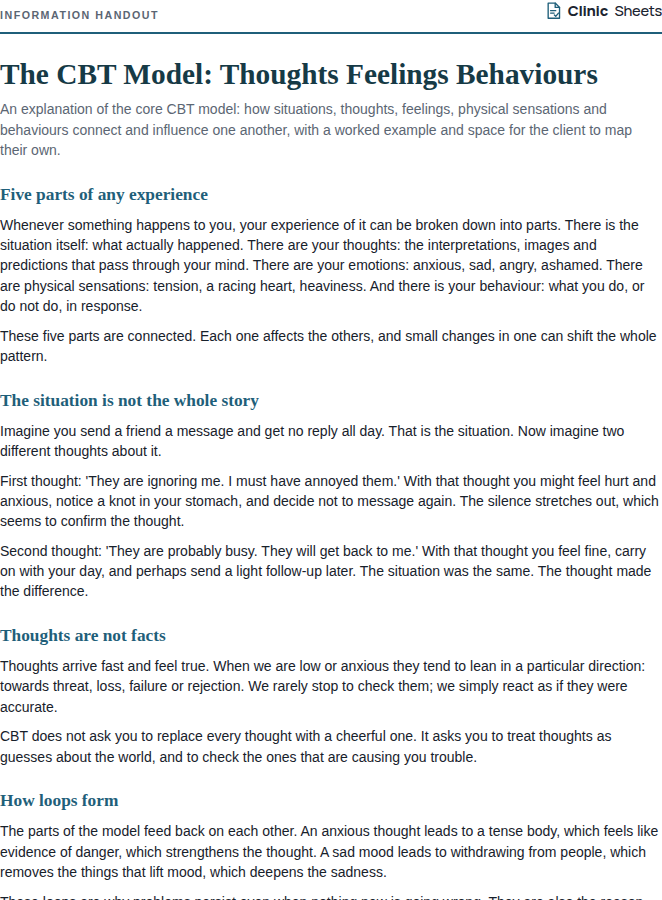
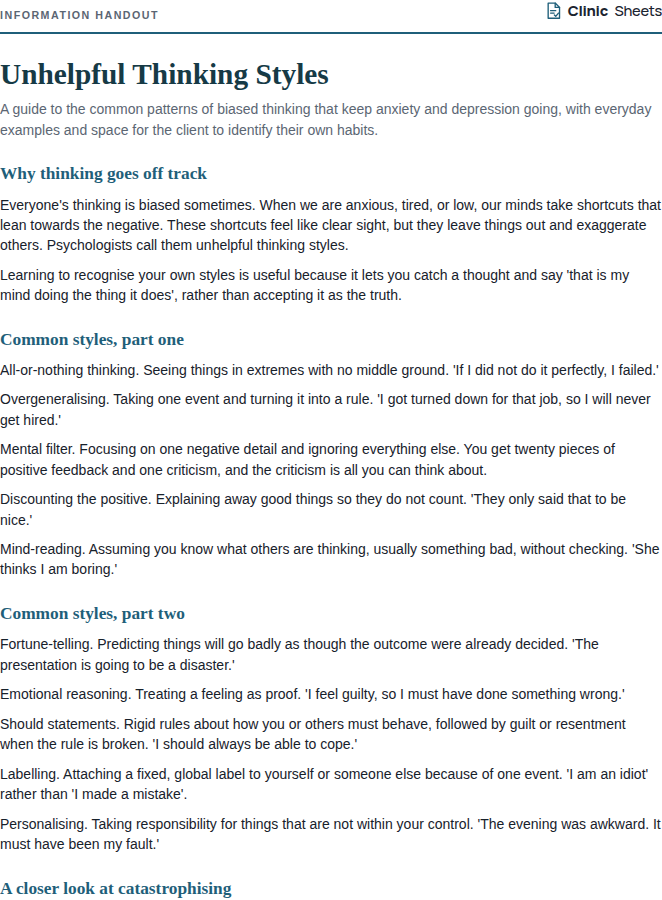
Understanding Bipolar Disorder
A psychoeducation handout on bipolar disorder for clients and families: the nature of mood episodes, the difference between bipolar I and II, common triggers, the role of medication and routine, and why recognising early warning signs matters.
About this resource
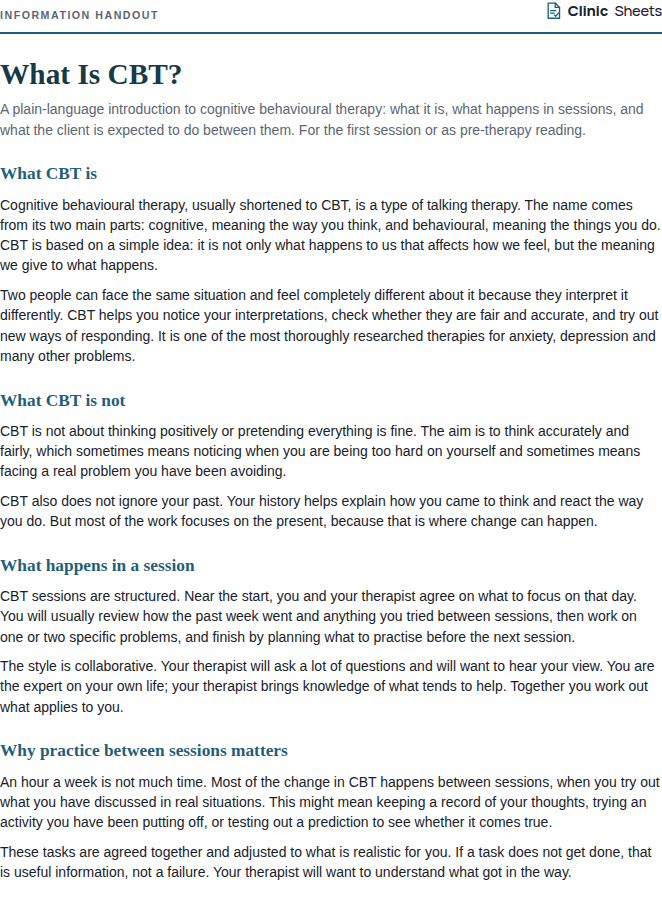
Psychoeducation is one of the best supported psychological interventions in bipolar disorder. Structured programmes that teach clients about the illness, its course, its triggers and its early warning signs reduce relapse and hospitalisation, particularly for manic episodes, and they improve adherence to medication. The cognitive behavioural approach to bipolar disorder, as described by Lam and colleagues and by Basco and Rush, builds on this foundation with relapse prevention, routine stabilisation and work on the beliefs that lead clients to abandon treatment when well.
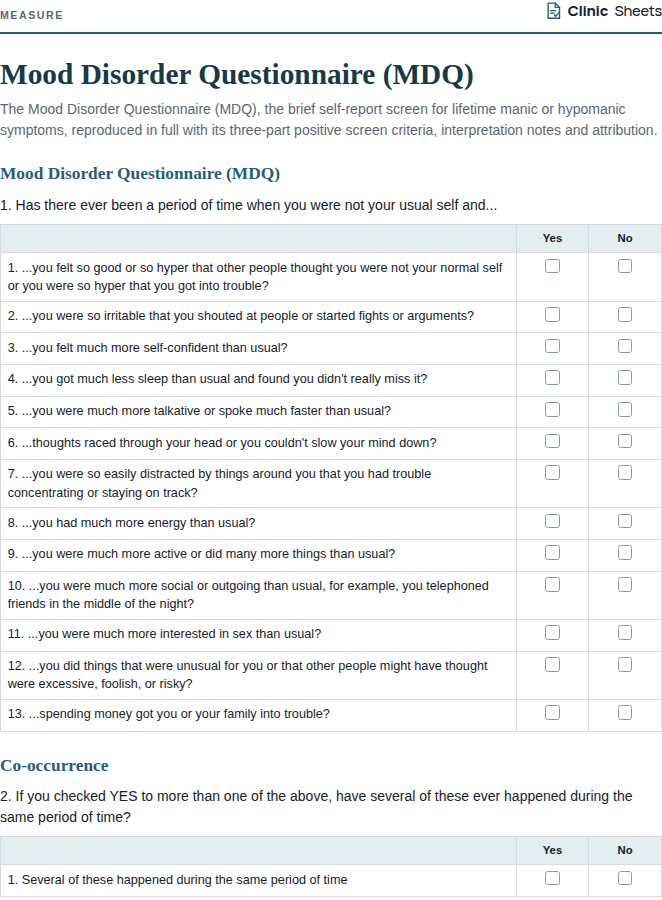
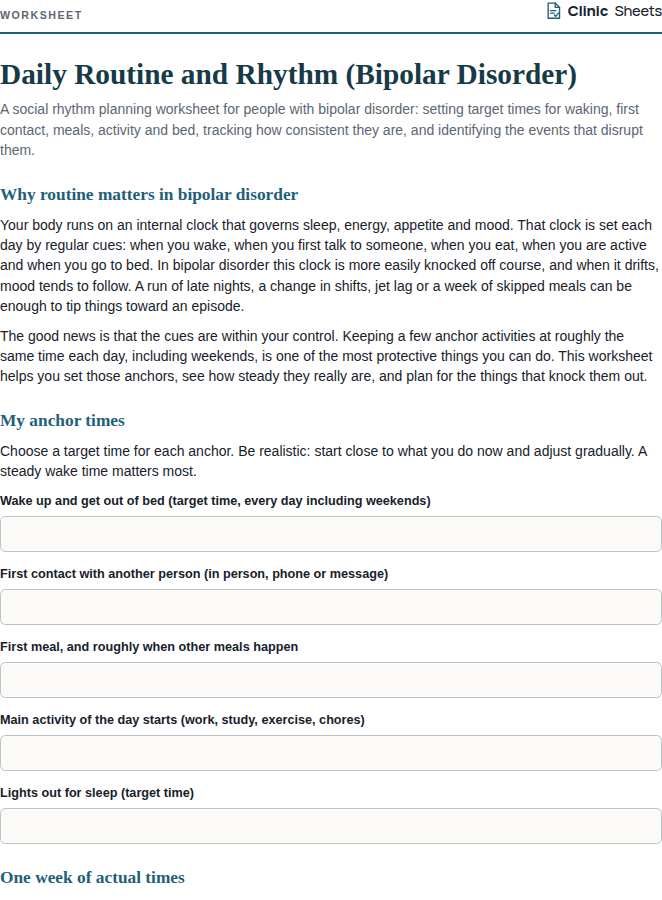
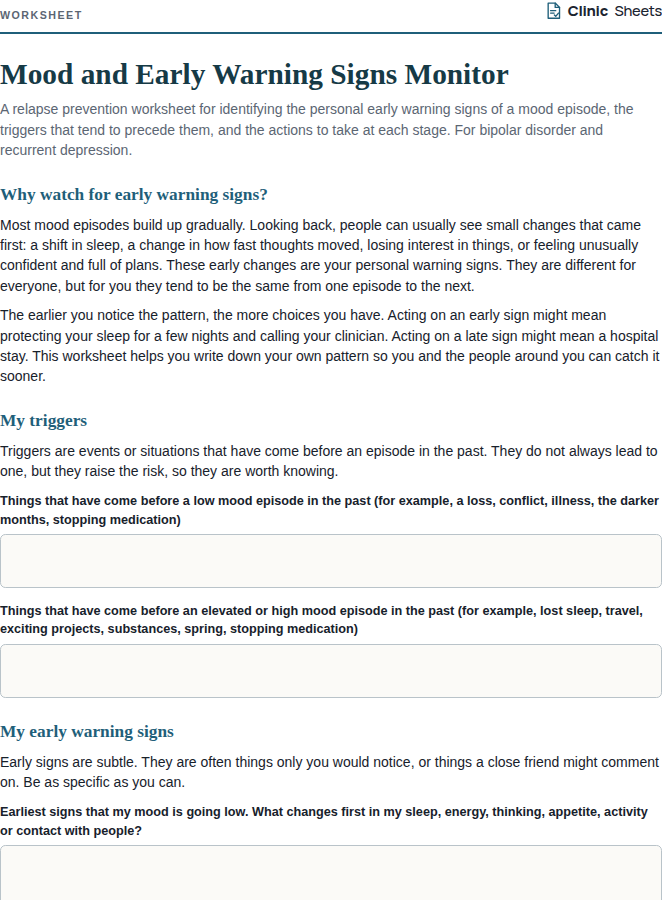
This handout explains bipolar disorder as an illness of mood regulation with a strong biological basis, describes depressive, manic and hypomanic episodes and mixed states in recognisable terms, distinguishes bipolar I and II, and outlines the factors that commonly trigger episodes: sleep disruption, circadian rhythm changes, stress, substance use and stopping medication. It introduces the idea of a personal relapse signature and sets up the collaborative, long-term stance that treatment requires. It closes with reflection prompts that begin the work of identifying the client's own early warning signs.
The professional version includes guidance on discussing diagnosis with clients who dispute it or who value their hypomanic states, on involving family with consent, and on the common cognitive themes (for example, 'I am only myself when I am high', 'the medication dulls me') that predict disengagement. It also notes that psychoeducation is most effective when delivered during euthymia rather than in the middle of an episode.
How to use it
- Offer the handout when the client is relatively stable, ideally with a family member or partner present if the client agrees.
- Read through the episode descriptions together and ask the client to describe their own experience of each, in their own words.
- Explore the client's view of the diagnosis and of hypomania in particular. Ambivalence about giving up the highs is common and should be discussed openly rather than argued down.
- Use the triggers section to identify which factors have preceded the client's past episodes, and use the reflection prompts to begin a relapse signature.
- Follow with mood monitoring and a written early warning signs and action plan. Reinforce that medication decisions rest with the prescriber and should not be made unilaterally.
References
- Colom, F., & Vieta, E. (2006). Psychoeducation Manual for Bipolar Disorder. Cambridge University Press.
- Lam, D. H., Jones, S. H., & Hayward, P. (2010). Cognitive Therapy for Bipolar Disorder: A Therapist's Guide to Concepts, Methods and Practice (2nd ed.). Wiley-Blackwell.
- Basco, M. R., & Rush, A. J. (2005). Cognitive-Behavioral Therapy for Bipolar Disorder (2nd ed.). Guilford Press.
- Perry, A., Tarrier, N., Morriss, R., McCarthy, E., & Limb, K. (1999). Randomised controlled trial of efficacy of teaching patients with bipolar disorder to identify early symptoms of relapse and obtain treatment. BMJ, 318(7177), 149-153.