Worry Postponement
A daily exercise in which worries are noticed, written down and deferred to a fixed 15 to 20 minute worry period later in the day. Teaches that worry can be controlled and that most worries lose their urgency when postponed.
About this resource
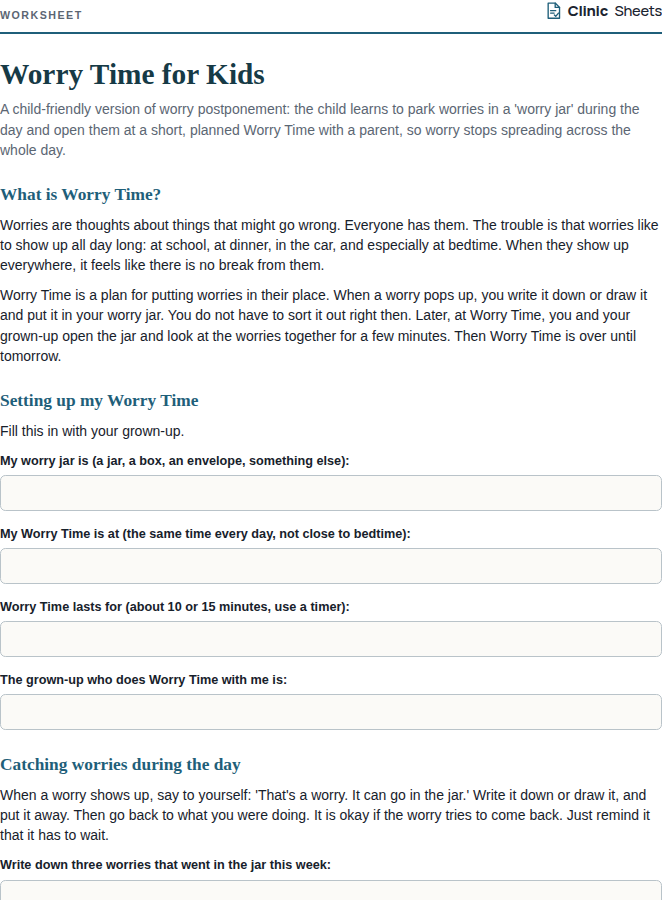
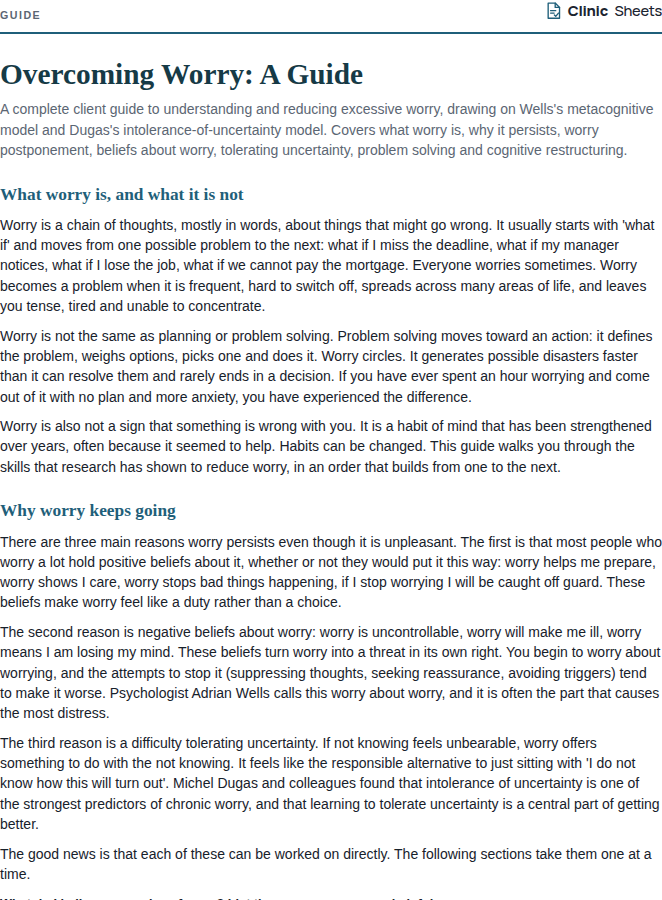
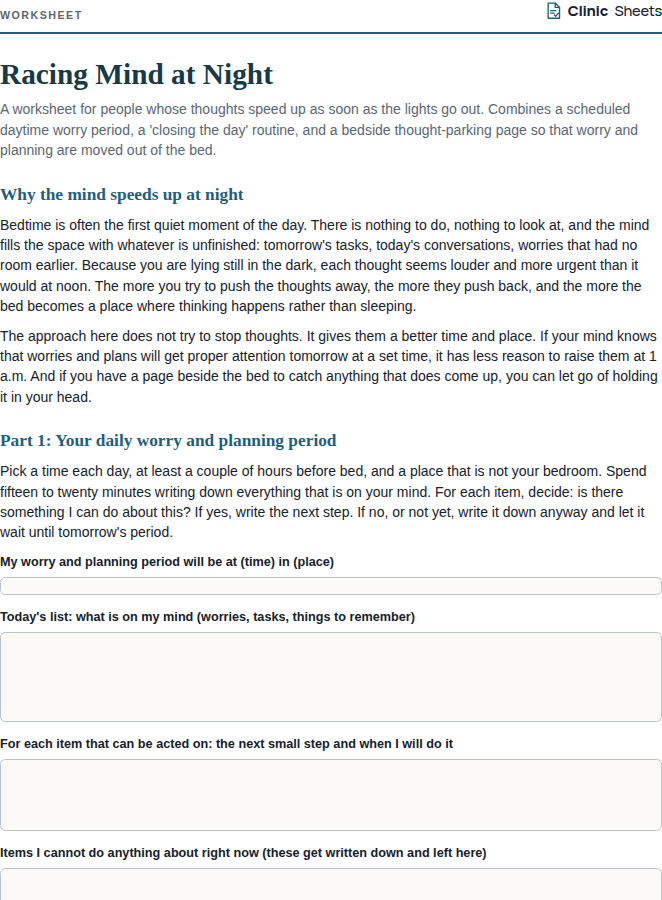
Worry postponement, also called stimulus control for worry, was developed by Borkovec and colleagues as one of the first behavioural interventions for generalized anxiety. The client sets aside a fixed worry period each day, at the same time and in the same place, and confines worrying to that window. When worries arise at other times they are briefly noted and deliberately set aside until the period. The technique works on several fronts: it interrupts the association between worry and every context of the day, it provides direct evidence that worry can be delayed (undermining the belief that it is uncontrollable), and it lets the client discover that most postponed worries have lost their force by the time the period arrives.
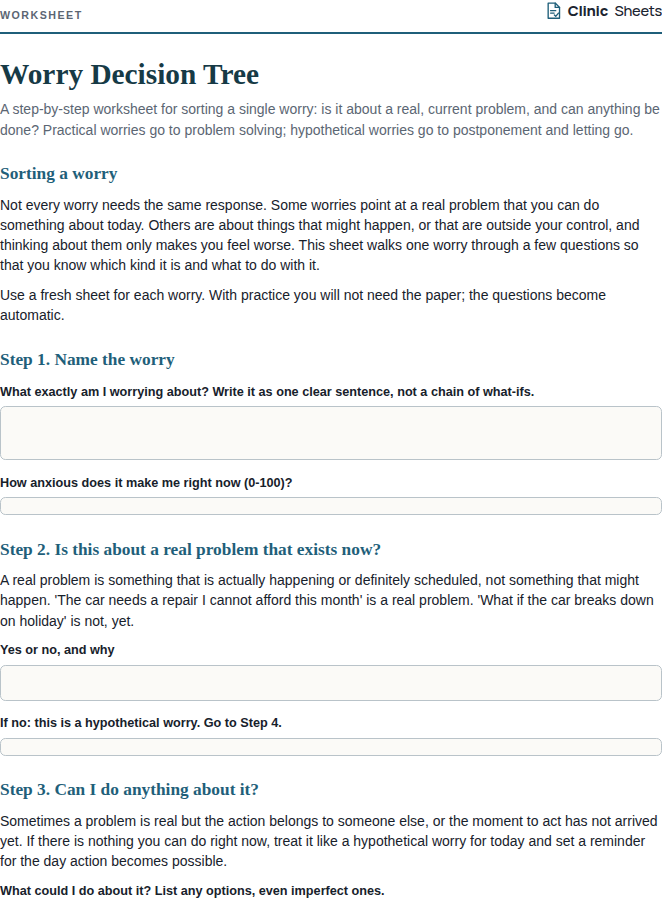
This exercise sets out the rationale for the client, gives step-by-step instructions for setting up the worry period and handling worries during the day, and describes what usually happens in the first two weeks. It includes a short practice log. The technique pairs naturally with the Worry Decision Tree, which can be used during the worry period to sort the day's list, and with attention refocusing exercises for the moments after a worry has been set aside.
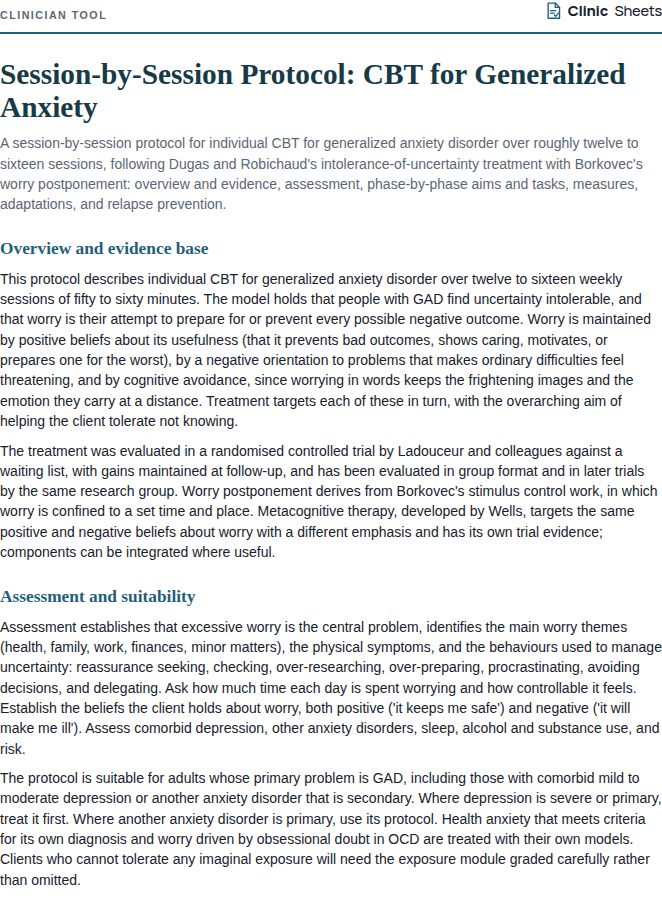
The professional version adds guidance on the most common obstacles: clients who forget to use the period (which often means they no longer need it), clients who use the period to worry more intensely rather than to sort and problem-solve, and clients who report that the worries cannot wait. In the metacognitive model the technique is used explicitly as an experiment testing the belief that worry is uncontrollable, and the belief rating before and after is the key outcome.
How to use it
- Introduce after psychoeducation about worry. Ask the client to rate, 0 to 100, how much they believe their worry is uncontrollable. Record it.
- Agree the worry period together: a fixed time (late afternoon or early evening works well, never within an hour of bed), a fixed place that is not the bed or the favourite armchair, and a fixed length of 15 to 20 minutes with a timer.
- Rehearse the daytime routine: notice the worry, write a few words in a notebook or phone, say 'I will think about this at six', and return attention to the task at hand. Practise the attention return in session using a brief distraction task.
- Explain that during the period the client may worry as much as they like about the listed items, but should also try sorting them with the decision tree. Many will already feel finished.
- Review the log weekly. Re-rate the uncontrollability belief. Point out, with the client's own data, how many worries were postponed successfully and how many had faded by the period.
- Once the pattern is established, the period can be shortened, then dropped, with the noting-and-returning skill kept as a habit.
References
- Borkovec, T. D., Wilkinson, L., Folensbee, R., & Lerman, C. (1983). Stimulus control applications to the treatment of worry. Behaviour Research and Therapy, 21(3), 247-251.
- Wells, A. (2009). Metacognitive Therapy for Anxiety and Depression. Guilford Press.
- McGowan, S. K., & Behar, E. (2013). A preliminary investigation of stimulus control training for worry: Effects on anxiety and insomnia. Behavior Modification, 37(1), 90-112.