GAD-7 Anxiety Questionnaire
The Generalized Anxiety Disorder 7-item scale (GAD-7), the brief self-report measure of anxiety severity over the past two weeks, reproduced in full with scoring bands, interpretation notes and licence information.
About this resource
The GAD-7 was developed by Spitzer, Kroenke, Williams and Löwe as a brief measure of generalized anxiety disorder for primary care. Its seven items cover the core features of GAD (nervousness, uncontrollable worry, excessive worry, difficulty relaxing, restlessness, irritability and a sense of dread), each rated for frequency over the past two weeks on a 0 to 3 scale, giving a total of 0 to 21. A final unscored item asks about functional difficulty.
Although designed for GAD, the scale performs reasonably well as a general screen for panic disorder, social anxiety disorder and PTSD, which makes it a practical single anxiety measure for routine outcome monitoring. In the original validation, a cut-off of 10 had a sensitivity of 89% and a specificity of 82% for GAD. Scores of 5, 10 and 15 mark the boundaries of mild, moderate and severe anxiety.
The professional version adds the scoring table, interpretation guidance, notes on its use alongside the PHQ-9, and the limitations of a symptom count as a basis for diagnosis.
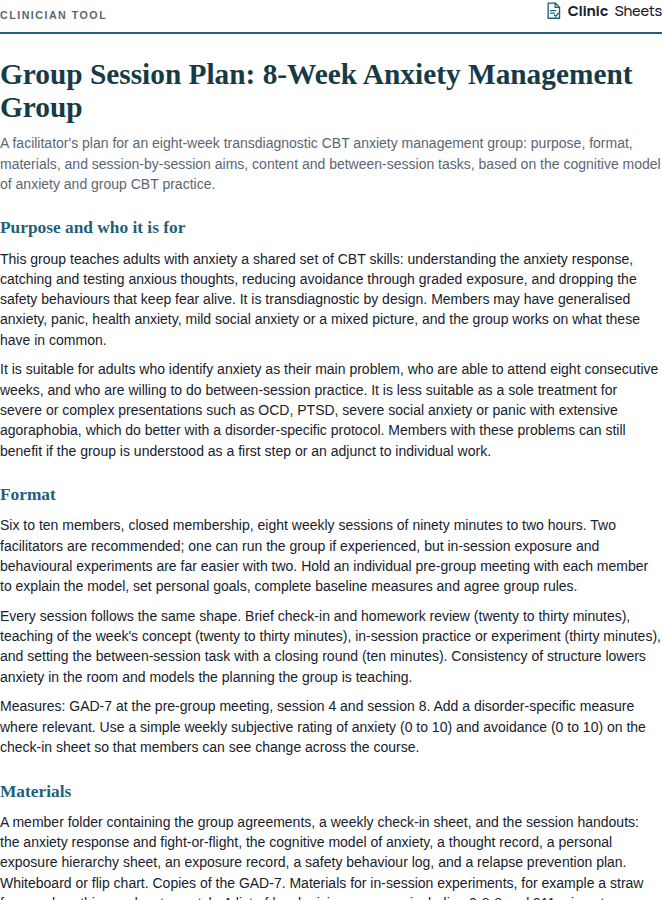
The instrument is reproduced here because Pfizer, the copyright holder, permits reproduction, translation, display and distribution of the GAD-7 without permission.
How to use it
- Administer at assessment and at regular intervals through treatment, alongside the PHQ-9 where depression is also a concern.
- Score by summing items 1 to 7 for a total of 0 to 21. The difficulty item is reported separately.
- Use the severity bands to describe the result to the client and to track change over time.
- Treat a score of 10 or more as a positive screen that calls for a fuller assessment of anxiety disorders, including which disorder best fits the presentation.
- When scores fall as treatment progresses, review the plan; when they stay flat or rise, revisit the formulation and check for avoidance, safety behaviours or life events that may explain it.
References
- Spitzer, R. L., Kroenke, K., Williams, J. B. W., & Löwe, B. (2006). A brief measure for assessing generalized anxiety disorder: The GAD-7. Archives of Internal Medicine, 166(10), 1092-1097.
- Kroenke, K., Spitzer, R. L., Williams, J. B. W., Monahan, P. O., & Löwe, B. (2007). Anxiety disorders in primary care: Prevalence, impairment, comorbidity, and detection. Annals of Internal Medicine, 146(5), 317-325.
- Plummer, F., Manea, L., Trepel, D., & McMillan, D. (2016). Screening for anxiety disorders with the GAD-7 and GAD-2: A systematic review and diagnostic metaanalysis. General Hospital Psychiatry, 39, 24-31.