Worry Decision Tree
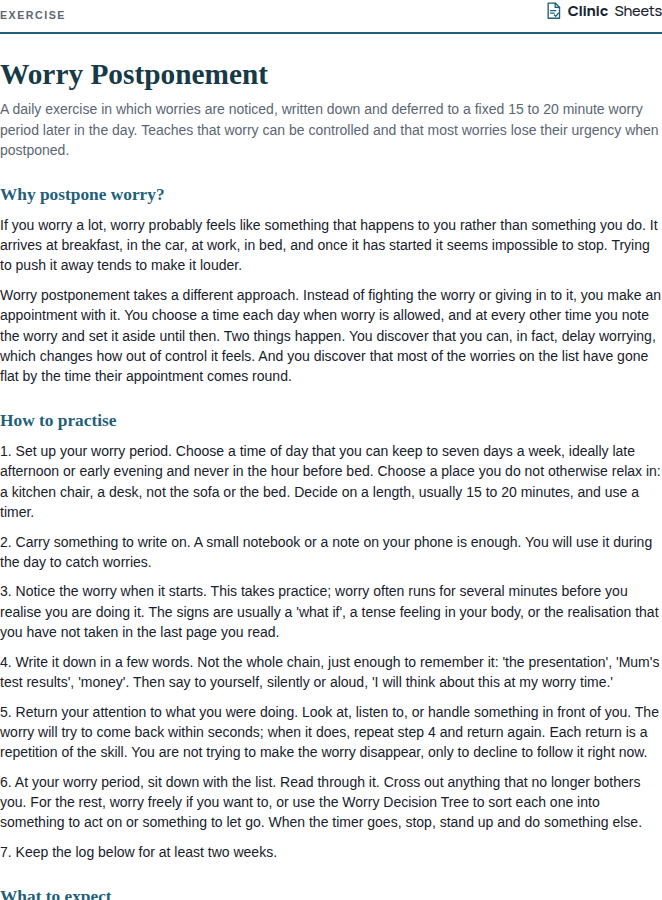
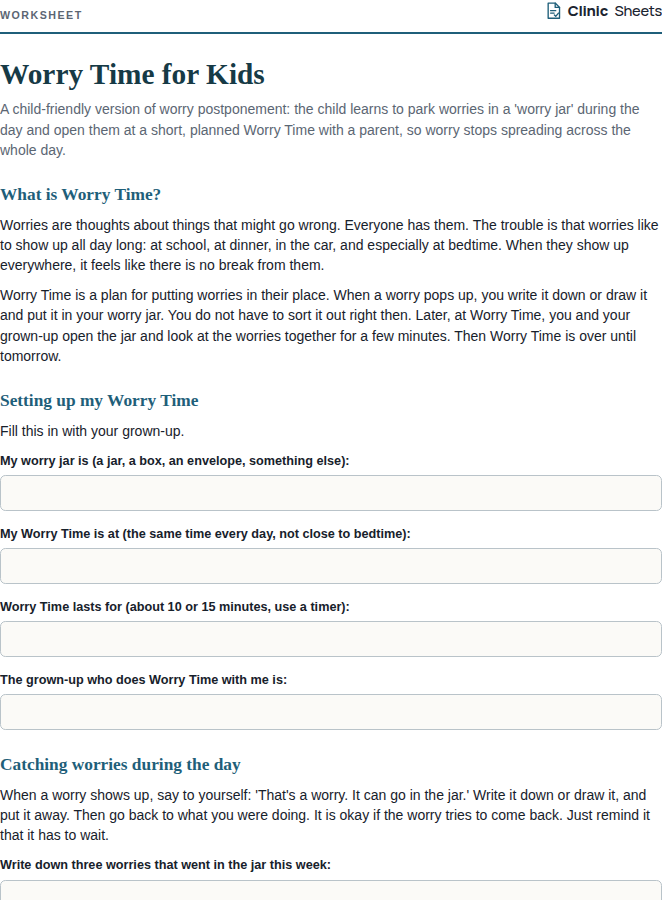
A step-by-step worksheet for sorting a single worry: is it about a real, current problem, and can anything be done? Practical worries go to problem solving; hypothetical worries go to postponement and letting go.
About this resource
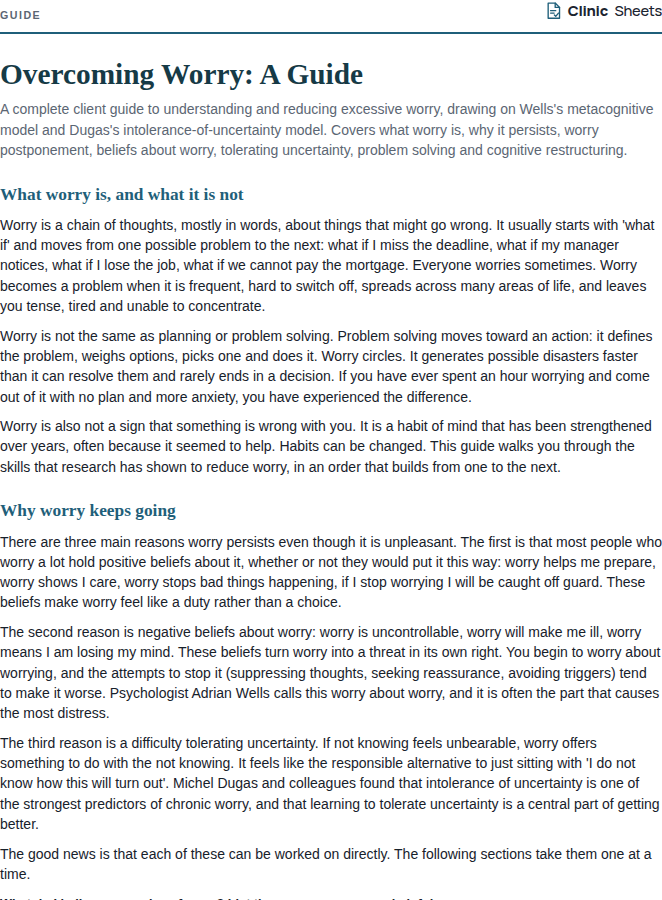
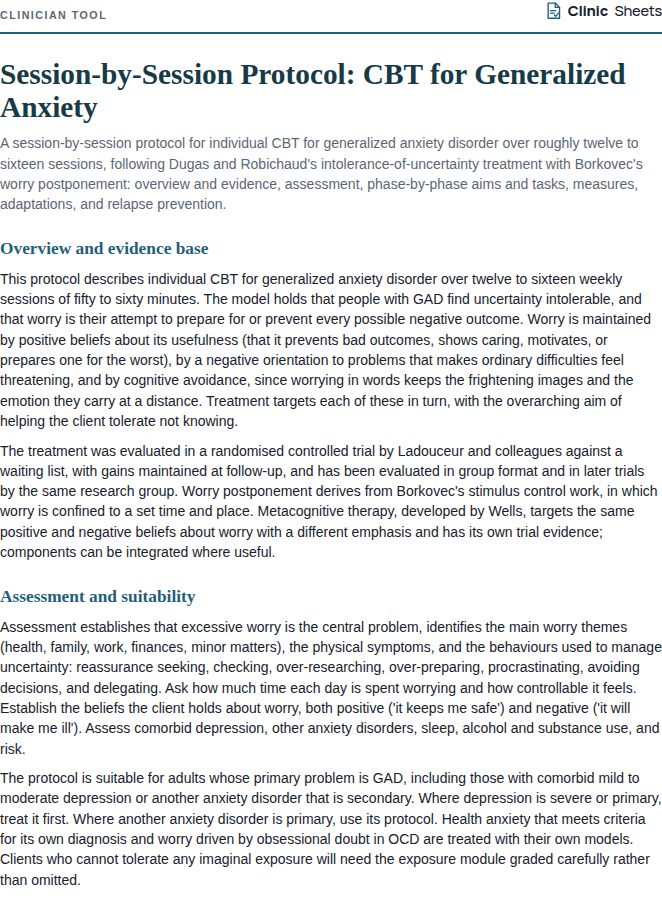
The worry decision tree operationalises one of the most useful distinctions in the treatment of generalized anxiety: the difference between worries about current, solvable problems and worries about hypothetical or uncontrollable future events. Dugas and Robichaud's treatment programme builds on this distinction, routing practical worries to structured problem solving and hypothetical worries to exposure to uncertainty. Without the distinction, clients either try to problem-solve the unsolvable (which fuels worry) or postpone the solvable (which fuels avoidance).
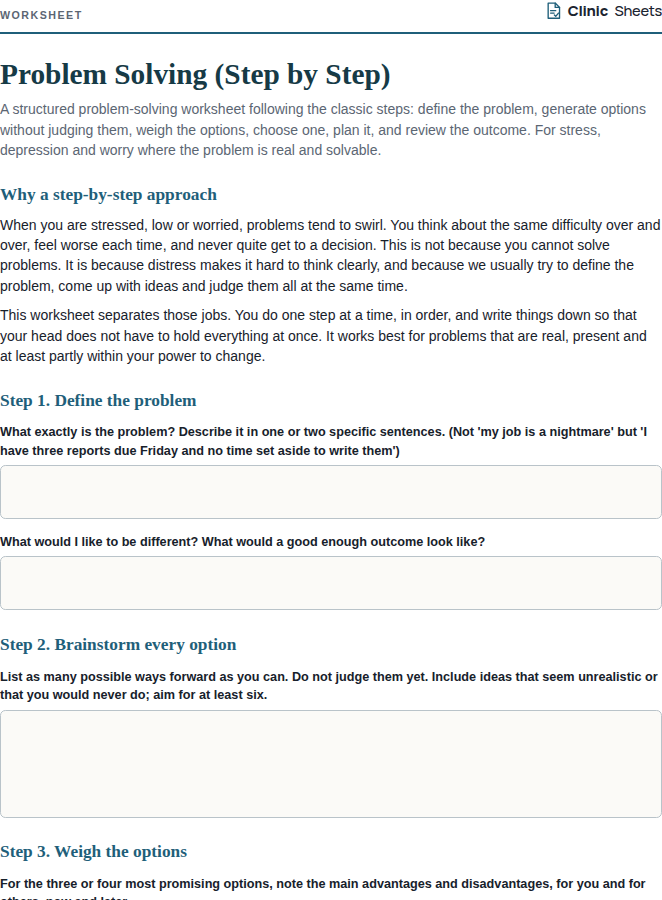
This worksheet takes a single worry through a short sequence of questions: what is the worry, is it about a real problem that exists now, can I do anything about it, and if so, what is the very next step and when will I take it. Where the answer is no at any branch, the client is directed to a brief letting-go script and a note to revisit the worry only during a scheduled worry period. The structure is deliberately simple so that the client can internalise it and eventually run through it in their head within seconds.
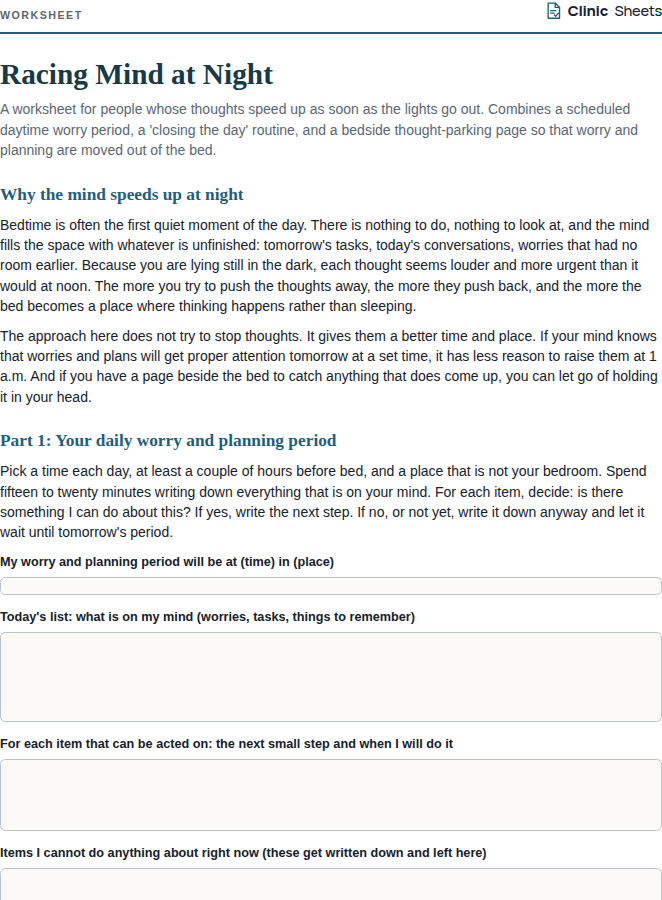
Use after psychoeducation about worry (see Understanding Worry) and alongside worry postponement. The professional version adds a full problem-solving sequence for practical worries, guidance for worries that are a mixture of the two (a real problem wrapped in hypothetical catastrophes), and notes on clients who classify everything as practical in order to keep problem-solving, which is a form of worry in disguise.
How to use it
- Introduce the practical versus hypothetical distinction first. Use two of the client's own worries as examples, one of each kind.
- Run one worry through the tree together in session, reading each question aloud and writing the answer. Choose a worry the client has had in the last day or two.
- For practical worries, insist on a next step that is small, concrete and time-bound: a phone call tomorrow at 10, not 'sort out the finances'.
- For hypothetical worries, practise the letting-go statement aloud. Acknowledge that it will feel unsatisfying at first; the discomfort is intolerance of uncertainty, and tolerating it is the skill.
- Ask the client to complete one sheet per day for a week, then review the pattern: what proportion of worries were hypothetical, and what happened when they were let go.
References
- Dugas, M. J., & Robichaud, M. (2007). Cognitive-Behavioral Treatment for Generalized Anxiety Disorder: From Science to Practice. Routledge.
- Butler, G., & Hope, T. (2007). Manage Your Mind: The Mental Fitness Guide (2nd ed.). Oxford University Press.
- Leahy, R. L. (2005). The Worry Cure: Seven Steps to Stop Worry from Stopping You. Harmony Books.