Racing Mind at Night
A worksheet for people whose thoughts speed up as soon as the lights go out. Combines a scheduled daytime worry period, a 'closing the day' routine, and a bedside thought-parking page so that worry and planning are moved out of the bed.
About this resource
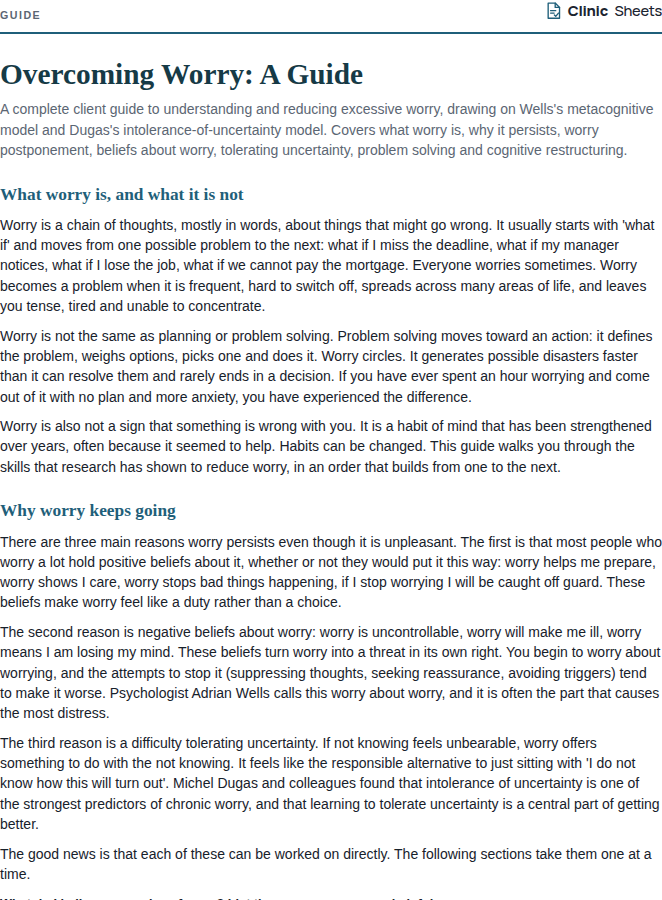
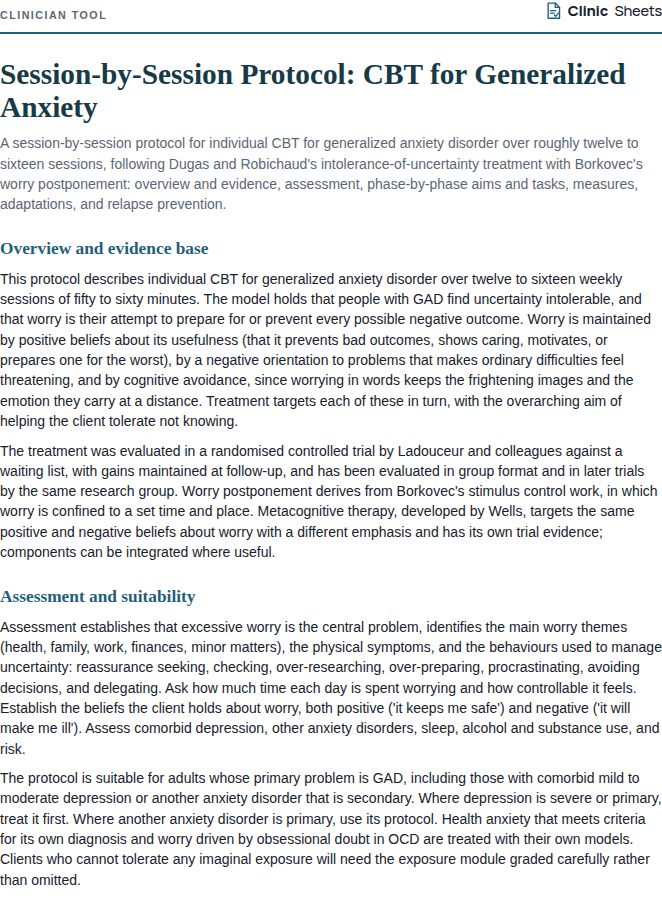
A busy mind at bedtime is one of the most common complaints in insomnia and in generalized anxiety. Harvey's cognitive model of insomnia describes how pre-sleep mental activity, monitoring for signs of not sleeping, and worry about the consequences of poor sleep together maintain wakefulness. Borkovec's stimulus control approach to worry adds a second idea: worry that happens anywhere and at any time becomes attached to everything, including the bed, and can be brought under control by confining it to a set time and place.
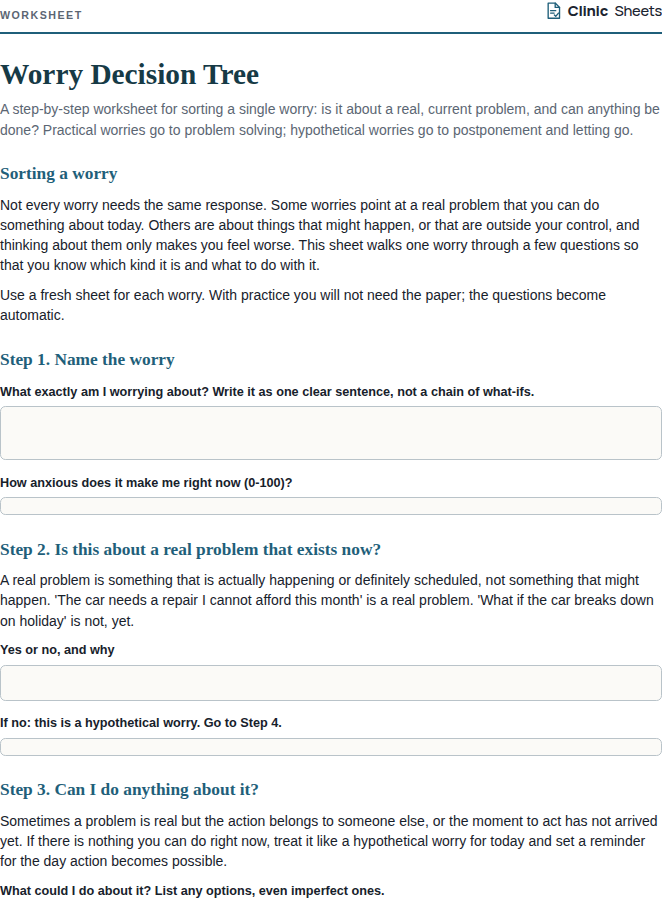
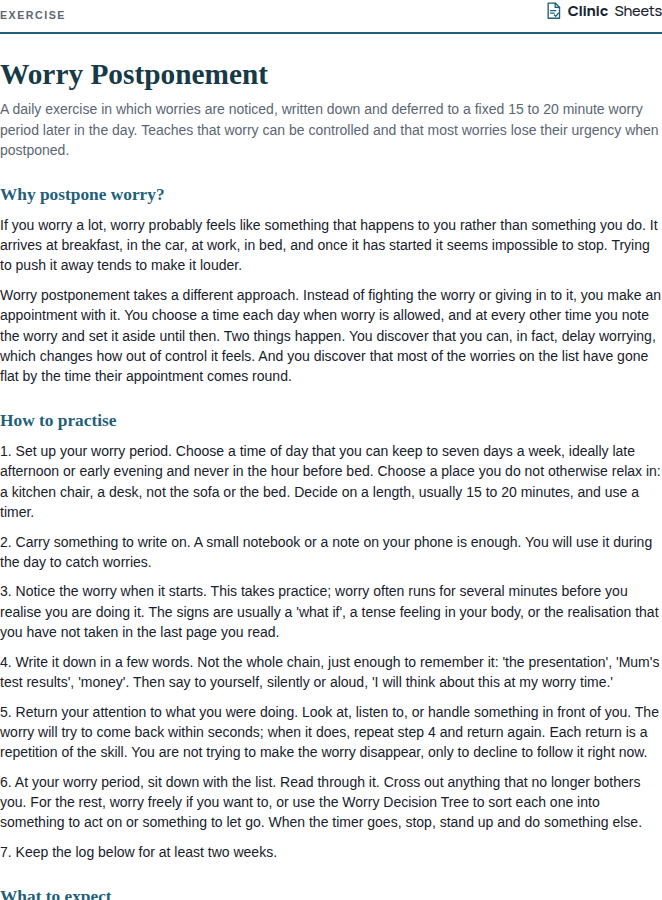
This worksheet applies both ideas. The client schedules a short daily worry and planning period, well before bed, in which they write down what is on their mind and decide on next steps. They then build a brief 'closing the day' routine that marks the end of doing and thinking. Finally, a thought-parking page sits beside the bed so that anything that surfaces in the night can be written down and returned to tomorrow, rather than held in mind or rehearsed.
The professional version notes that the worksheet complements, rather than replaces, stimulus control and sleep restriction, and that where nighttime thoughts are predominantly about sleep itself ('I will never get to sleep, tomorrow will be ruined') cognitive work on sleep-related beliefs is the next step. Where the content is ruminative rather than worried, the same scheduling principle applies, but the daytime period should push toward concrete problem solving or acceptance rather than analysis.
How to use it
- Ask the client what their mind does at night: planning, worrying, replaying the day, or worrying about not sleeping. The worksheet suits the first three well; the fourth also needs cognitive work on beliefs about sleep.
- Help the client choose a worry period time and place. It should be at least two to three hours before bed, fifteen to twenty minutes long, sitting somewhere that is not the bedroom.
- Complete the 'closing the day' routine section together, keeping it short and concrete: three to five actions that can be done in ten to fifteen minutes.
- Explain the thought-parking page: any thought that arrives in bed is written down in a few words and left there. The client does not solve it, only records it, and reviews the page during the next day's worry period.
- Review the completed pages at the next session. Look for repeated themes, which often point to a problem that needs solving or a worry that needs testing.
References
- Harvey, A. G. (2002). A cognitive model of insomnia. Behaviour Research and Therapy, 40(8), 869-893.
- Borkovec, T. D., Wilkinson, L., Folensbee, R., & Lerman, C. (1983). Stimulus control applications to the treatment of worry. Behaviour Research and Therapy, 21(3), 247-251.
- Morin, C. M., & Espie, C. A. (2003). Insomnia: A Clinical Guide to Assessment and Treatment. Kluwer Academic/Plenum.