Penn State Worry Questionnaire: Scoring and Interpretation Guide
A clinician's guide to scoring and interpreting the Penn State Worry Questionnaire (PSWQ), Meyer, Miller, Metzger and Borkovec's 16-item measure of the tendency to worry. Covers reverse scoring, the published cut-offs, typical score ranges, and how to use it in CBT for generalised anxiety and worry.
About this resource
The Penn State Worry Questionnaire was published in 1990 by Thomas Borkovec's group at Pennsylvania State University. It measures the trait of pathological worry: how excessive, uncontrollable and pervasive a person's worry is, independent of what they worry about. The 16 items are statements about worrying (for example, about worry being hard to stop, or about worrying even when there is no reason to) rated on a five-point scale of how typical each is of the person. Eleven items are worded in the direction of worry and five in the direction of not worrying. It is the standard self-report measure of worry in research on generalised anxiety disorder and is used across the CBT and metacognitive therapy literature.
This resource is a scoring and interpretation guide. The PSWQ is copyrighted by its authors and is free for clinical and research use, but we do not reproduce the items; obtain the official version, which is printed in the 1990 paper. The guide covers the response format, reverse scoring of the five contrary items (the most common source of error), the score range, the cut-offs from receiver operating characteristic studies, and the typical ranges seen in community, anxious and GAD samples. It is a trait measure with no reference period, which has consequences for tracking change that the guide explains.
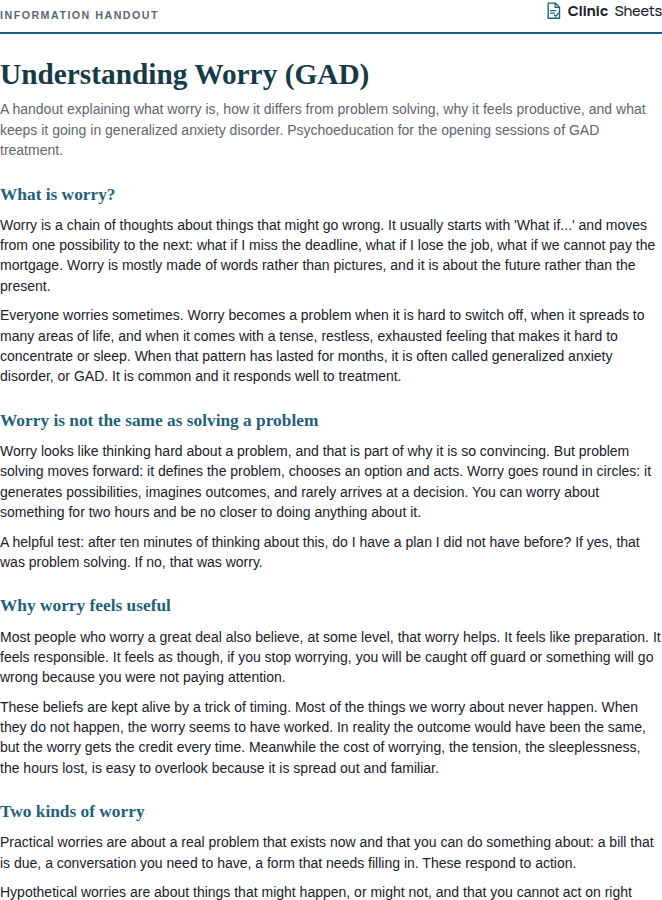
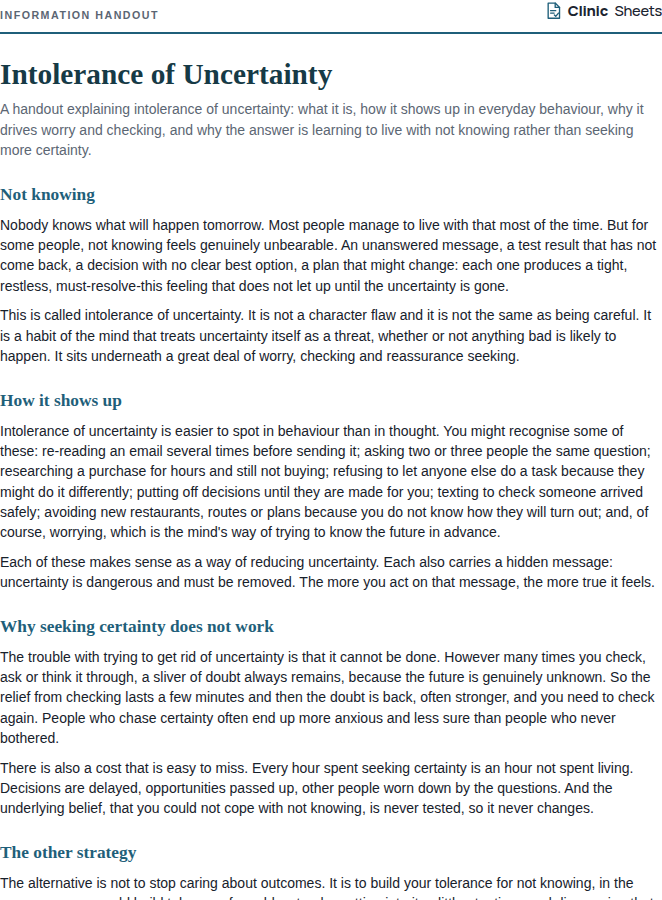
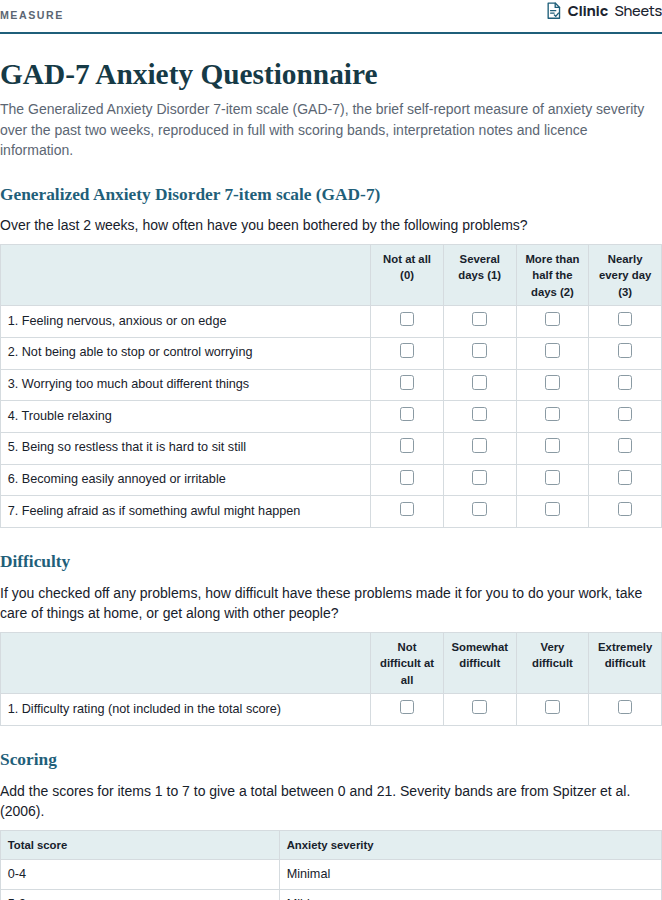
For clinicians treating worry, the PSWQ quantifies the thing the person comes in with and gives a clear number to revisit. It sits well beside Wells's metacognitive model, since high scores reflect exactly the beliefs about worry being uncontrollable that the model targets, and beside the GAD-7, which measures symptoms over the past two weeks and therefore moves faster.
How to use it
- Obtain the official PSWQ. Give it at assessment when worry is a presenting problem, alongside the GAD-7 for a current-symptom measure.
- Score carefully. Five items are worded in the direction of not worrying and must be reversed (1 becomes 5, 2 becomes 4, 3 stays 3, 4 becomes 2, 5 becomes 1) before adding. The official scoring identifies them. The total ranges from 16 to 80.
- Compare the total to the ranges in this guide. Scores in the 60s and above are typical of people with generalised anxiety disorder; scores in the 40s and 50s are typical of anxious people without GAD; community samples average lower.
- Use the items in session to elicit the person's beliefs about worry: is it uncontrollable, is it useful, is it dangerous? These beliefs are the targets of treatment.
- Repeat the PSWQ at the end of treatment and at follow-up rather than every session. As a trait measure it changes more slowly than the GAD-7, and clients should be told that.
References
- Meyer, T. J., Miller, M. L., Metzger, R. L., & Borkovec, T. D. (1990). Development and validation of the Penn State Worry Questionnaire. Behaviour Research and Therapy, 28(6), 487-495.
- Behar, E., Alcaine, O., Zuellig, A. R., & Borkovec, T. D. (2003). Screening for generalized anxiety disorder using the Penn State Worry Questionnaire: A receiver operating characteristic analysis. Journal of Behavior Therapy and Experimental Psychiatry, 34(1), 25-43.
- Wells, A. (2009). Metacognitive therapy for anxiety and depression. Guilford Press.