Understanding Rumination
A handout explaining what rumination is, how it differs from useful reflection, why it feels productive but is not, and how it keeps low mood and anxiety going.
About this resource
Rumination is repetitive, passive thinking about the causes, meanings and consequences of one's distress. Nolen-Hoeksema's response styles theory established it as a key maintaining factor in depression, and subsequent work by Watkins and others has clarified that the problem is not thinking about problems as such but a particular abstract, evaluative style of thinking ('why does this always happen to me?', 'what is wrong with me?') that generates no solutions and deepens negative mood. Concrete, process-focused thinking about the same problem ('what specifically happened, and what could I do next?') has the opposite effect.
This handout explains rumination in terms clients recognise: the sense of going round in circles, the feeling that thinking hard about a problem ought to solve it, and the way rumination masquerades as self-understanding or preparation. It introduces the abstract versus concrete distinction, the role of rumination as avoidance, and the reason it is so hard to stop by willpower alone. It is designed to prepare the client for the practical work of noticing rumination early and shifting mode.
The professional version adds notes on assessing rumination when the client describes it as 'overthinking' or 'analysing', on the overlap and differences with worry, and on the evidence for rumination-focused CBT.
How to use it
- Use when a client describes prolonged, circular thinking about their problems, mood or shortcomings, or when low mood seems to be prolonged by 'thinking it through'.
- Read together and ask the client to identify their own rumination themes and triggers. Most can name a few immediately.
- Explore the client's beliefs about rumination: many believe it helps them understand themselves or prepare for the worst. Note these beliefs for later work.
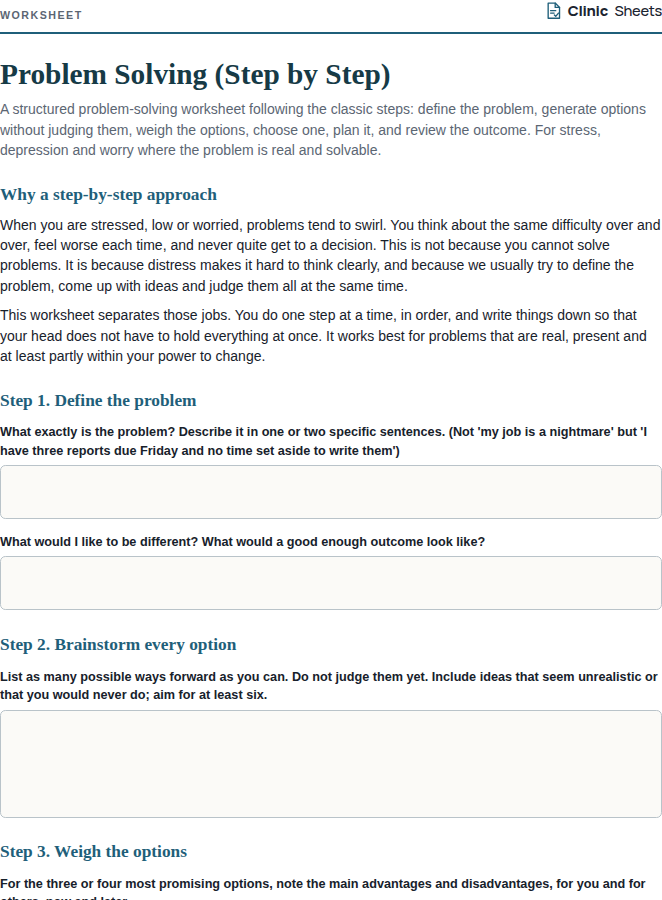
- Demonstrate the abstract versus concrete distinction in session using a live example. Ask the client to shift from 'why' questions to 'how' and 'what' questions and notice the difference.
- Follow with the Rumination Log and Interruption Plan so the client can start noticing episodes and practising alternatives.
References
- Nolen-Hoeksema, S., Wisco, B. E., & Lyubomirsky, S. (2008). Rethinking rumination. Perspectives on Psychological Science, 3(5), 400-424.
- Watkins, E. R. (2008). Constructive and unconstructive repetitive thought. Psychological Bulletin, 134(2), 163-206.
- Watkins, E. R. (2016). Rumination-Focused Cognitive-Behavioral Therapy for Depression. Guilford Press.
- Nolen-Hoeksema, S. (1991). Responses to depression and their effects on the duration of depressive episodes. Journal of Abnormal Psychology, 100(4), 569-582.