Understanding Worry (GAD)
A handout explaining what worry is, how it differs from problem solving, why it feels productive, and what keeps it going in generalized anxiety disorder. Psychoeducation for the opening sessions of GAD treatment.
About this resource
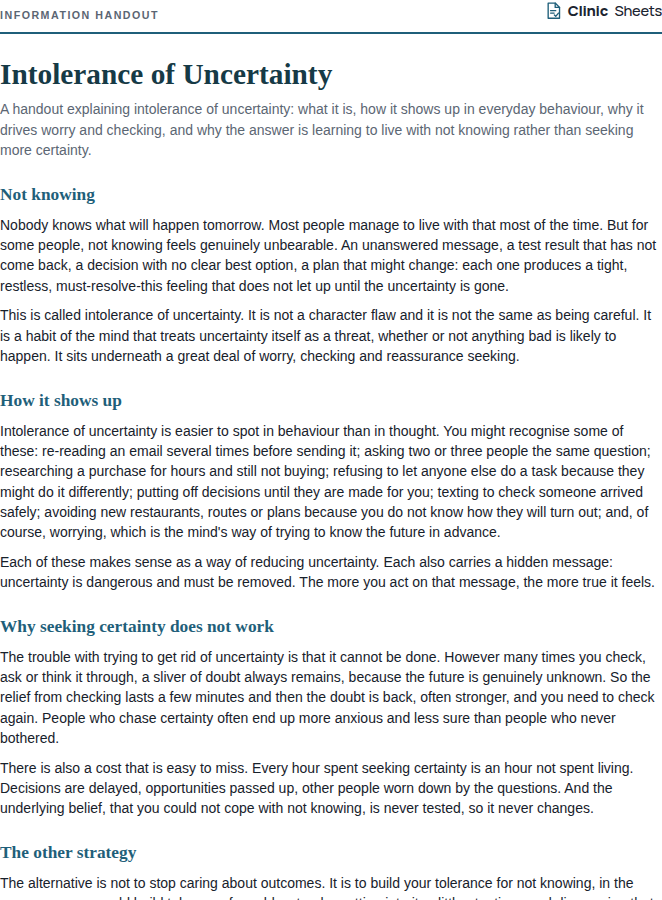
Worry is a chain of verbal thoughts about possible negative future events, typically beginning with 'What if...'. Everyone worries, but in generalized anxiety disorder worry becomes excessive, difficult to control, spread across many topics and accompanied by restlessness, fatigue, poor concentration, irritability, muscle tension and disturbed sleep. Several cognitive models explain its persistence: Dugas and colleagues emphasise intolerance of uncertainty and positive beliefs about worry; Wells's metacognitive model highlights the shift from worrying about events to worrying about worry itself; Borkovec proposes that worry, being verbal and abstract, suppresses emotional imagery and is negatively reinforced by the short-term relief it provides.
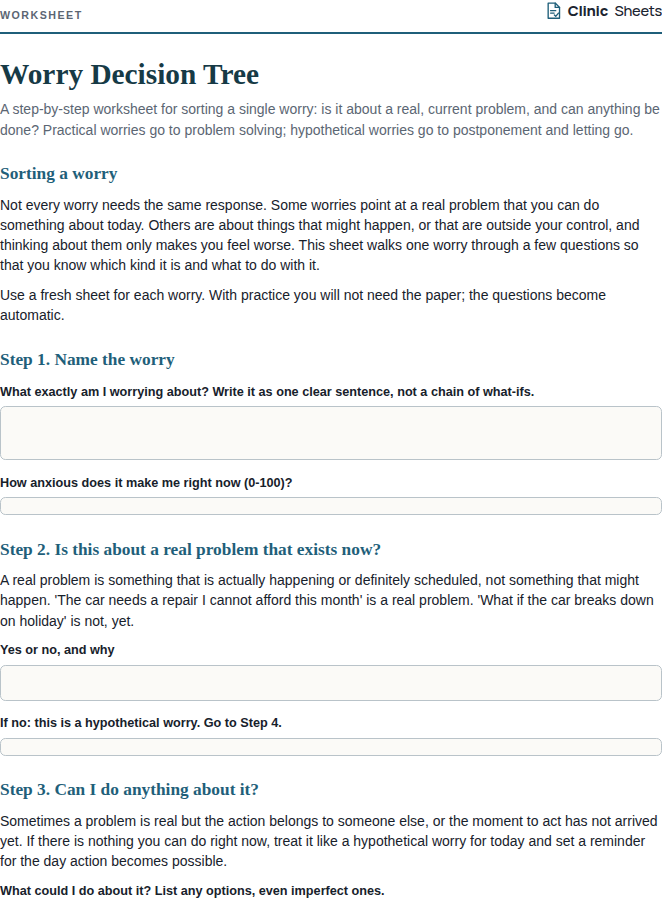
This handout draws on all three without requiring the clinician to commit to a single protocol. It distinguishes worry from planning and problem solving, explains why worry feels useful (it is reinforced by the non-occurrence of feared events and by a sense of preparation), introduces the idea of hypothetical versus practical worries, and names intolerance of uncertainty as the underlying engine. It ends with a reflection section inviting the client to list their own worry themes and the beliefs that keep them worrying.
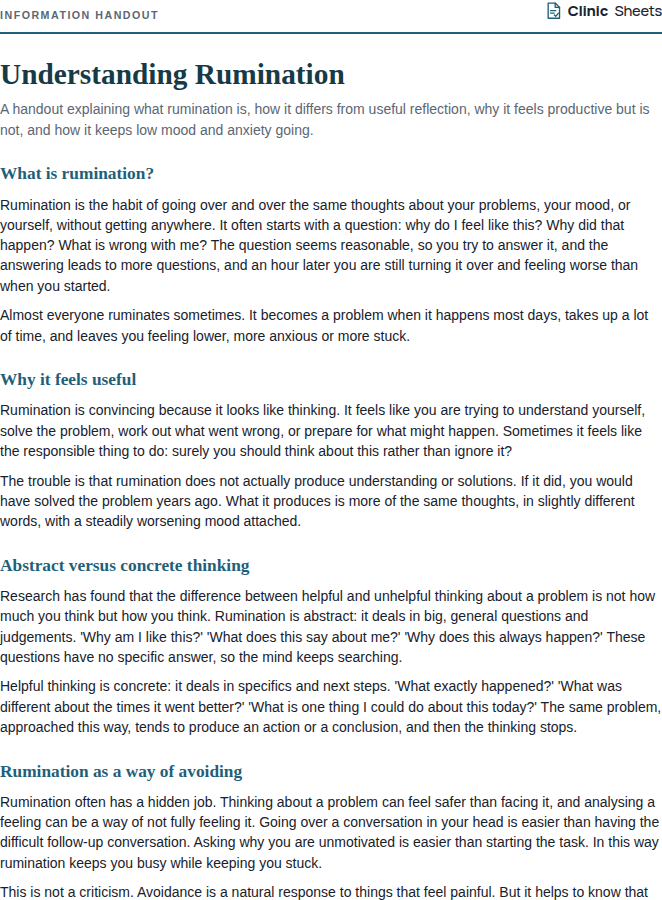
Use it in session one or two, after assessment and before introducing worry postponement, the worry decision tree or uncertainty experiments. The professional version adds a brief guide to eliciting positive and negative metacognitive beliefs about worry, and notes on distinguishing GAD worry from rumination in depression and from obsessional doubt in OCD.
How to use it
- Use once the client has described their worry and you have a sense of the main themes and the daily pattern (time of day, triggers, how it ends).
- Read the handout together and pause at the section on why worry feels useful. Ask the client directly: What would be the downside of worrying less? Their answer reveals the positive beliefs you will need to work with.
- Introduce the practical versus hypothetical distinction with two of the client's own worries. Most clients quickly see that the majority of their worries are hypothetical.
- Complete the reflection section in session or as homework. Ask the client to keep a simple worry diary for a week, noting the trigger and whether each worry was practical or hypothetical.
- Follow with Worry Postponement for the daily pattern and the Worry Decision Tree for sorting individual worries.
References
- Dugas, M. J., & Robichaud, M. (2007). Cognitive-Behavioral Treatment for Generalized Anxiety Disorder: From Science to Practice. Routledge.
- Wells, A. (2009). Metacognitive Therapy for Anxiety and Depression. Guilford Press.
- Borkovec, T. D., Alcaine, O. M., & Behar, E. (2004). Avoidance theory of worry and generalized anxiety disorder. In R. G. Heimberg, C. L. Turk, & D. S. Mennin (Eds.), Generalized Anxiety Disorder: Advances in Research and Practice (pp. 77-108). Guilford Press.
- Behar, E., DiMarco, I. D., Hekler, E. B., Mohlman, J., & Staples, A. M. (2009). Current theoretical models of generalized anxiety disorder (GAD): Conceptual review and treatment implications. Journal of Anxiety Disorders, 23(8), 1011-1023.