Planned Ignoring and Selective Attention
A parent handout explaining how attention shapes children's behaviour, and how to deliberately withdraw attention from minor misbehaviour while giving warm, specific attention to the behaviour you want to see more of.
About this resource
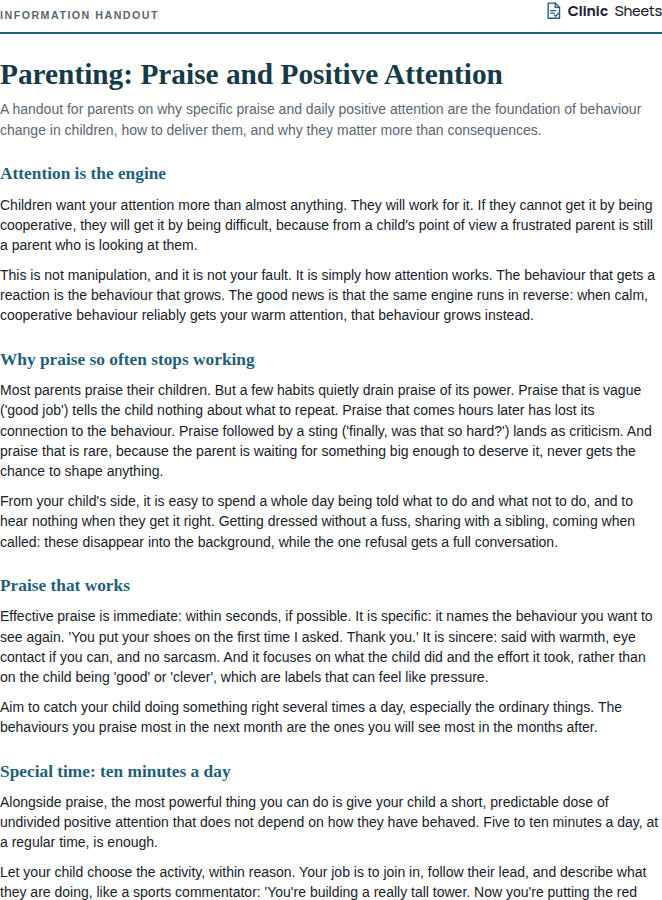
Selective attention is one of the core skills taught in behavioural parent training programmes such as Parent Management Training, the Incredible Years and Triple P. The principle is simple: children work for parental attention, and attention of any kind, including scolding, arguing and repeated reminders, can reinforce the behaviour it follows. Planned ignoring removes attention from minor, attention-seeking behaviours (whining, nagging, mild rudeness, tantrums that pose no safety risk) while positive attention is directed, immediately and specifically, at the behaviour the parent wants instead.
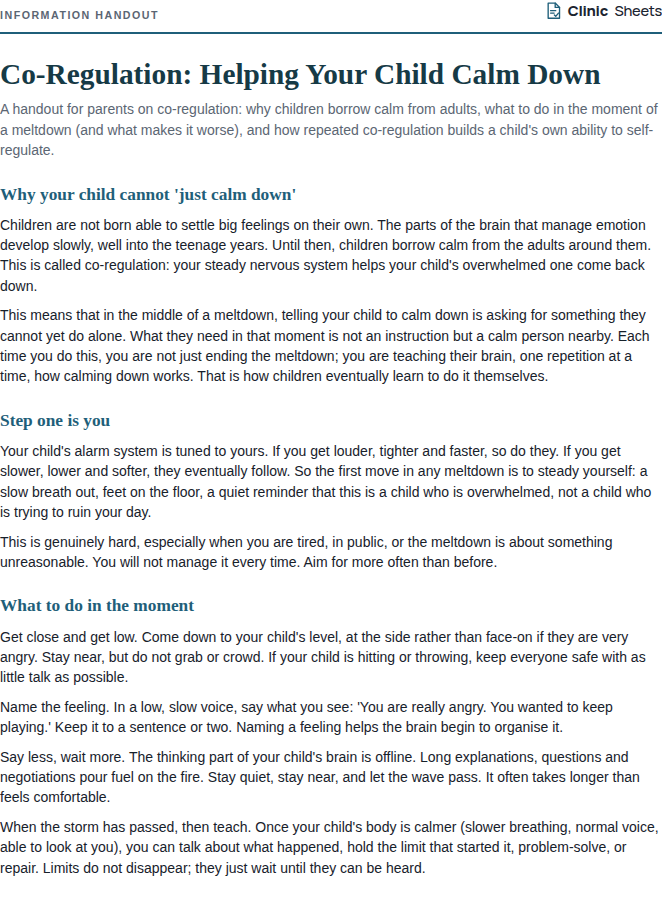
The handout explains the attention principle in plain language, sets out which behaviours are suitable for ignoring and which are not, describes what ignoring actually looks like (no eye contact, no words, no visible reaction, while remaining physically present and safe), and prepares parents for the extinction burst: the predictable period when the behaviour gets worse before it gets better. It pairs ignoring with descriptive praise so that the child is never simply left without attention.
The professional version adds guidance on selecting target behaviours in session, on preparing parents for the extinction burst so they do not abandon the strategy at its hardest point, and on the common ways the skill fails: intermittent ignoring (which strengthens the behaviour), ignoring without a positive alternative, and using the strategy for behaviours that are unsafe or that the child cannot yet regulate.
How to use it
- Introduce the attention principle first. Ask the parent to notice, over a few days, what their child is doing when they are most likely to get a response from them. Most parents discover they respond fastest to misbehaviour.
- Choose one or two minor target behaviours with the parent. They must be safe to ignore, attention-driven, and something the parent can realistically ignore every time.
- Rehearse ignoring in session: neutral face, no words, turning slightly away, staying in the room. Rehearse the moment of re-engagement as well, since parents often forget to reconnect warmly the instant the behaviour stops.
- Explain the extinction burst clearly and ask the parent to predict what it will look like for their child. A parent who expects escalation is far more likely to hold steady through it.
- Pair the skill with descriptive praise for the opposite behaviour (see the section on catching the behaviour you want). Review at the next session with the parent's record, and troubleshoot inconsistency before concluding the strategy does not work.
References
- Kazdin, A. E. (2005). Parent Management Training: Treatment for Oppositional, Aggressive, and Antisocial Behavior in Children and Adolescents. Oxford University Press.
- Webster-Stratton, C. (2005). The Incredible Years: A Trouble-Shooting Guide for Parents of Children Aged 2-8 Years. Incredible Years.
- Sanders, M. R. (2012). Development, evaluation, and multinational dissemination of the Triple P-Positive Parenting Program. Annual Review of Clinical Psychology, 8, 345-379.
- Patterson, G. R. (1982). Coercive Family Process. Castalia.