Resource Development: Installing Strengths
A client exercise based on EMDR resource development and installation: identifying a quality you need (calm, courage, boundaries), finding a memory, image or person that embodies it, and strengthening it with short sets of slow bilateral stimulation. Used in the preparation phase and as a self-help skill.
About this resource
Resource development and installation (RDI) is a set of procedures used in the preparation phase of EMDR to strengthen a client's access to adaptive internal states before trauma processing begins. Described by Leeds and evaluated by Korn and Leeds in clients with complex PTSD, the procedure identifies a quality the client needs in order to face a current challenge or to tolerate memory work (for example calm, courage, self-compassion, the ability to say no), locates a resource that embodies it (a mastery memory, a relational figure, a symbol or image), elicits the associated sensations and feelings, and pairs them with short, slow sets of bilateral stimulation. Unlike trauma processing, which uses longer and faster sets and follows wherever associations lead, RDI uses brief sets and keeps the client anchored to the positive material, stopping if negative associations arise.
RDI is not a substitute for processing, and the evidence for its stand-alone effect is preliminary. Its clinical value lies in building a client's confidence that they can shift their own state, in providing a reliable anchor for closure and between sessions, and in making trauma processing tolerable for clients whose access to adaptive states is poor. It is also useful outside EMDR as a structured positive-imagery exercise, and clients can practise the self-administered version at home using a butterfly hug or alternating taps.
This exercise teaches the client the procedure in plain language, with a step-by-step method they can follow with their therapist and then independently. The professional version notes the importance of choosing resources without trauma associations, of keeping sets short (roughly six to twelve slow passes), of stopping and returning to the positive image if the client's attention drifts to distressing material, and of using the installed resource as a cue phrase and image for later use.
How to use it
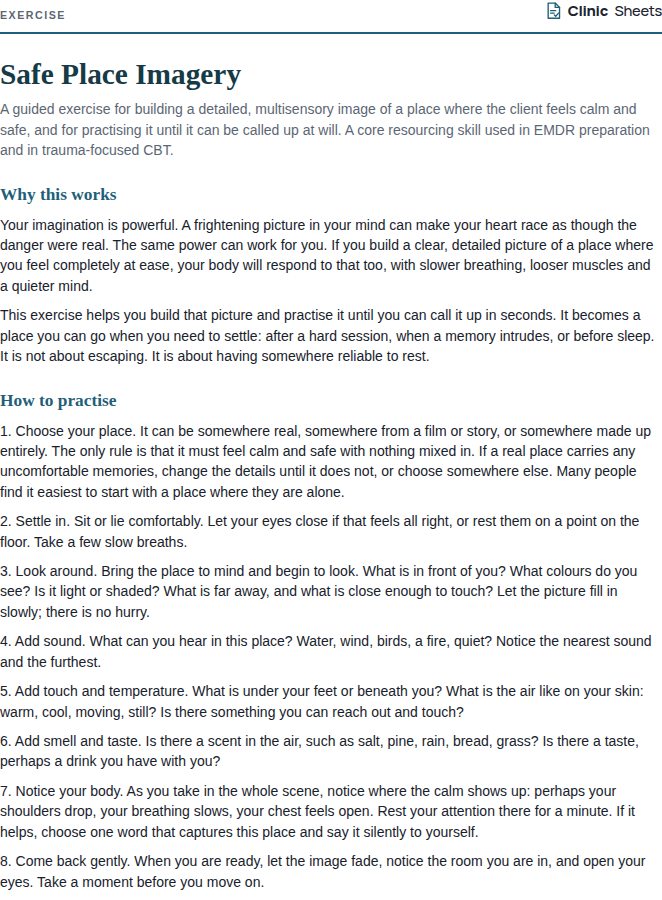
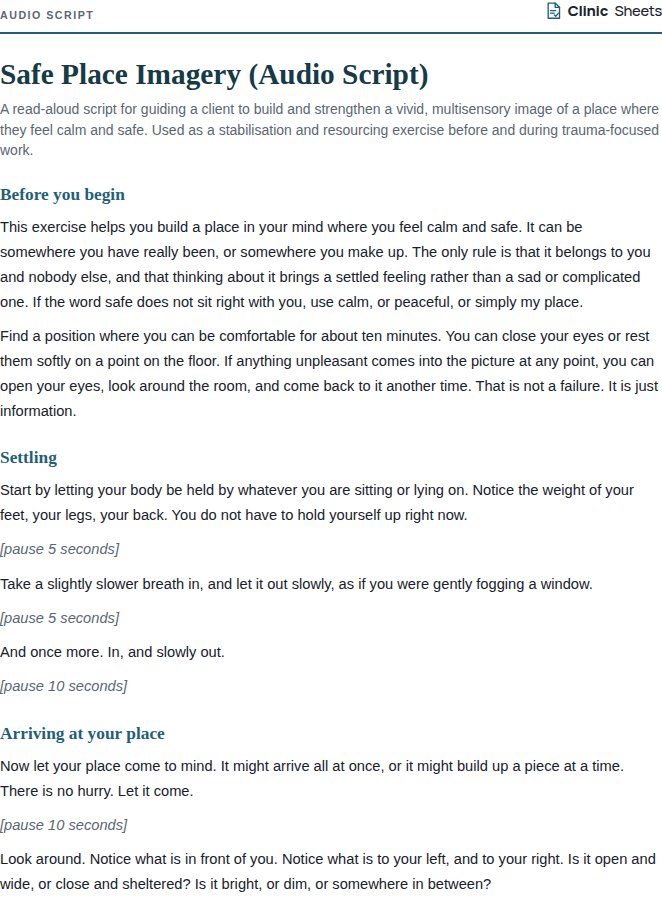
- Use in the preparation phase of EMDR, or as a stand-alone exercise for clients who need a stronger sense of their own capacities before challenging work. Introduce it after the client has practised a basic calming exercise such as a calm place.
- Identify the quality needed. Ask what the client would need more of in order to handle the challenge ahead, and keep it specific: 'the calm I feel when I am walking the dog' is more usable than 'inner peace'.
- Help the client find a resource that embodies the quality: a memory of a time they had it, a person who has it, a symbol, an image. Check that the resource has no link to trauma. Elicit the image, the feelings, the body sensations and a word or phrase that captures it.
- Add bilateral stimulation in short, slow sets of about six to twelve passes. After each set ask what the client notices. If the resource strengthens, continue for a few sets. If distressing material intrudes, stop, return to the resource without stimulation, and consider a different resource.
- Test the resource: ask the client to imagine a mildly challenging future situation while holding the resource and its cue word. Then set the self-administered version as home practice, using the log at the end of the exercise.
References
- Korn, D. L., & Leeds, A. M. (2002). Preliminary evidence of efficacy for EMDR resource development and installation in the stabilization phase of treatment of complex posttraumatic stress disorder. Journal of Clinical Psychology, 58(12), 1465-1487.
- Leeds, A. M. (2016). A Guide to the Standard EMDR Therapy Protocols for Clinicians, Supervisors, and Consultants (2nd ed.). Springer.
- Shapiro, F. (2018). Eye Movement Desensitization and Reprocessing (EMDR) Therapy: Basic Principles, Protocols, and Procedures (3rd ed.). Guilford Press.