SCARED Child Anxiety Screener: Scoring and Interpretation Guide
A scoring and interpretation guide to the Screen for Child Anxiety Related Emotional Disorders (SCARED), the 41-item child and parent anxiety questionnaire by Birmaher and colleagues. Covers the five subscales, the published cut-offs, and how to use the results with families.
About this resource
The SCARED was developed by Boris Birmaher and colleagues at the University of Pittsburgh as a screen for anxiety disorders in children and adolescents aged roughly 8 to 18. It has matched child and parent versions, each with 41 statements rated on a three-point scale according to how true each has been over the last three months. The items sort into five subscales that map onto the main childhood anxiety presentations: panic and somatic symptoms, generalised anxiety, separation anxiety, social anxiety, and significant school avoidance. The measure is free to use for clinical and research purposes and is widely used in Canadian child and youth mental health services.
This resource is a scoring and interpretation guide rather than a copy of the instrument. Although the SCARED is public domain, we have not reproduced the 41 items here because we could not verify every item's wording to the standard required for a faithful reproduction. Use the official version, available from the University of Pittsburgh, and use this guide to score and interpret it. The guide explains the subscale structure, gives the published cut-offs for the total and each subscale, and covers how to compare child and parent reports, which frequently disagree in informative ways.
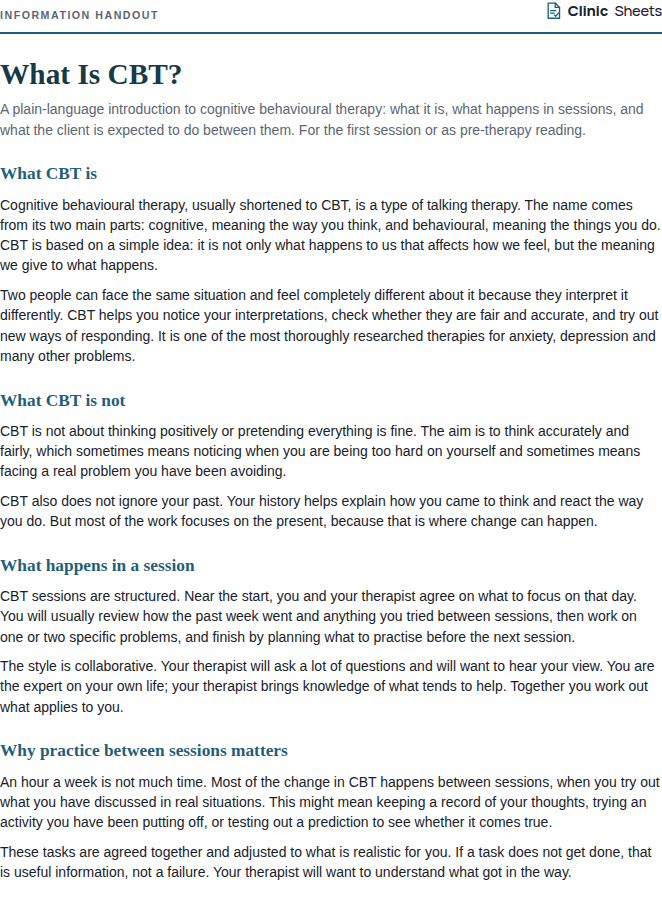
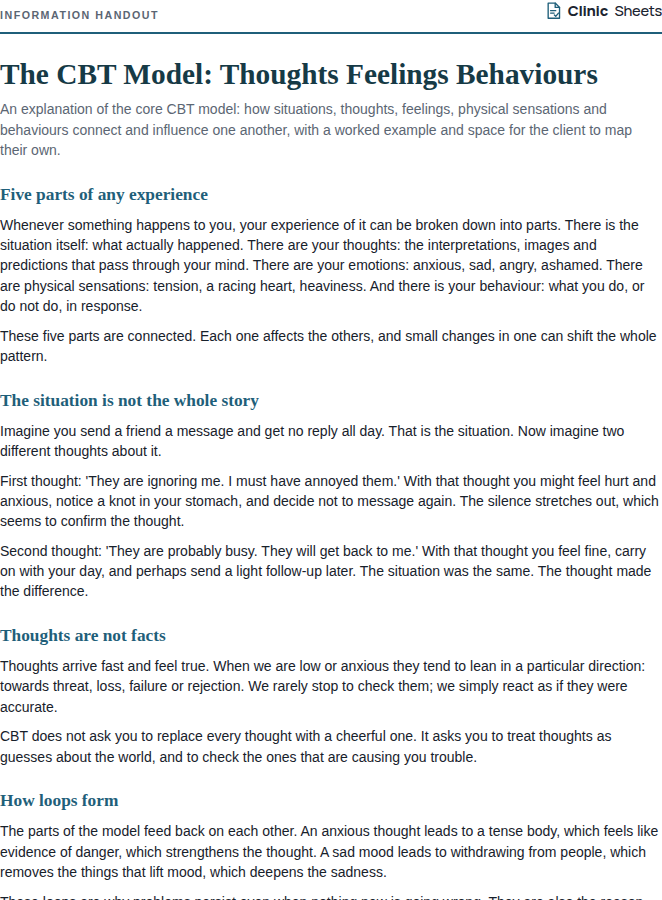
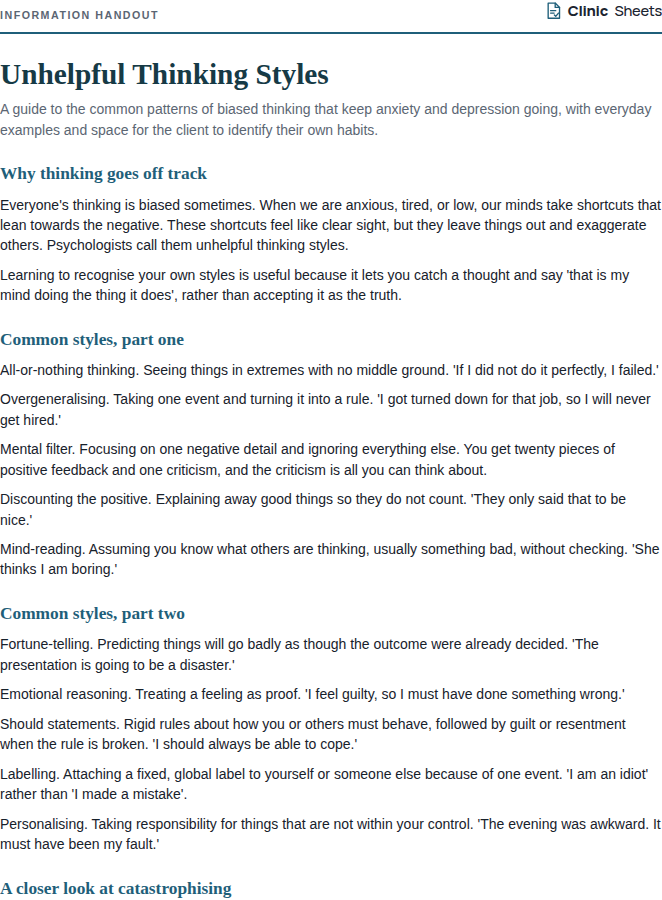
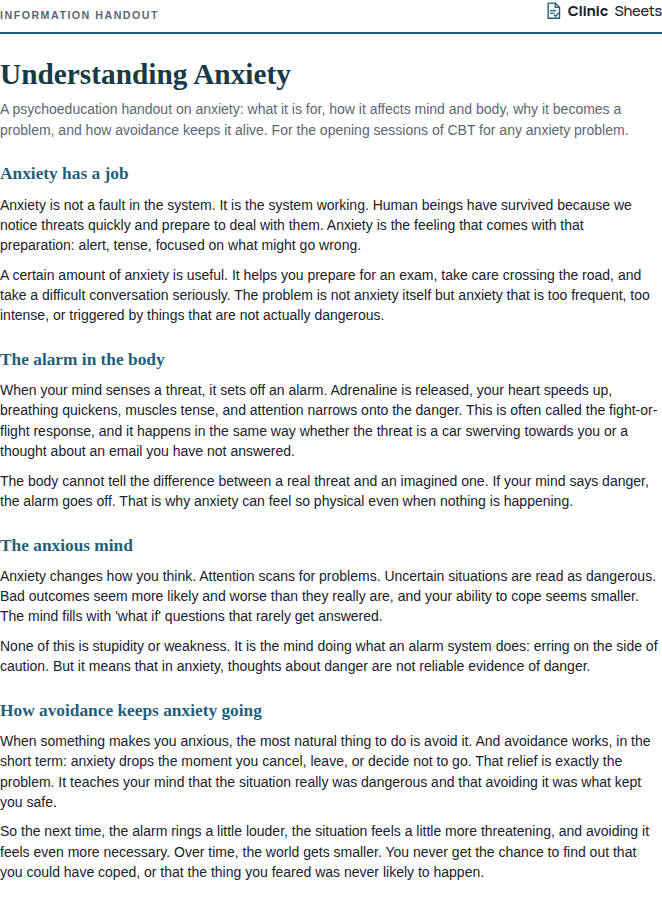
For clinicians the SCARED is most valuable as a map. The total score tells you whether anxiety is likely to be a clinical problem; the subscale profile tells you where to look first, and often points directly at the exposure hierarchy or the parent work that treatment will need. Repeating the measure every few sessions gives the child and family concrete evidence of progress.
How to use it
- Obtain the official child and parent versions of the SCARED. Give the child version to the young person and the parent version to a caregiver, ideally at the same appointment and completed separately.
- Score each item 0, 1 or 2 and add them for the total (0 to 82). Then add the items belonging to each of the five subscales using the key that accompanies the official form.
- Compare the total and each subscale to the cut-offs in this guide. A total of 25 or more suggests a probable anxiety disorder; each subscale has its own threshold.
- Lay the child and parent profiles side by side. Where they agree, treat the elevated subscale as the likely focus. Where they disagree, ask about it openly: children often report more internal symptoms (panic sensations, worry) than parents can see, and parents often report more avoidance than children admit.
- Use the profile to plan treatment and set goals. Repeat the SCARED every four to six sessions and at discharge, and show the young person the change.
References
- Birmaher, B., Khetarpal, S., Brent, D., Cully, M., Balach, L., Kaufman, J., & Neer, S. M. (1997). The Screen for Child Anxiety Related Emotional Disorders (SCARED): Scale construction and psychometric characteristics. Journal of the American Academy of Child and Adolescent Psychiatry, 36(4), 545-553.
- Birmaher, B., Brent, D. A., Chiappetta, L., Bridge, J., Monga, S., & Baugher, M. (1999). Psychometric properties of the Screen for Child Anxiety Related Emotional Disorders (SCARED): A replication study. Journal of the American Academy of Child and Adolescent Psychiatry, 38(10), 1230-1236.
- Kendall, P. C., & Hedtke, K. A. (2006). Cognitive-behavioral therapy for anxious children: Therapist manual (3rd ed.). Workbook Publishing.