Session-by-Session Protocol: Habit Reversal Training
A session-by-session clinician protocol for habit reversal training for tics and body-focused repetitive behaviours, following Azrin and Nunn's method and the Comprehensive Behavioral Intervention for Tics (CBIT): functional assessment, awareness training, competing response training, social support, function-based interventions, and relapse prevention.
About this resource
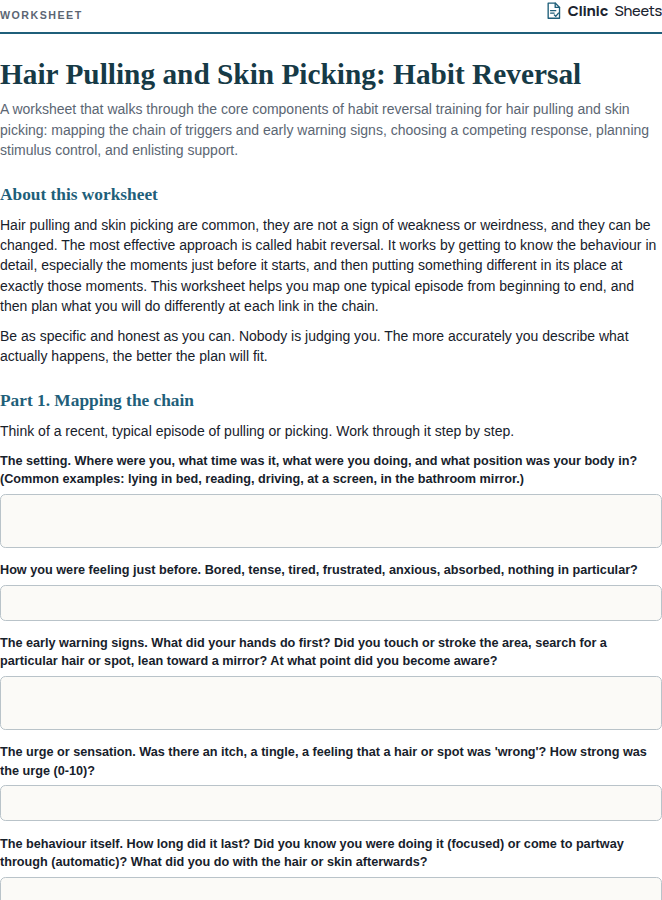
Habit reversal training was developed by Azrin and Nunn as a treatment for nervous habits and tics. Its core components are awareness training, in which the person learns to detect the habit and the sensations and situations that precede it, and competing response training, in which they learn to perform an incompatible behaviour for a minute or so whenever the urge or the habit begins. Social support enlists a family member to prompt and praise practice. Later developments added a functional assessment of the situations that make the behaviour more likely and interventions to change them. The Comprehensive Behavioral Intervention for Tics (CBIT), which packages these elements with relaxation training and psychoeducation, was shown to be effective for Tourette disorder in children and adults in randomised trials led by Piacentini and Wilhelm.
This protocol follows the CBIT structure of eight sessions over about ten weeks and extends it to body-focused repetitive behaviours such as hair pulling and skin picking, where the same components are used with a functional analysis in the style of Mansueto's comprehensive behavioural model. The sequence is: assessment and psychoeducation, building a hierarchy of tics or habit episodes, functional assessment through chain analysis, awareness training, competing response training for one target at a time, social support and reward, function-based interventions for the antecedents, generalisation, and relapse prevention.
The professional version explains how to conduct the functional assessment, how to choose and shape a competing response that is discreet and truly incompatible, how to run in-session awareness practice, and how to adapt the treatment for children, for premonitory urges that the person finds hard to tolerate, and for pulling and picking that occur outside awareness.
How to use it
- Assess the tics or repetitive behaviour in detail: topography, frequency, premonitory urges or sensations, situations and emotional states that increase them, and consequences. Administer the Yale Global Tic Severity Scale for tics or the Massachusetts General Hospital Hairpulling Scale or an equivalent for body-focused behaviours at baseline and end.
- Begin self-monitoring in the first session and use it throughout to select targets and track change.
- Work on one tic or one habit at a time. Complete awareness training for that target before introducing its competing response, and practise both in session before assigning home practice.
- Involve a support person from the start for children, and where the client wishes for adults, with clear instructions on prompting and praising.
- Use the final sessions for generalisation to new settings and a written relapse prevention plan.
References
- Azrin, N. H., & Nunn, R. G. (1973). Habit-reversal: A method of eliminating nervous habits and tics. Behaviour Research and Therapy, 11(4), 619-628.
- Woods, D. W., Piacentini, J. C., Chang, S. W., Deckersbach, T., Ginsburg, G. S., Peterson, A. L., Scahill, L. D., Walkup, J. T., & Wilhelm, S. (2008). Managing Tourette Syndrome: A Behavioral Intervention for Children and Adults, Therapist Guide. Oxford University Press.
- Piacentini, J., Woods, D. W., Scahill, L., Wilhelm, S., Peterson, A. L., Chang, S., Ginsburg, G. S., Deckersbach, T., Dziura, J., Levi-Pearl, S., & Walkup, J. T. (2010). Behavior therapy for children with Tourette disorder: A randomized controlled trial. JAMA, 303(19), 1929-1937.
- Woods, D. W., & Twohig, M. P. (2008). Trichotillomania: An ACT-Enhanced Behavior Therapy Approach, Therapist Guide. Oxford University Press.