Shift Work and Sleep
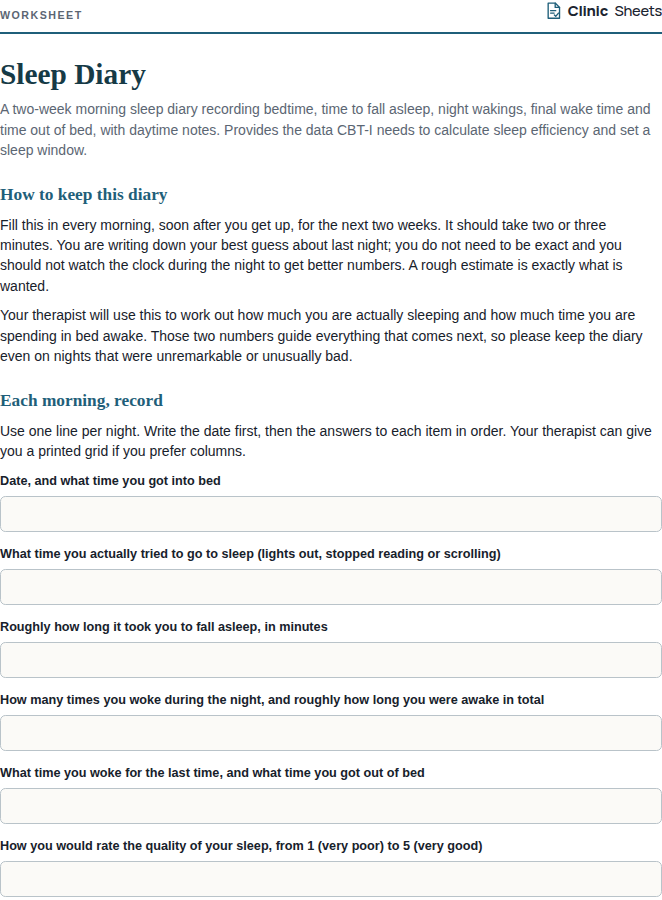
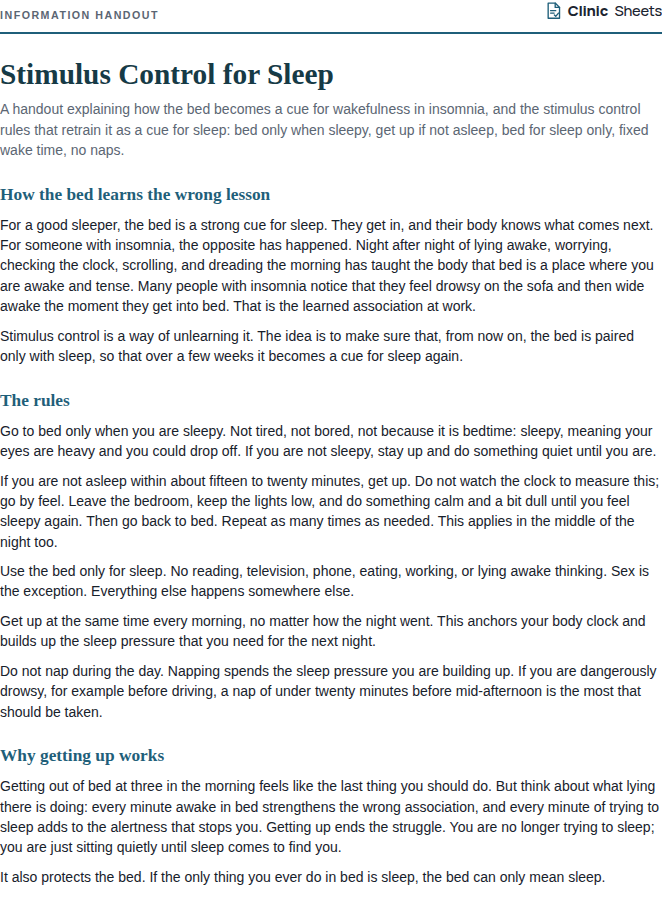
A handout for people who work nights, rotating or early shifts, explaining why shift work disrupts sleep and offering practical strategies for sleep timing, light, naps, caffeine and the bedroom. Adapted from CBT for insomnia principles.
About this resource
Shift work forces sleep into times when the body's circadian clock is promoting wakefulness, and forces wakefulness into times when the clock is promoting sleep. The result for many workers is short, fragmented daytime sleep and reduced alertness at work. Where this is persistent and causes distress or impairment, it meets the description of shift work disorder, a circadian rhythm sleep-wake disorder. Many more workers fall short of that threshold but still struggle.
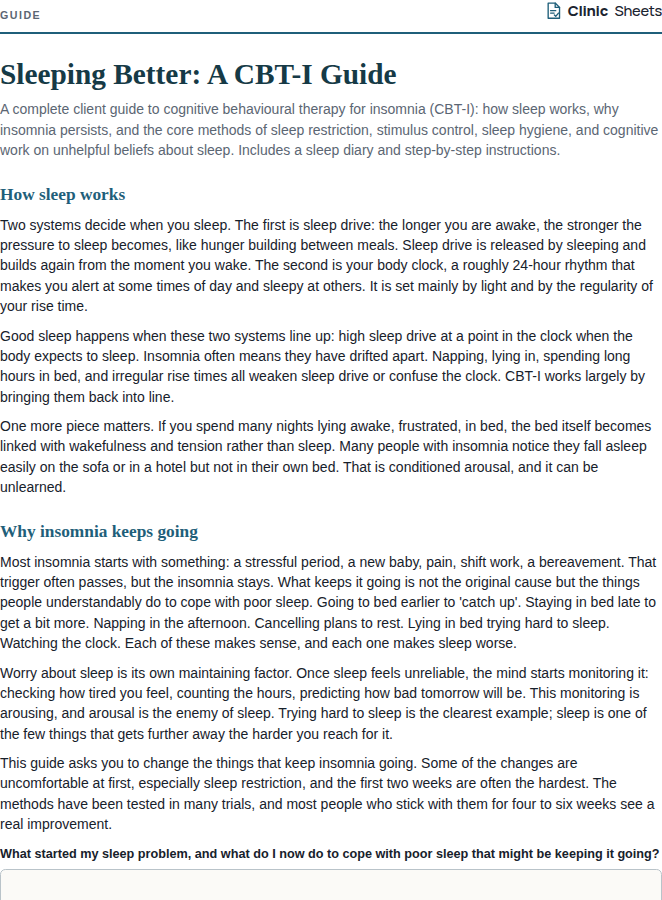
This handout explains the two-process model in plain terms: sleep pressure builds with time awake, and the circadian clock sets a daily rhythm of alertness that light anchors. Shift work sets these two against each other. The strategies that follow are drawn from the circadian and behavioural sleep medicine literature: managing light exposure to shift or protect the clock, planning sleep in a protected block, using strategic naps, timing caffeine, and applying the stimulus control and sleep-effort principles of CBT for insomnia so that the worker does not add an insomnia problem on top of a circadian one.
The professional version notes that standard sleep restriction needs adapting for rotating schedules, that sleep diaries should record work times alongside sleep, and that persistent excessive sleepiness, snoring or witnessed apnoeas warrant medical referral to rule out sleep apnoea or other causes. Any discussion of melatonin or wake-promoting medication belongs with the client's physician.
How to use it
- Take a detailed schedule history: shift pattern, rotation direction and speed, commute, and what the client currently does on days off. Ask them to keep a two-week sleep diary that includes work hours and light exposure.
- Distinguish a circadian problem (sleep is short because it is scheduled at the wrong clock time) from a conditioned insomnia problem (sleep is short even when the timing is right). Many shift workers have both.
- Work through the handout with the client and help them pick two or three changes that fit their actual life: a protected sleep block, a light plan, and a nap plan are usually the highest yield.
- Apply stimulus control and sleep-effort principles as you would for any insomnia client: bed is for sleep, get up if not sleeping, do not chase sleep.
- Review the diary at each session. Refer to the client's physician if there is heavy snoring, breathing pauses, or sleepiness that is dangerous at work or on the road.
References
- Wright, K. P., Bogan, R. K., & Wisor, J. P. (2013). Shift work and the assessment and management of shift work disorder (SWD). Sleep Medicine Reviews, 17(1), 41-54.
- Drake, C. L., Roehrs, T., Richardson, G., Walsh, J. K., & Roth, T. (2004). Shift work sleep disorder: Prevalence and consequences beyond that of symptomatic day workers. Sleep, 27(8), 1453-1462.
- Morin, C. M., & Espie, C. A. (2003). Insomnia: A Clinical Guide to Assessment and Treatment. Kluwer Academic/Plenum.
- American Academy of Sleep Medicine. (2014). International Classification of Sleep Disorders (3rd ed.). American Academy of Sleep Medicine.