Sleep Workbook (CBT-I)
A six-week workbook for adults with chronic insomnia that walks through cognitive behavioural therapy for insomnia: how sleep is regulated, a baseline sleep diary, stimulus control, sleep restriction with weekly adjustment, reducing sleep effort and worry about sleep, and supporting daytime habits, with fields for the diary calculations and weekly review.
About this resource
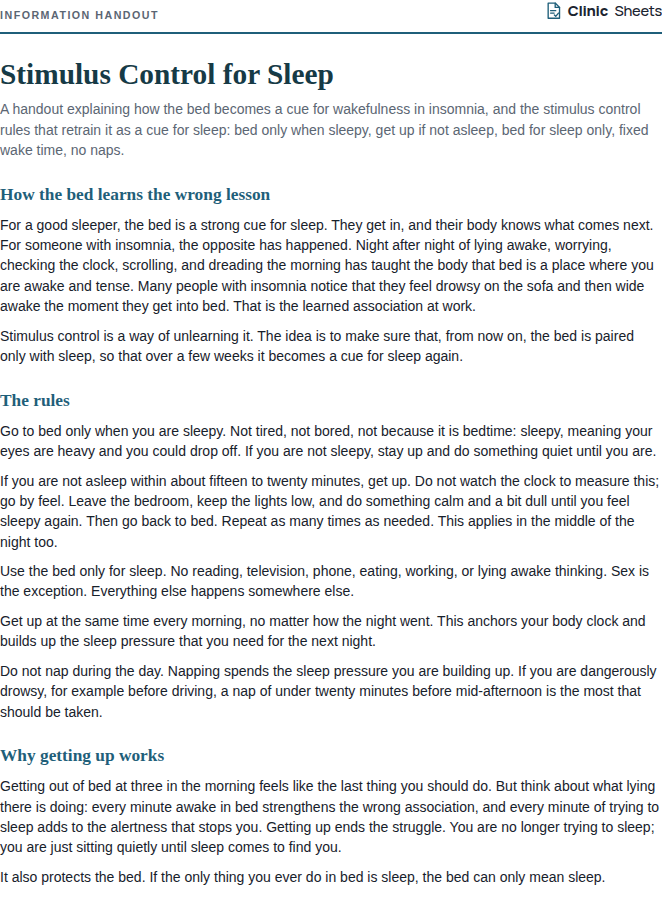
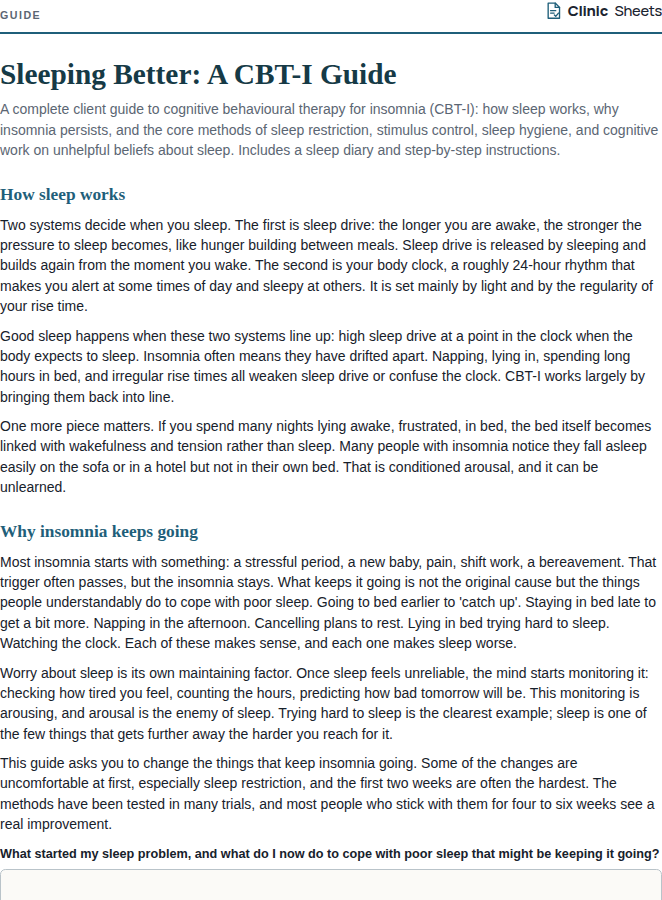
This workbook delivers CBT-I in the sequence used in Morin's and Edinger and Carney's treatment programmes: psychoeducation grounded in the two-process model of sleep regulation and Spielman's three-factor model of insomnia, a baseline diary week, stimulus control based on Bootzin's rules, sleep restriction with a sleep window titrated weekly on sleep efficiency, cognitive work on sleep effort and unhelpful beliefs drawing on Harvey's cognitive model, and sleep hygiene as a supporting rather than central component. It is written for weekly use across six sessions, with the diary running throughout.
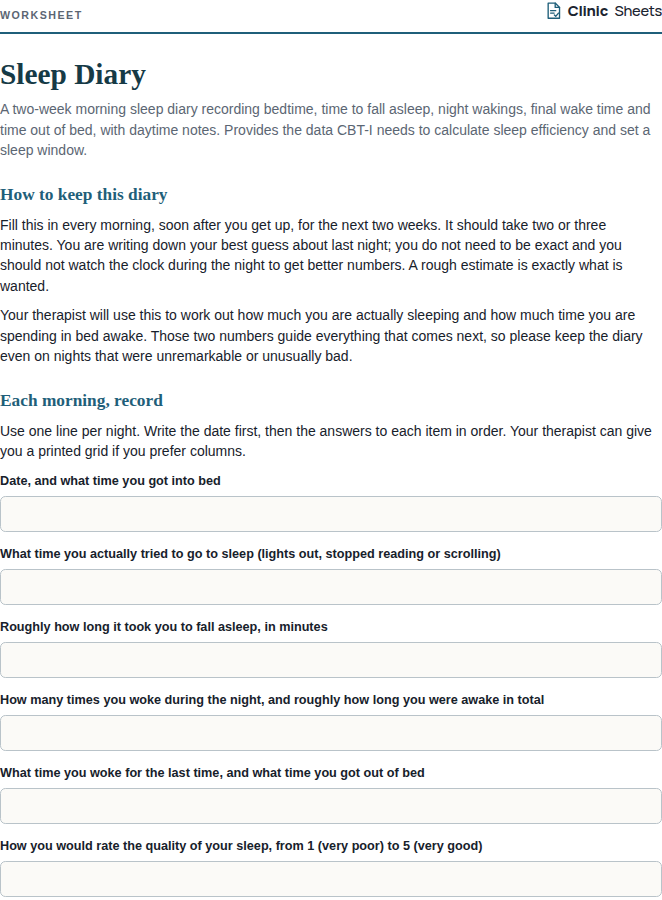
The workbook is organised around the client's own numbers. Each week the client calculates time in bed, total sleep time and sleep efficiency from the diary and records the resulting decision about the sleep window. This keeps the treatment concrete and gives the client a method they can continue independently. The target mechanism is sleep effort: the workbook repeatedly frames trying to sleep, monitoring sleep and protecting sleep as the behaviours that maintain insomnia, and the behavioural changes as ways of getting out of sleep's way.
The professional version adds contraindications and cautions for sleep restriction (bipolar disorder, seizure disorders, untreated sleep apnoea, parasomnias, safety-critical work such as driving for a living, pregnancy, and some other medical conditions), the titration rules, the five-and-a-half-hour minimum window commonly used in practice, and guidance on the first two weeks, when daytime sleepiness peaks and adherence is most fragile. Screen for other sleep disorders before starting and refer for a sleep study where indicated.
How to use it
- Screen for obstructive sleep apnoea, restless legs, circadian rhythm disorders, parasomnias and conditions where sleep restriction is contraindicated or needs modification. Refer where indicated before starting.
- Begin the sleep diary in week 1 and do not set a sleep window until at least one full week of diary data is available. Calculate average total sleep time and sleep efficiency with the client in session.
- Introduce stimulus control in week 3 and sleep restriction in week 4, or combine them in one session if the client is ready. Set a fixed rise time first and derive the bedtime from the window.
- Review the diary every week. Extend the window by 15 minutes when sleep efficiency is 85 percent or above, hold it between 80 and 85, and shorten it by 15 minutes if below 80 for the week, never going below the agreed minimum.
- Warn the client that daytime sleepiness increases for the first one to two weeks of restriction, discuss driving and safety, and frame the sleepiness as the sleep drive rebuilding.
- Introduce the cognitive work in week 5 once the behavioural changes are underway, and use the client's own diary and worry log to identify the beliefs to target.
References
- Morin, C. M., & Espie, C. A. (2003). Insomnia: A Clinical Guide to Assessment and Treatment. Kluwer Academic/Plenum.
- Spielman, A. J., Saskin, P., & Thorpy, M. J. (1987). Treatment of chronic insomnia by restriction of time in bed. Sleep, 10(1), 45-56.
- Bootzin, R. R. (1972). Stimulus control treatment for insomnia. Proceedings of the 80th Annual Convention of the American Psychological Association, 7, 395-396.
- Harvey, A. G. (2002). A cognitive model of insomnia. Behaviour Research and Therapy, 40(8), 869-893.
- Edinger, J. D., & Carney, C. E. (2015). Overcoming Insomnia: A Cognitive-Behavioral Therapy Approach, Therapist Guide (2nd ed.). Oxford University Press.