The Miracle Question and Scaling (Solution-Focused)
A solution-focused worksheet built around two signature techniques: the miracle question, which helps the client describe in detail what life would look like if the problem were gone, and scaling questions, which locate where they are now and identify the next small step.
About this resource
Solution-Focused Brief Therapy, developed by Steve de Shazer, Insoo Kim Berg and colleagues, starts from the premise that clients already possess resources and exceptions to their problems, and that detailed description of a preferred future is more useful than detailed analysis of the problem. The miracle question invites the client to imagine that, while they sleep, the problem that brought them to therapy is resolved, and to describe in concrete, observable terms what they would notice first and what others would notice. Scaling questions then ask the client to place themselves on a 0 to 10 scale between the worst things have been and the miracle, and to identify what already accounts for their current position and what one point higher would look like.
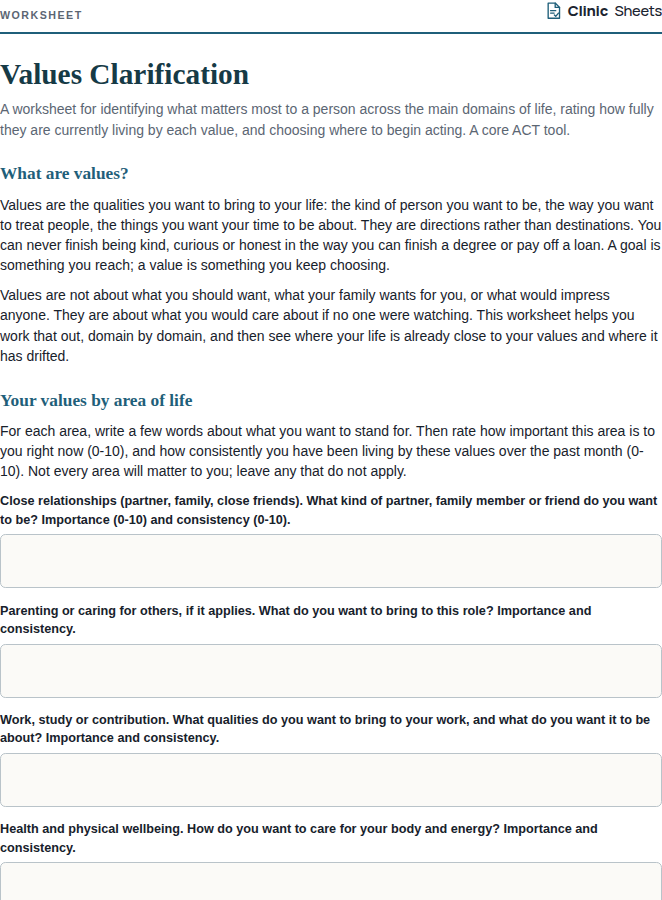
This worksheet gives clients a written version of both. It asks for a rich, behavioural description of the morning after the miracle, including what significant others would notice; a search for pieces of the miracle that already happen; a scaling exercise with the reasons the client is not lower; and a description of the next point on the scale as a concrete goal. It suits adults and adolescents and works well for depression, life transitions and goal-setting where the client feels stuck or hopeless.
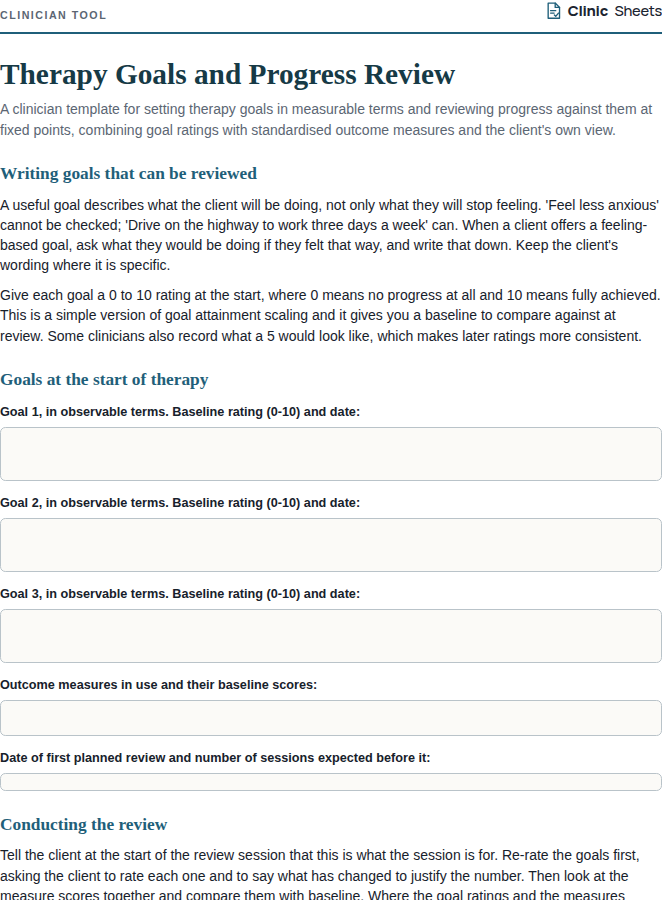
The professional version adds guidance on asking the miracle question slowly and with pauses, on redirecting answers that are vague ('I would feel better') or absent ('the other person would change') toward what the client would be doing, on complimenting existing resources, and on the use of scaling across sessions as a simple progress measure.
How to use it
- Ask the miracle question aloud in session before giving the worksheet, slowly and with the standard set-up: tonight, while you sleep, a miracle happens and the problem is solved, but you do not know it because you were asleep. What is the first small thing you notice in the morning that tells you?
- Keep pressing for concrete, observable detail. When the client says how they would feel, ask what they would be doing differently, and what others would see.
- Ask who else would notice and what they would notice. Then ask whether any small piece of the miracle has already happened, even briefly.
- Move to the scale. Ask where the client is today, what they are already doing that keeps them from being lower, and what one point higher would look like in practice.
- Agree a small, observable step that would move the client one point. Revisit the scale at each session and notice, and compliment, movement.
References
- De Jong, P., & Berg, I. K. (2013). Interviewing for Solutions (4th ed.). Brooks/Cole.
- de Shazer, S. (1988). Clues: Investigating Solutions in Brief Therapy. W. W. Norton.
- de Shazer, S., Dolan, Y., Korman, H., Trepper, T., McCollum, E., & Berg, I. K. (2007). More Than Miracles: The State of the Art of Solution-Focused Brief Therapy. Haworth Press.