Longitudinal CBT Formulation
A clinician template for a longitudinal (developmental) CBT formulation: early experiences, core beliefs, conditional assumptions and rules, compensatory strategies, critical incidents, and the current maintaining cycle of thoughts, feelings and behaviours.
About this resource
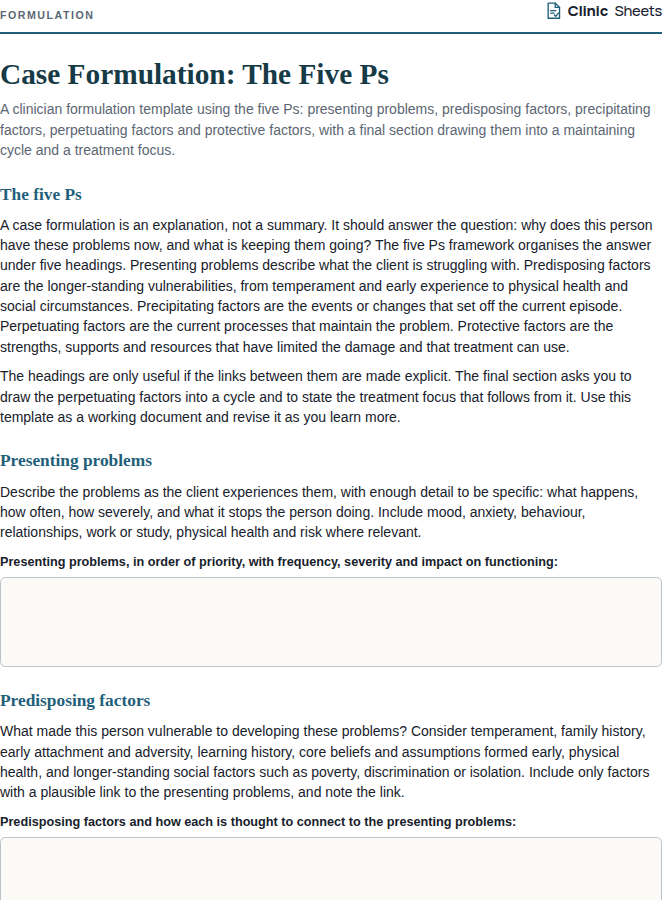
A longitudinal formulation extends the here-and-now maintenance formulation backwards in time. It follows the structure set out by Judith Beck: early experiences give rise to core beliefs about the self, others and the world; these generate conditional assumptions and rules for living that allow the person to function despite the beliefs; the person develops compensatory strategies to keep the rules; and a critical incident that breaks the rules or activates the beliefs produces the current episode, which is then maintained by the familiar cycle of automatic thoughts, emotions, physical sensations and behaviours.
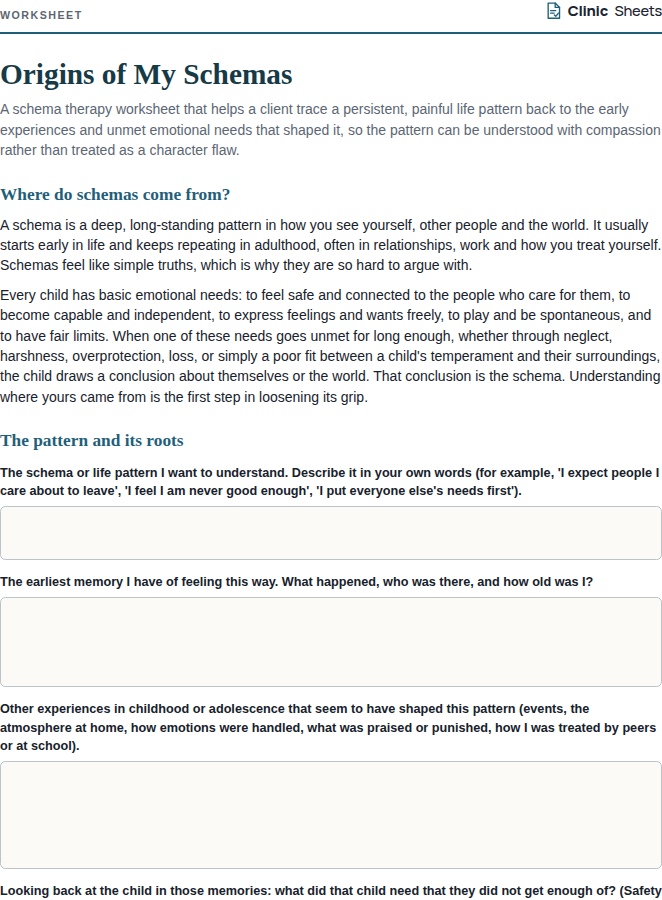
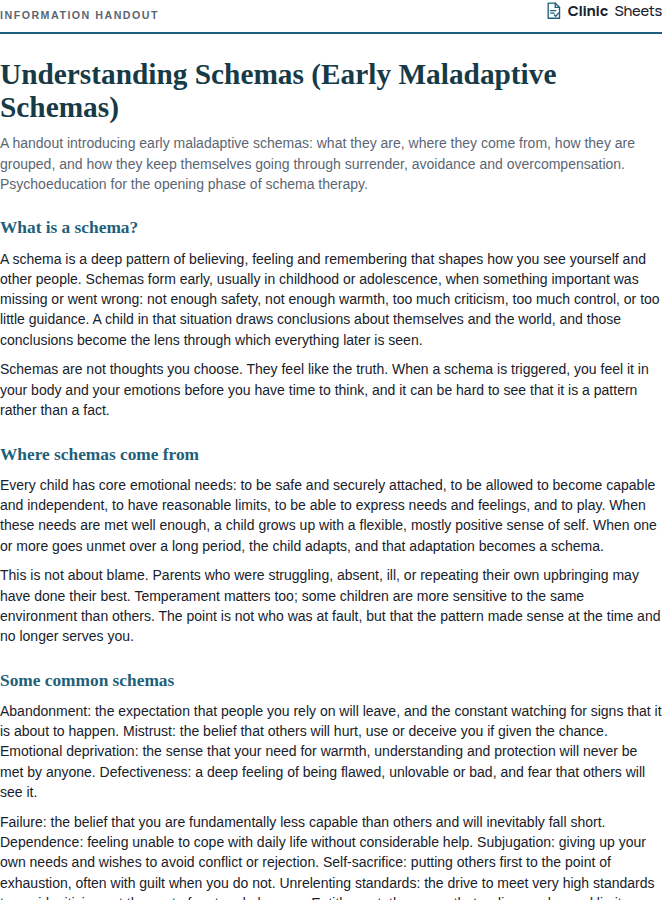
This kind of formulation is most useful when the presenting problem is long-standing, when a maintenance formulation alone has not produced change, when the client's difficulties recur across many situations, or when personality difficulties or chronic low self-esteem are part of the picture. It shares much with the schema therapy account of early maladaptive schemas and coping styles, and it helps to explain to the client why beliefs that seem obviously extreme feel so true: they were reasonable conclusions from the experiences that formed them.
The professional version includes guidance on eliciting core beliefs without leading, on distinguishing beliefs from assumptions, on tracing the link from an assumption to a specific compensatory strategy, and on timing: the longitudinal formulation is usually built gradually over the middle phase of therapy rather than presented complete in the first sessions.
How to use it
- Build the maintenance level first, using a recent specific situation, so that the client has a concrete cycle to anchor the rest of the diagram.
- Work backwards from the automatic thoughts. Ask what the thought would mean if it were true, and continue until you reach a statement about the self, others or the world that the client recognises as a long-held belief.
- Identify the assumptions and rules that let the client live with the belief. They usually take the form 'If I ... then ...' or 'I must ...'. Ask what the client does to keep the rule; that behaviour is the compensatory strategy.
- Identify the critical incident: the event or period in which the rule could no longer be kept, or the belief was activated. Clients can often name it once the assumption is clear.
- Trace the beliefs to early experiences with care. The aim is understanding, not blame, and the client sets the pace. Note the experiences that fit and leave gaps rather than guess.
- Share the diagram and ask what fits. Then use it to plan: which assumptions and strategies will be targeted, and whether core belief work is needed or whether change at the assumption level will be enough.
References
- Beck, J. S. (2020). Cognitive Behavior Therapy: Basics and Beyond (3rd ed.). Guilford Press.
- Young, J. E., Klosko, J. S., & Weishaar, M. E. (2003). Schema Therapy: A Practitioner's Guide. Guilford Press.
- Kuyken, W., Padesky, C. A., & Dudley, R. (2009). Collaborative Case Conceptualization: Working Effectively with Clients in Cognitive-Behavioral Therapy. Guilford Press.