The Continuum Technique
A worksheet for loosening all-or-nothing self-judgements by defining the extremes of a quality, breaking it into concrete criteria, placing oneself and others along the scale, and re-rating. Used in CBT for low self-esteem and perfectionism.
About this resource
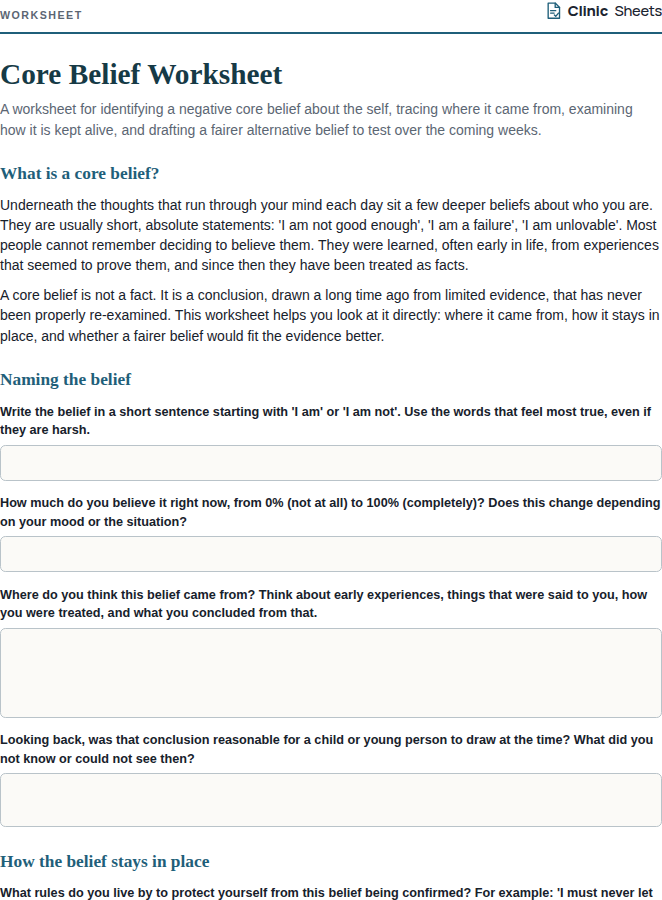
All-or-nothing thinking is a hallmark of both low self-esteem and clinical perfectionism. In Fennell's model of low self-esteem, a global negative belief such as 'I am a failure' is protected by dichotomous judgement: anything short of complete success confirms the belief. In the cognitive-behavioural model of perfectionism the same process operates, with self-worth tied to performance and standards set so that partial success reads as failure. The continuum technique, described by Padesky as a schema change method, targets this directly by replacing a two-category judgement (failure or success, worthless or worthwhile) with a graded scale.
The client first rates themselves on the belief, usually near the extreme. They then define what the two ends of the scale would actually look like, break the quality into specific observable criteria, and rate themselves on each. Finally they place real people they know along the scale. The effect is twofold: the extremes are revealed as caricatures that no real person occupies, and the client's own position, once judged on concrete criteria, moves toward the middle. Repeated over several beliefs, the technique builds a more graded and realistic self-view.
The professional version includes guidance on defining extremes vividly enough to be useful, on handling clients who define the negative extreme in a way that still includes themselves, and on pairing the continuum with positive data logs and behavioural experiments to consolidate change.
How to use it
- Select a global negative self-belief that the client holds in all-or-nothing terms, such as 'I am incompetent', 'I am a bad mother', or 'I am boring'. Take an initial rating of belief strength and an initial placement on a 0 to 100 line.
- Define the negative extreme in detail. Ask what a 0% person would be like in every area of life: how they would behave, what they would never manage, how others would experience them. Then define the 100% extreme the same way. Make both concrete and slightly absurd; the point is that neither describes a real human being.
- Break the quality into criteria. If the belief is about competence, list the components: getting work done, learning new things, handling problems, managing money, relationships, and so on. Have the client rate themselves on each criterion separately.
- Place other people on the line: a colleague, a friend, a public figure, someone the client admires. Notice that they too are spread along the middle and that the client is rarely at the extreme once judged criterion by criterion.
- Re-rate the original belief and placement. Discuss what changed and why. Ask the client what it would mean to judge themselves on the criteria rather than on the single global label.
- Repeat the exercise on other beliefs and encourage the client to use a continuum mentally whenever they notice an all-or-nothing judgement. Follow up with behavioural experiments that test the newer, graded view.
References
- Padesky, C. A. (1994). Schema change processes in cognitive therapy. Clinical Psychology and Psychotherapy, 1(5), 267-278.
- Fennell, M. J. V. (2016). Overcoming Low Self-Esteem (2nd ed.). Robinson.
- Egan, S. J., Wade, T. D., Shafran, R., & Antony, M. M. (2014). Cognitive-Behavioral Treatment of Perfectionism. Guilford Press.