Understanding Anxiety (for Teens)
A plain-language explanation for teenagers of what anxiety is, why the body reacts the way it does, and how avoidance keeps anxiety going. Psychoeducation for the first sessions of CBT with an adolescent.
About this resource
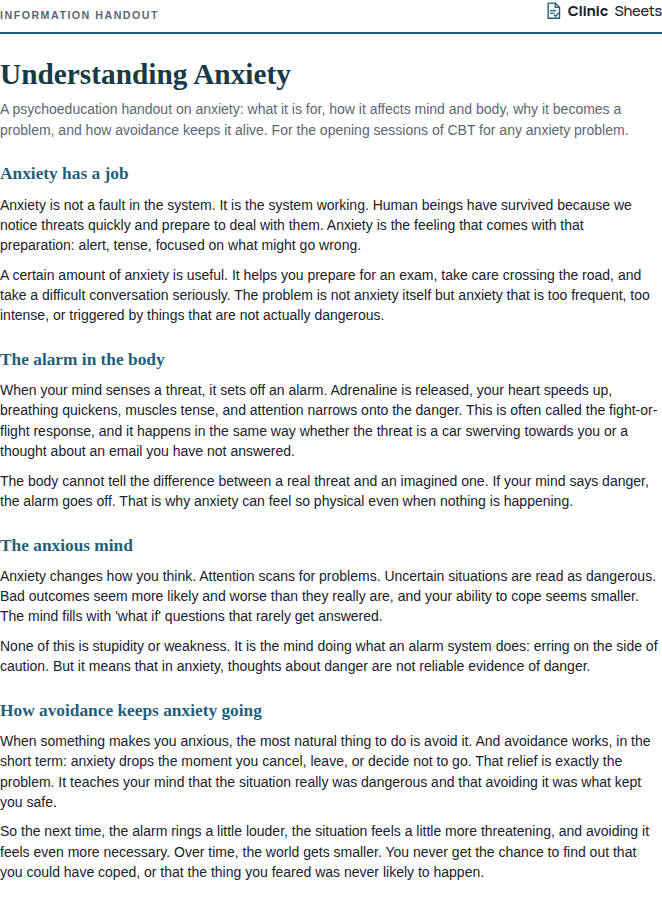
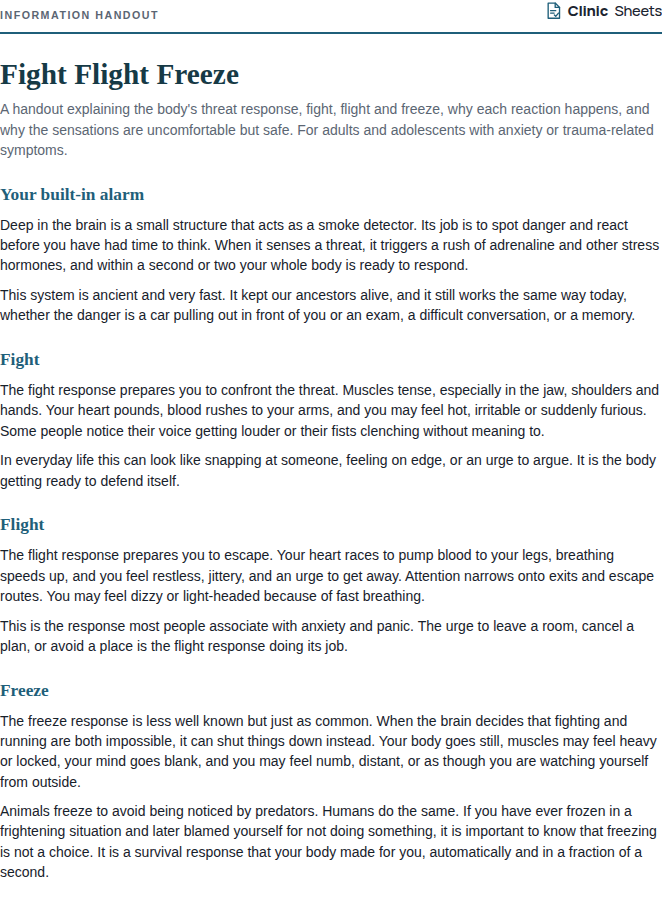
Anxiety disorders are among the most common mental health problems in adolescence, and many young people arrive in therapy with the sense that their anxiety is a personal weakness or a sign that something is wrong with them. This handout normalises anxiety as a protective system that has become oversensitive, explains the fight-or-flight response in everyday terms, and introduces the central CBT idea that avoidance brings short-term relief at the cost of long-term anxiety.
The handout is written directly to the adolescent, without talking down, and is deliberately concrete: it uses school, social and family examples that most teenagers will recognise. It closes with a short reflection section that starts the process of identifying the young person's own anxiety triggers, body signals and avoidance patterns, which feeds naturally into a hierarchy or a first behavioural experiment.
The professional version adds notes on pacing the conversation, engaging a reluctant adolescent, and how to draw out avoidance without the young person feeling criticised for it.
How to use it
- Use in the first or second session once you have a sense of the young person's main worries. Read it together rather than sending it home unread.
- Pause after the section on the body's alarm system and ask which sensations the young person recognises. Normalise each one.
- Spend the most time on the avoidance section. Ask for one recent example of something avoided and what happened to the anxiety afterwards, both immediately and the next time the situation came up.
- Complete the reflection fields together, or ask the young person to complete them before the next session and bring them back.
- Follow with a fear hierarchy or a first small behavioural experiment so the handout leads directly into action.
References
- Kendall, P. C., & Hedtke, K. A. (2006). Coping Cat Workbook (2nd ed.). Workbook Publishing.
- Stallard, P. (2019). Think Good, Feel Good: A Cognitive Behavioural Therapy Workbook for Children and Young People (2nd ed.). Wiley.
- Beck, J. S. (2020). Cognitive Behavior Therapy: Basics and Beyond (3rd ed.). Guilford Press.