Understanding Sadness (for Kids)
A child-friendly explanation of sadness and low mood: what it feels like, why it is not the child's fault, how sadness can become a stuck loop of doing less and feeling worse, and what helps. Psychoeducation for the first sessions of treatment for childhood depression.
About this resource
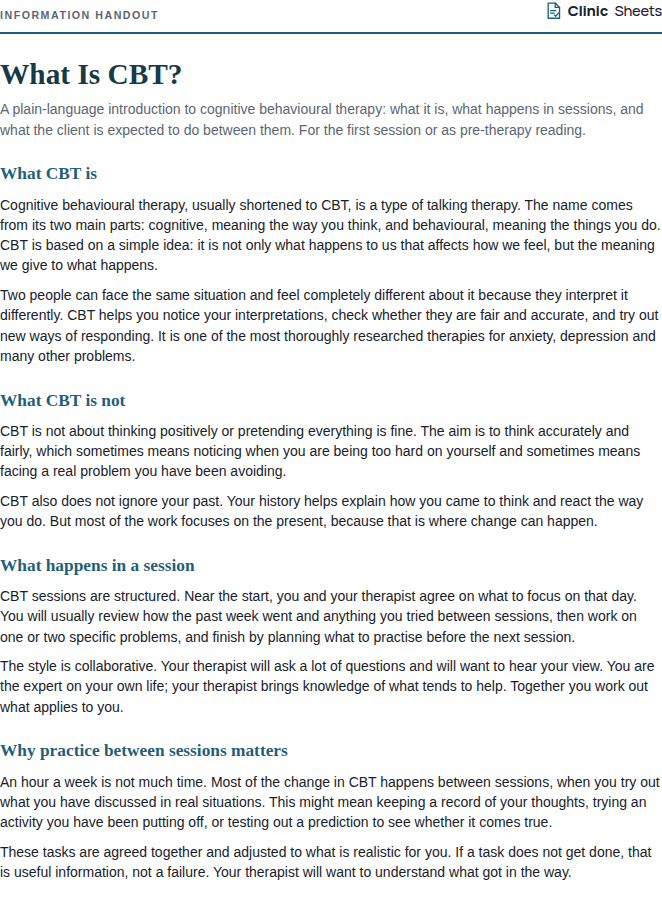
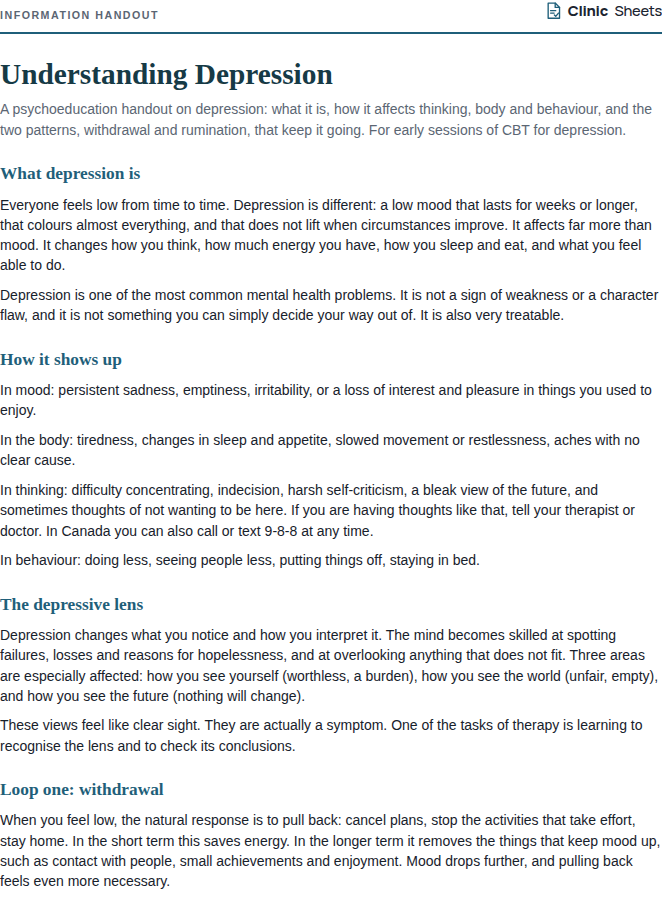
Depression in children can look different from depression in adults: irritability, boredom, tearfulness, stomach aches, refusing activities they used to enjoy, and a sense that nothing is fun anymore. Children rarely have language for this and often conclude that something is wrong with them or that they are bad. Psychoeducation is the first component of evidence-based CBT programs for youth depression, such as Stark's ACTION program, and of behavioural activation approaches. Its aims are to normalise the experience, externalise it slightly (sadness is something that has happened to you, not who you are), and introduce the simple maintenance model that treatment will target: feeling low leads to doing less, and doing less leads to feeling lower.
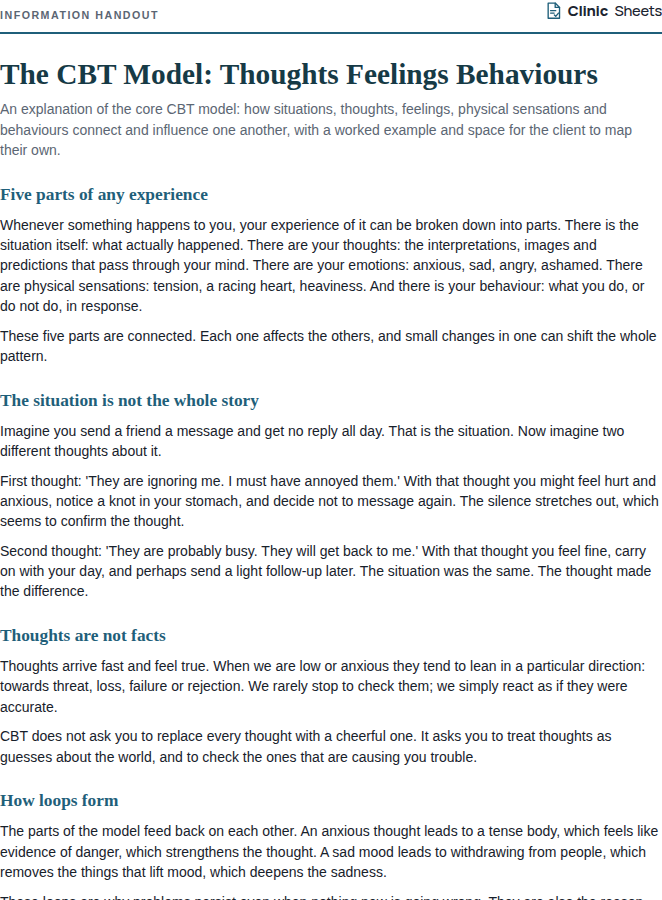
This handout explains sadness as a normal feeling that everyone has, describes what it is like when sadness sticks around too long, and gives the child an accurate but hopeful account of why this happens and what helps. It introduces the 'stuck loop' in concrete terms (stop playing with friends, feel more lonely, feel more sad, want to do even less) and previews the two main ways out: doing things even when you do not feel like it, and noticing unhelpful thoughts. A reflection section asks the child what sadness is like for them, and a parent section explains how to support without pressure.
The professional version adds guidance on adapting the language for younger versus older children, on checking for hopelessness and thoughts of self-harm in an age-appropriate way as part of routine assessment, and on using the handout's loop diagram as the entry point for activity scheduling in the following session.
How to use it
- Read the handout with the child and parent together in an early session, a section at a time, checking after each one whether it fits the child's experience.
- Ask the child for their own examples of the stuck loop: an activity they have stopped, and what happened to their mood afterwards. Draw the loop on paper with their example in it.
- Use the reflection fields to gather the child's words for sadness and the situations where it is worst. These become the targets for activity scheduling and thought work.
- Assess safety as part of your standard practice with any child presenting with low mood, using developmentally appropriate questions. Do this in a calm, routine way so the child learns it is safe to talk about.
- Go through the parent section with the caregiver and agree how they will talk about sadness at home: with warmth and encouragement to do things, without pressure to cheer up.
- Follow with Fun Activities Menu (Behavioural Activation for Kids) and Feelings Check-In (Kids).
References
- Weersing, V. R., Jeffreys, M., Do, M. T., Schwartz, K. T., & Bolano, C. (2017). Evidence base update of psychosocial treatments for child and adolescent depression. Journal of Clinical Child and Adolescent Psychology, 46(1), 11-43.
- Stark, K. D., Streusand, W., Krumholz, L. S., & Patel, P. (2010). Cognitive-behavioral therapy for depression: The ACTION treatment program for girls. In J. R. Weisz & A. E. Kazdin (Eds.), Evidence-Based Psychotherapies for Children and Adolescents (2nd ed.). Guilford Press.
- Lewinsohn, P. M. (1974). A behavioral approach to depression. In R. J. Friedman & M. M. Katz (Eds.), The Psychology of Depression: Contemporary Theory and Research (pp. 157-178). Wiley.