Schema Coping Styles: Surrender Avoid and Overcompensate
A psychoeducation handout explaining the three ways people cope with early maladaptive schemas, surrender, avoidance and overcompensation, with examples of each and a reflection on which styles the reader uses. For adults in schema therapy.
About this resource
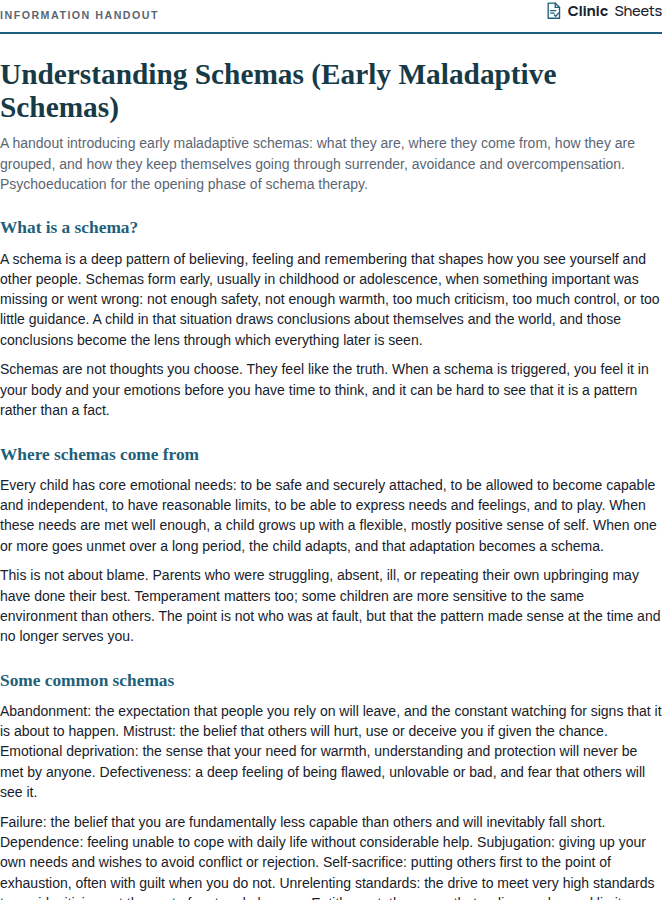
In Young's schema therapy, an early maladaptive schema is a broad, enduring pattern of memories, emotions, bodily sensations and beliefs about oneself and one's relationships, developed in childhood and elaborated throughout life. Schemas are painful, and people develop characteristic ways of coping with them. Young, Klosko and Weishaar describe three maladaptive coping styles, mapped loosely onto the fight, flight and freeze responses. Schema surrender means giving in to the schema, accepting it as true and behaving in ways that confirm it. Schema avoidance means arranging life so that the schema is not triggered, or blocking the feelings when it is. Schema overcompensation means fighting the schema by behaving as though the opposite were true, often to an extreme.
Understanding coping styles matters clinically because the same schema can produce very different presentations. A person with a defectiveness schema may surrender (choose critical partners, accept blame), avoid (keep relationships shallow, use substances to numb shame) or overcompensate (become perfectionistic, status-driven or contemptuous of others). All three styles perpetuate the schema because none allows it to be tested and disconfirmed. This handout explains the three styles in plain language, gives examples, and invites the reader to identify their own patterns, which is a necessary step before behavioural pattern-breaking can begin.
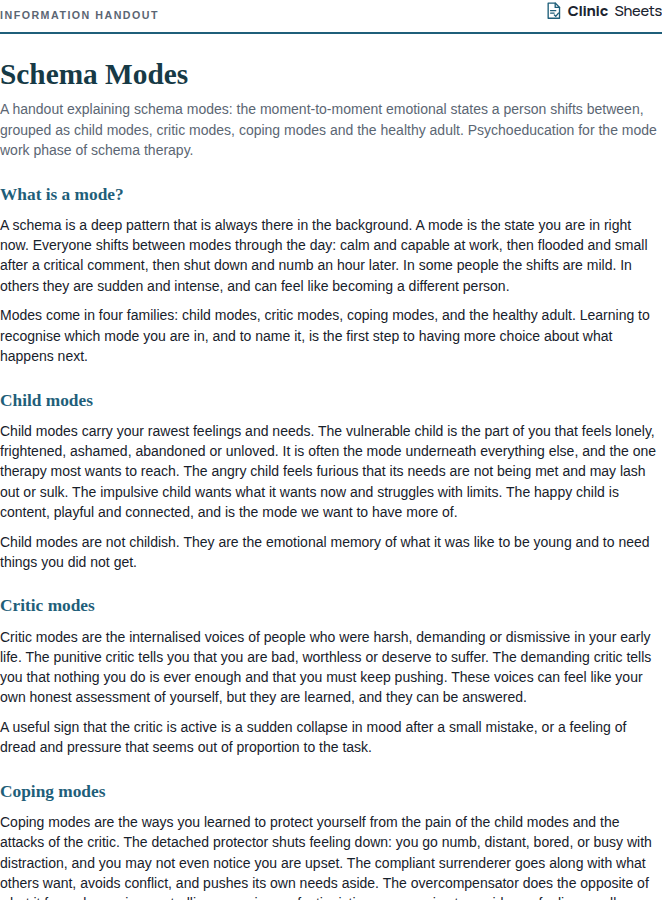
The professional version includes notes on how coping styles shift across situations and life stages, on the frequent combination of styles within one person, and on the link between coping styles and coping modes in the mode model.
How to use it
- Use after schemas have been identified through assessment and history, typically in the early-to-middle phase of schema therapy.
- Read the handout with the client, pausing at each style to ask for their own examples. Most clients recognise more than one style.
- Take one schema the client has identified and trace how each of the three styles might look for that schema in their life. This helps clients see that seemingly opposite behaviours can serve the same schema.
- Ask the client to complete the reflection section between sessions, and to notice coping styles in action during the week.
- Use the identified styles to plan behavioural pattern-breaking: what would a healthy response to the schema, neither surrendering, avoiding nor overcompensating, look like?
References
- Young, J. E., Klosko, J. S., & Weishaar, M. E. (2003). Schema Therapy: A Practitioner's Guide. Guilford Press.
- Young, J. E., & Klosko, J. S. (1993). Reinventing Your Life: The Breakthrough Program to End Negative Behavior and Feel Great Again. Plume.
- Arntz, A., & Jacob, G. (2013). Schema Therapy in Practice: An Introductory Guide to the Schema Mode Approach. Wiley-Blackwell.