Schema Modes
A handout explaining schema modes: the moment-to-moment emotional states a person shifts between, grouped as child modes, critic modes, coping modes and the healthy adult. Psychoeducation for the mode work phase of schema therapy.
About this resource
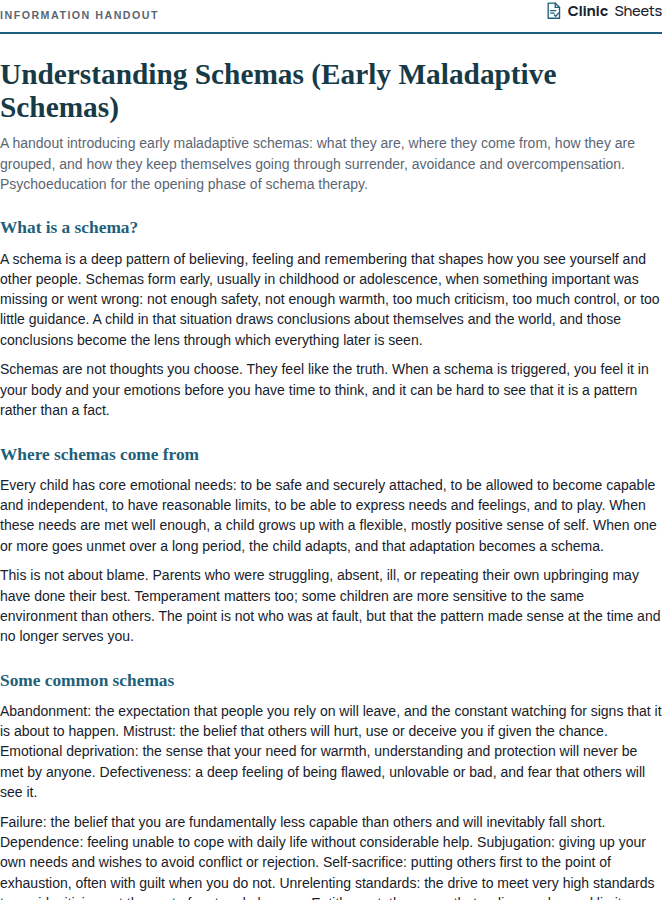
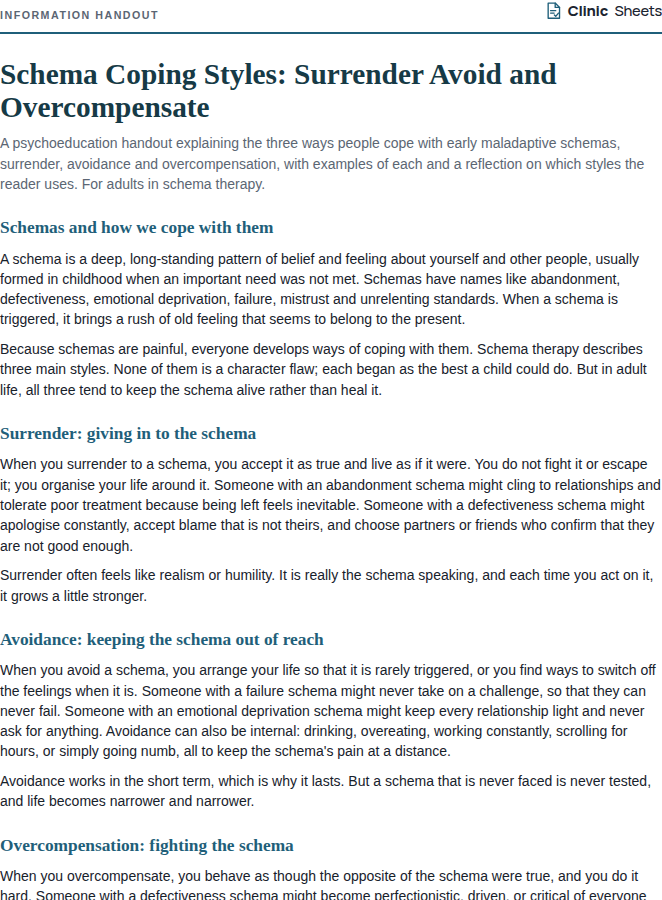
Schema modes are the states a person is in at a given moment, as opposed to schemas, which are the enduring underlying patterns. The mode model was developed by Young and colleagues to work with clients who shift rapidly between very different presentations, as is common in borderline and narcissistic personality difficulties, and it has since become the dominant framework in schema therapy for a wide range of problems. Modes are grouped into four families: child modes carrying raw emotion and need (vulnerable, angry, impulsive, happy), inner critic modes that punish or demand (punitive, demanding), coping modes that protect against pain (detached protector, compliant surrenderer, overcompensator), and the healthy adult mode that can care for the child, stand up to the critic, and make choices.
This handout gives the client a plain-language map of the modes with recognisable examples of each. Naming modes gives client and therapist a shared vocabulary for what is happening in the room and in the client's life: 'It sounds like the detached protector has come in' is easier to hear and work with than a description of the behaviour. It also externalises the critic, which helps clients begin to see punitive self-talk as a mode rather than the voice of truth.
The professional version adds guidance on identifying which modes are present in session from posture, tone and content, common mode sequences (for example, vulnerable child triggering critic triggering detached protector), and an introduction to the main mode interventions: empathic confrontation of coping modes, limited reparenting of the vulnerable child, and impeachment of the critic. Use with Understanding Schemas as the preceding handout.
How to use it
- Introduce modes after the client understands schemas, and after you have seen enough shifts in session to give live examples. Keep the initial list to the modes actually relevant to the client.
- Ask the client to give each of their modes a personal name in their own words. 'The wall', 'the bully', 'the small one' will stick better than the technical labels.
- Draw the client's typical mode sequence together: what triggers the vulnerable child, what the critic says, which coping mode takes over, and what the cost is.
- Start noticing modes in session and naming them gently. This is the foundation of all later mode work.
- Use the reflection section as homework and follow it with mode monitoring in the schema diary.
- Be alert to the critic mode being activated by the handout itself, for example the client concluding that having modes means they are broken. Name it if it happens.
References
- Young, J. E., Klosko, J. S., & Weishaar, M. E. (2003). Schema Therapy: A Practitioner's Guide. Guilford Press.
- Arntz, A., & Jacob, G. (2013). Schema Therapy in Practice: An Introductory Guide to the Schema Mode Approach. Wiley-Blackwell.
- Lobbestael, J., van Vreeswijk, M., & Arntz, A. (2007). Shedding light on schema modes: A clarification of the mode concept and its current research status. Netherlands Journal of Psychology, 63(3), 69-78.
- Arntz, A., & van Genderen, H. (2009). Schema Therapy for Borderline Personality Disorder. Wiley-Blackwell.