Attention Training and Detached Mindfulness
Client instructions for two core exercises from Wells's metacognitive therapy: the Attention Training Technique, a daily practice of directing, switching and dividing attention between sounds, and detached mindfulness, the skill of noticing a thought without engaging with it. Both reduce the self-focused, ruminative processing that maintains worry and depression.
About this resource
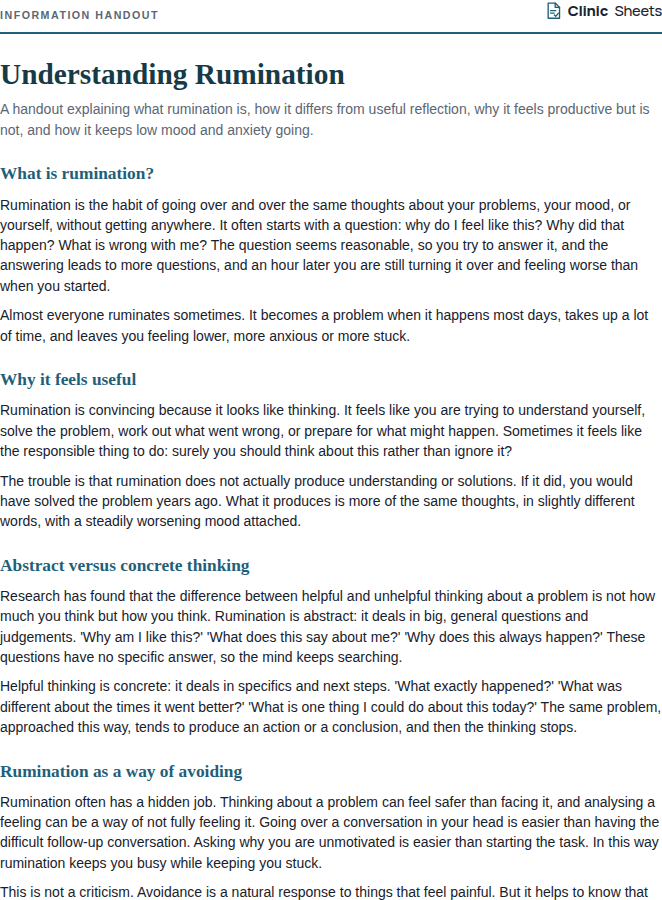
In Wells's metacognitive model, anxiety and depression are maintained not by the content of negative thoughts but by a style of responding to them that he calls the cognitive attentional syndrome: sustained worry or rumination, monitoring for threat, and unhelpful coping such as thought suppression. This style is self-perpetuating because it keeps attention locked on internal events and prevents the person from discovering that thoughts and feelings pass on their own. Metacognitive therapy aims to give the person flexible control over attention and a new relationship with their thoughts.
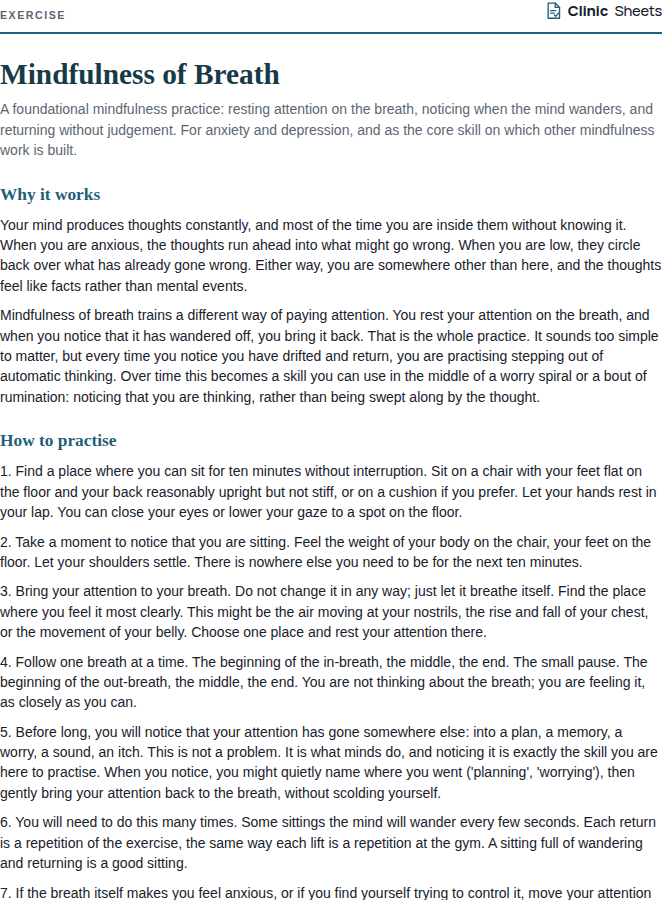
The Attention Training Technique (ATT), developed by Wells, is a roughly twelve-minute auditory exercise in three phases: selective attention to individual sounds, rapid switching between sounds, and divided attention across all sounds at once. It is practised daily, ideally twice, at times when the person is not acutely distressed. It is explicitly not a distraction or relaxation method; its purpose is to strengthen executive control over attention so that worry and rumination can be interrupted at will. Detached mindfulness, described by Wells as a metacognitive mode, is the ability to observe a thought as a passing mental event, without analysing it, suppressing it, or acting on it. Wells outlines several brief techniques for teaching it, including the free association task and the tiger task, some of which are adapted here.
The professional version includes the standard set-up for ATT (selection of at least three sounds in the room plus sounds at a distance, the self-attention rating before and after), the importance of framing ATT as training rather than coping, and guidance on the common misunderstanding of detached mindfulness as emptying the mind or pushing thoughts away.
How to use it
- Introduce the metacognitive model first so the client understands that the target is the process of worry and rumination, not the content of any particular thought. Establish that ATT is training for the mind's attention system, not a way of feeling better in the moment.
- Deliver the first ATT session in the room. Arrange at least three distinct sounds nearby (for example, a ticking clock, a tapping sound, your own voice) and identify sounds further away and outside. Take a self-attention rating on a scale from minus three (entirely externally focused) to plus three (entirely self-focused) before and after.
- Guide the three phases with a steady voice: about five minutes of selective attention, about five minutes of rapid switching, and about two minutes of divided attention. Then repeat the self-attention rating and discuss.
- Ask the client to practise ATT once or twice daily for around twelve minutes, at neutral times. Stress that it should not be used as an escape when anxiety rises. Review practice each session.
- Introduce detached mindfulness in the same or a following session using a brief in-session demonstration, and give the client the short daily practices described here. Check that they are not using it to suppress or to reassure.
- Combine both exercises with the other components of metacognitive therapy, chiefly work on beliefs about the uncontrollability and usefulness of worry or rumination, and worry or rumination postponement.
References
- Wells, A. (1990). Panic disorder in association with relaxation induced anxiety: An attentional training approach to treatment. Behavior Therapy, 21(3), 273-280.
- Wells, A. (2005). Detached mindfulness in cognitive therapy: A metacognitive analysis and ten techniques. Journal of Rational-Emotive and Cognitive-Behavior Therapy, 23(4), 337-355.
- Wells, A. (2009). Metacognitive Therapy for Anxiety and Depression. Guilford Press.