Boundaries: What They Are and How to Set Them
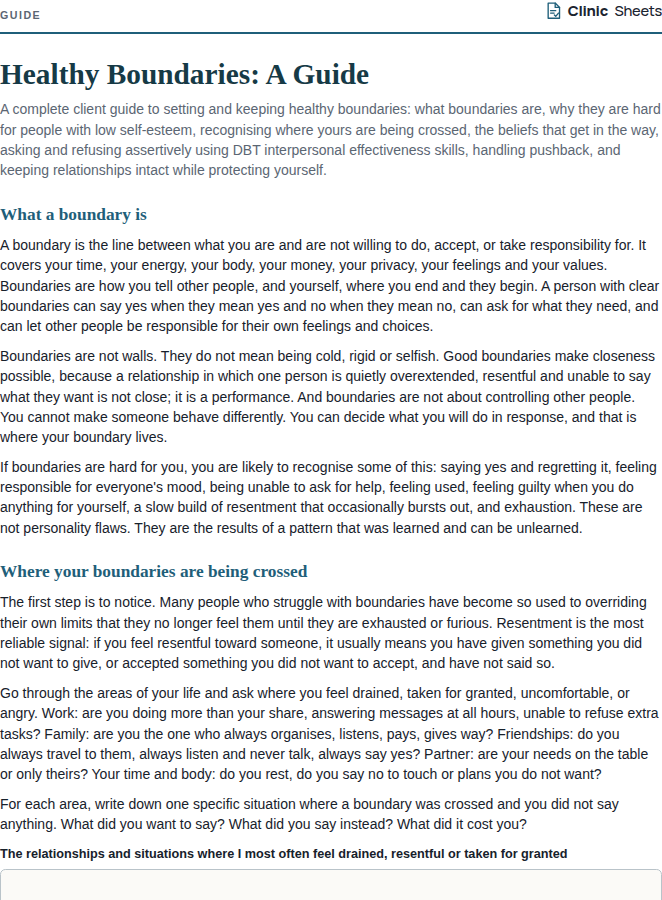
A handout on personal boundaries: what they are, why they are hard for people with low self-esteem or a history of putting others first, the difference between rigid, porous and healthy boundaries, and a practical structure for setting and holding one.
About this resource
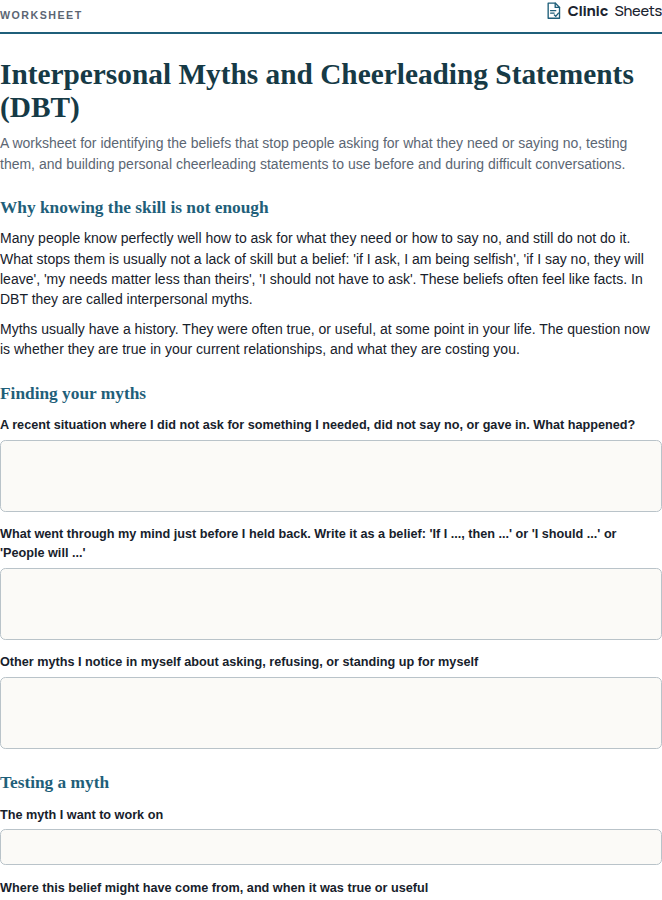
Boundaries are the limits a person sets on what they will accept from others and what they will give, across time, energy, physical space, emotional involvement and values. Difficulty setting boundaries is a common presenting problem in its own right and a frequent feature of low self-esteem, relationship difficulties, burnout and depression. People who struggle typically hold beliefs such as 'my needs are less important', 'saying no is selfish' or 'if I set a limit they will leave', often rooted in early environments where their needs were dismissed or where keeping others happy was the price of safety.
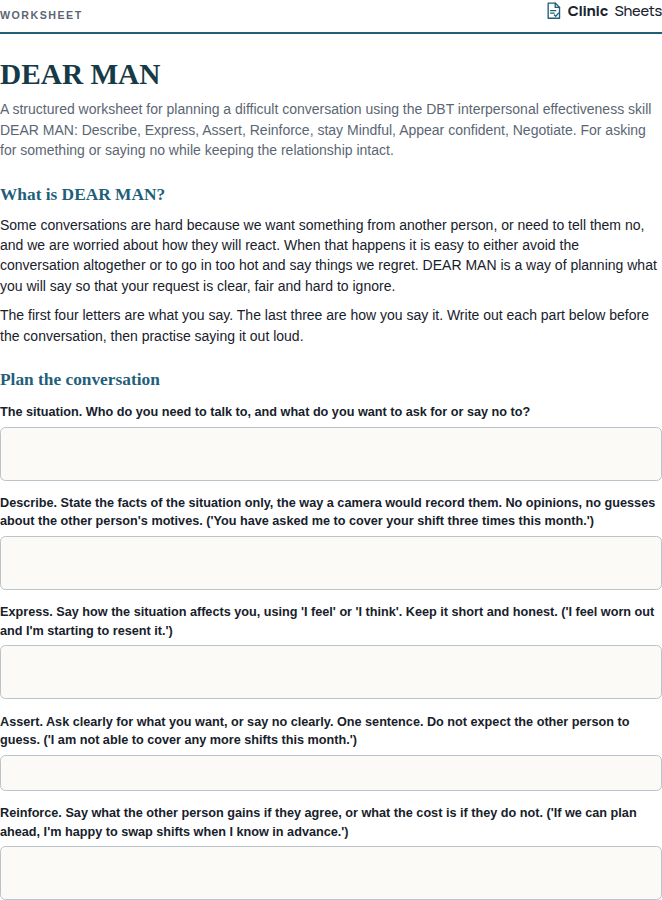
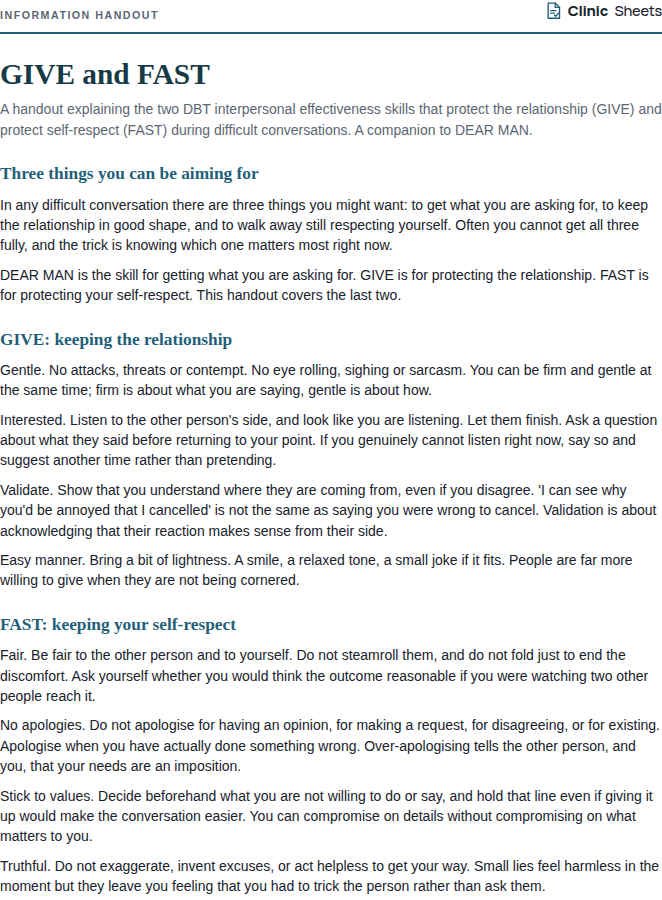
This handout combines a CBT account of the beliefs that block boundary setting with practical skills from DBT interpersonal effectiveness, in particular the DEAR MAN structure for making a request or saying no while maintaining the relationship and self-respect. It distinguishes rigid boundaries (keeping everyone out), porous boundaries (letting everything in) and flexible healthy boundaries, and it normalises the guilt and anxiety that follow a boundary as an expected, temporary reaction rather than a sign of having done wrong. It closes with a structure for planning a specific boundary and anticipating the other person's response.
Suitable for adults in individual therapy, and often useful alongside assertiveness work and schema work on subjugation and self-sacrifice. The professional version adds guidance on identifying the client's boundary beliefs and testing them through behavioural experiments, common pitfalls such as boundaries delivered as ultimatums, and notes on boundaries in relationships where there is coercion or abuse, where safety planning takes priority over assertiveness.
How to use it
- Explore the client's history with boundaries first: what happened in their family when they said no, and what they believe now about their right to set limits. Record the beliefs; they will be tested later.
- Read the handout together and ask the client to identify their pattern, rigid or porous, and in which relationships it shows up most.
- Choose one specific, moderately difficult boundary to plan using the structure at the end. Avoid starting with the most entrenched relationship.
- Rehearse the wording in session. Check for apologising, over-explaining, and softening the limit until it disappears.
- Predict the emotional aftermath. Ask the client to rate expected guilt and anxiety, then to notice what actually happens and how long it lasts. Use this as a behavioural experiment on the belief that setting a limit is dangerous or selfish.
- If the other person's response includes threats, escalation or retaliation, shift to safety and support rather than persistence.
References
- Linehan, M. M. (2015). DBT Skills Training Manual (2nd ed.). Guilford Press.
- Fennell, M. J. V. (2016). Overcoming Low Self-Esteem (2nd ed.). Robinson.
- Alberti, R. E., & Emmons, M. L. (2017). Your Perfect Right: Assertiveness and Equality in Your Life and Relationships (10th ed.). Impact Publishers.
- Young, J. E., Klosko, J. S., & Weishaar, M. E. (2003). Schema Therapy: A Practitioner's Guide. Guilford Press.