Managing Conflict with In-Laws and Extended Family
A worksheet for adults and couples dealing with recurring conflict with in-laws or extended family. Maps the interpersonal cycle, clarifies what each partner wants, and uses DBT interpersonal effectiveness skills to plan a boundary conversation the couple delivers as a team.
About this resource
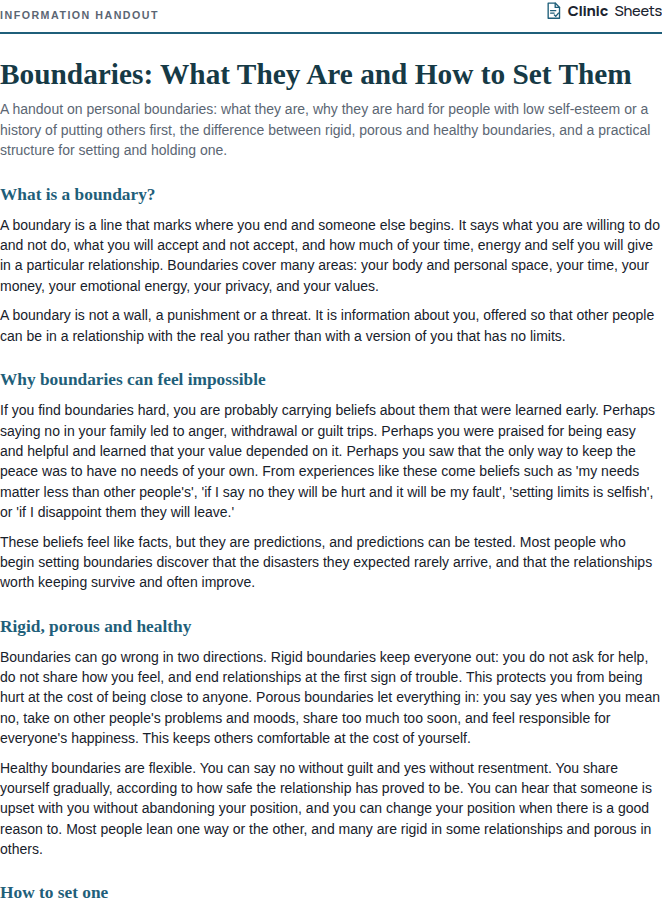
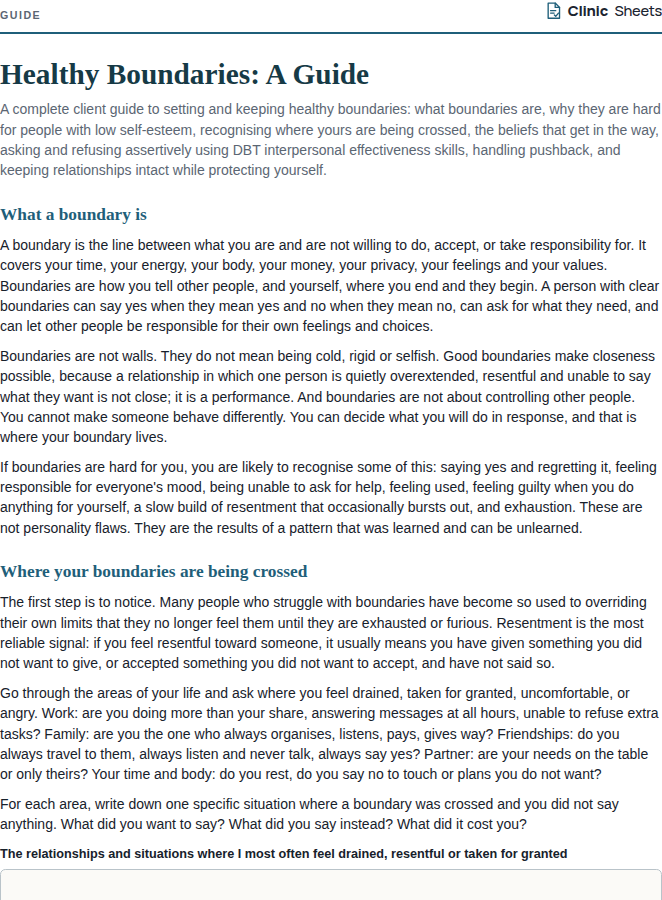
Conflict with in-laws and extended family is one of the most common presenting issues in couple work and a frequent source of individual stress. It is rarely about the stated topic (holidays, childcare, visits, money, advice). More often it is about loyalty, autonomy and belonging: a partner who feels caught between spouse and parents, a spouse who feels unsupported, and relatives who feel excluded or entitled. Family systems thinking describes the triangle that forms when tension between two people is routed through a third, and the way couples get pulled apart when one partner is positioned as the go-between.
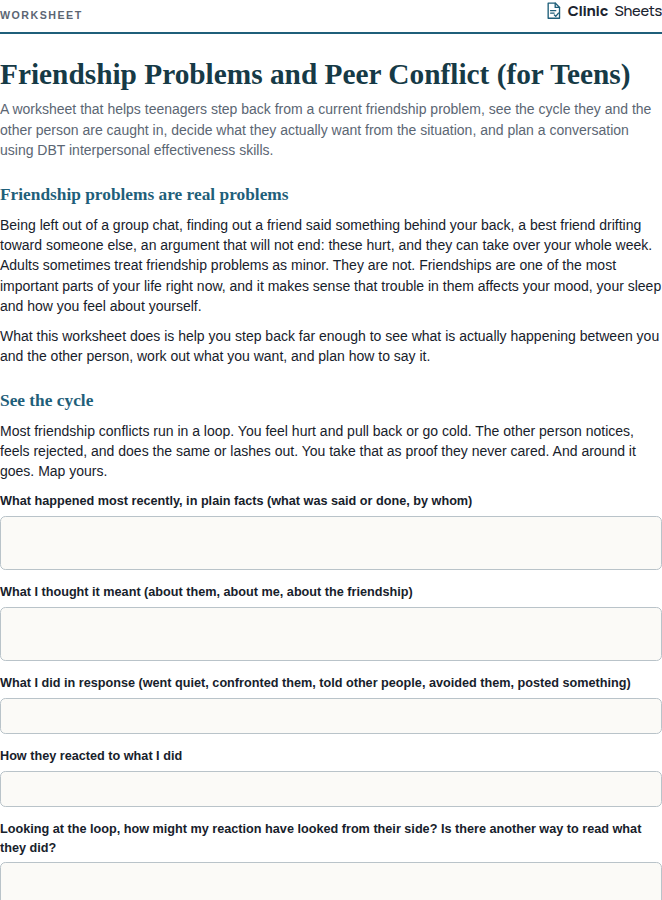
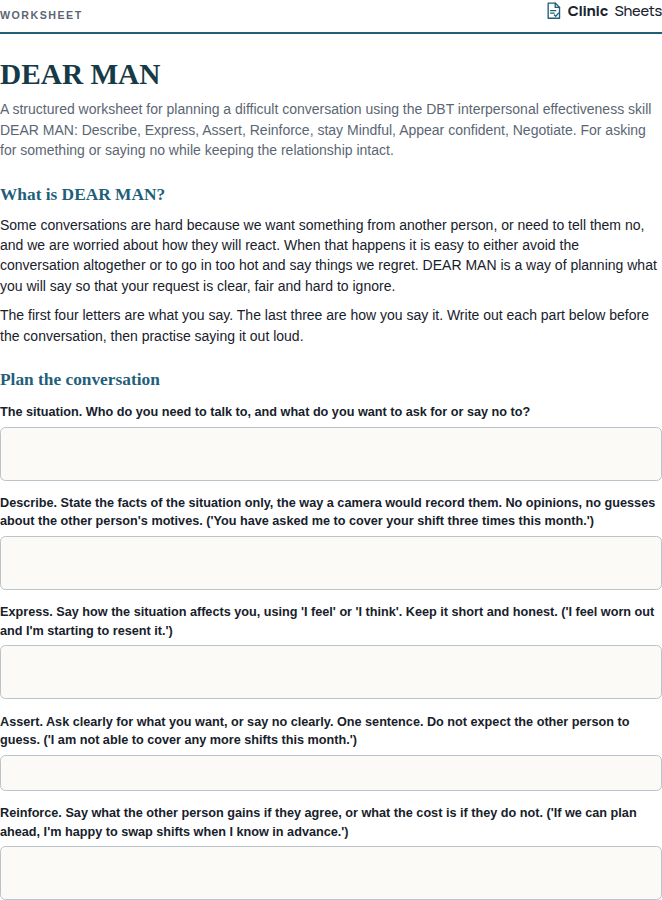
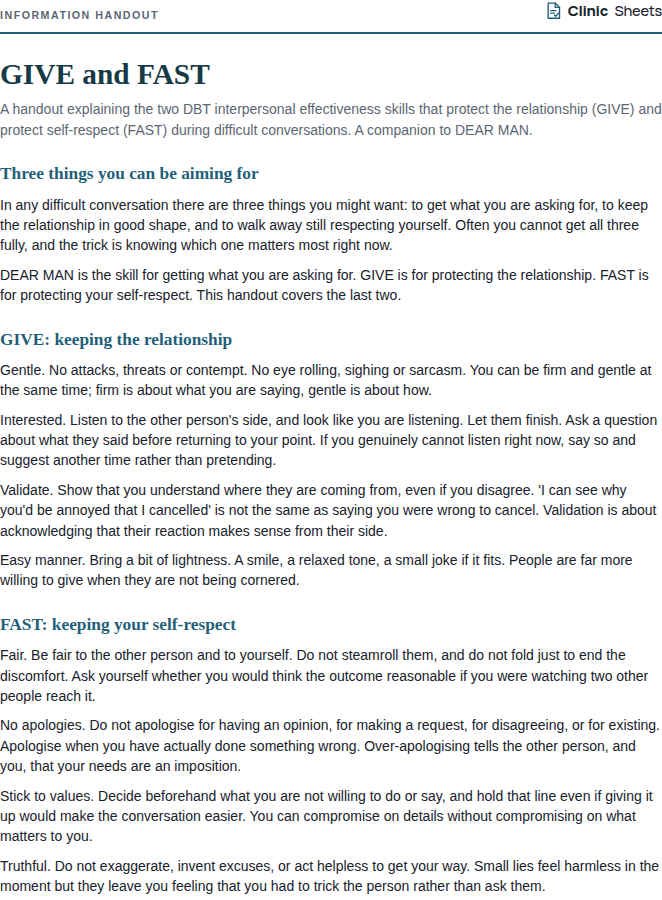
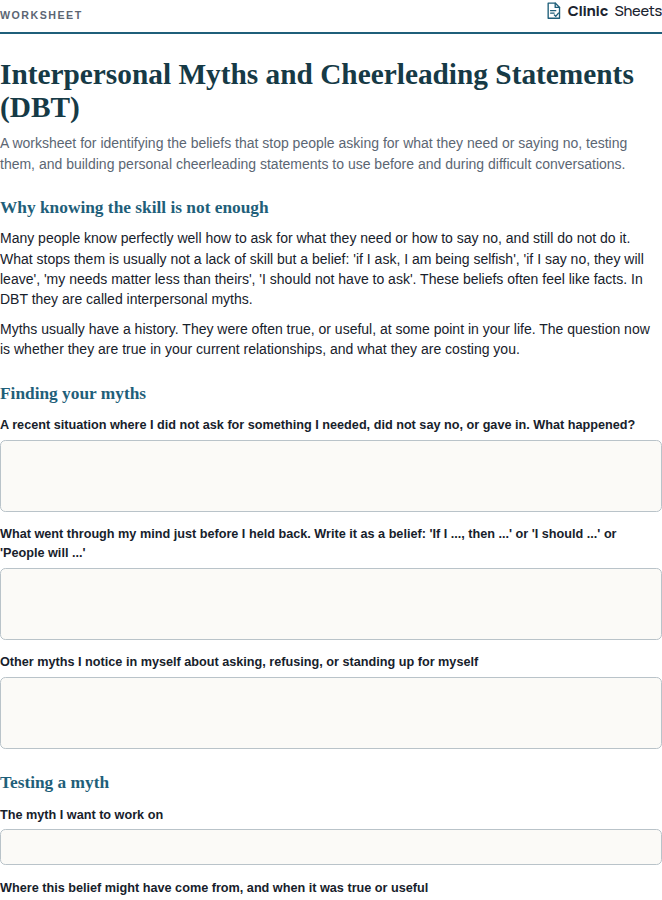
This worksheet approaches the problem in three moves. First, the couple (or the individual, if working alone) maps the cycle: what the relative does, how each partner reacts, and how those reactions feed the next round. Second, each partner clarifies what they actually want, since much in-law conflict is fuelled by partners assuming rather than checking each other's position. Third, using Linehan's interpersonal effectiveness skills (DEAR MAN for asking or refusing, GIVE for keeping the relationship, FAST for keeping self-respect), they script a boundary conversation, decide who will deliver it, and plan how to hold the line when it is tested.
The professional version notes that the couple's unity is the intervention: the partner whose family it is should generally be the one to set the boundary, with the other partner visibly supportive; that cultural expectations about family obligation vary widely and should be explored rather than assumed; and that where a relative's behaviour is abusive or where there are safeguarding concerns about children, the task shifts from negotiation to protection.
How to use it
- Establish the recurring situation and ask each partner separately what they want, before any planning. Differences between the partners are often the real issue and need to be resolved first.
- Map the cycle together using the first section. Include the relative's likely perspective; understanding it does not mean agreeing with it, but it improves the plan.
- Introduce the DEAR MAN, GIVE and FAST skills briefly, then script the conversation in the worksheet. Keep the request small, specific and behavioural.
- Agree who delivers the message. In most cases it is the partner whose family it is, with the other partner backing them rather than leading. Role-play it in session.
- Plan for pushback: guilt, escalation, going around the boundary via other relatives. Rehearse the 'broken record' of calmly repeating the request. Review what happened at the next session.
References
- Linehan, M. M. (2015). DBT Skills Training Manual (2nd ed.). Guilford Press.
- Bowen, M. (1978). Family Therapy in Clinical Practice. Jason Aronson.
- Epstein, N. B., & Baucom, D. H. (2002). Enhanced Cognitive-Behavioral Therapy for Couples: A Contextual Approach. American Psychological Association.