Healthy Boundaries: A Guide
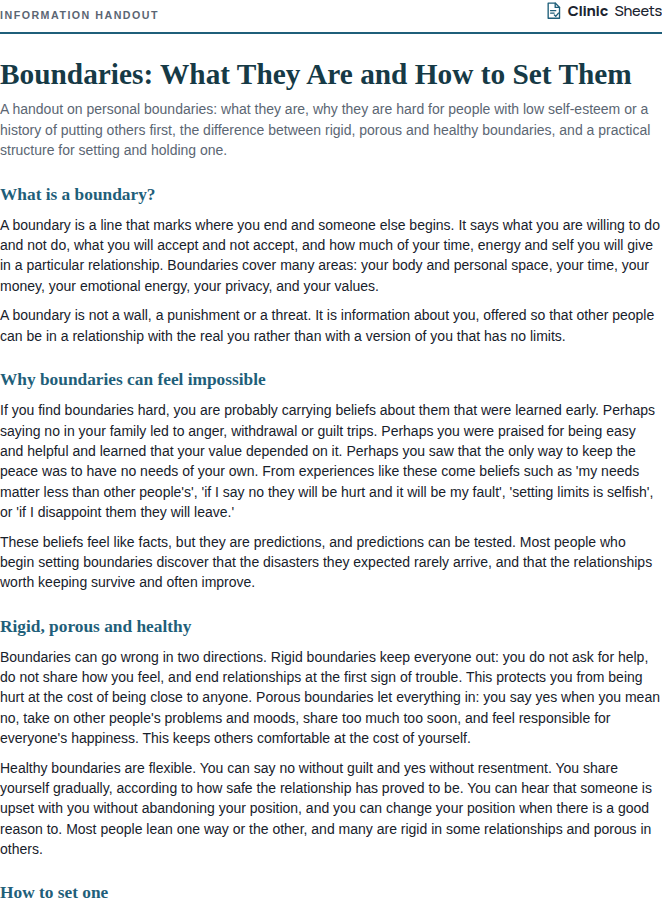
A complete client guide to setting and keeping healthy boundaries: what boundaries are, why they are hard for people with low self-esteem, recognising where yours are being crossed, the beliefs that get in the way, asking and refusing assertively using DBT interpersonal effectiveness skills, handling pushback, and keeping relationships intact while protecting yourself.
About this resource
Difficulty setting boundaries is a common presenting problem and a frequent feature of low self-esteem, relationship difficulties, burnout and chronic resentment. It typically rests on beliefs about one's own worth and the consequences of asserting oneself: that other people's needs matter more, that saying no will lead to rejection or conflict, that being liked depends on being accommodating. These beliefs are maintained by the avoidance of assertive behaviour, so that the feared outcomes are never tested and the resentment and depletion accumulate.
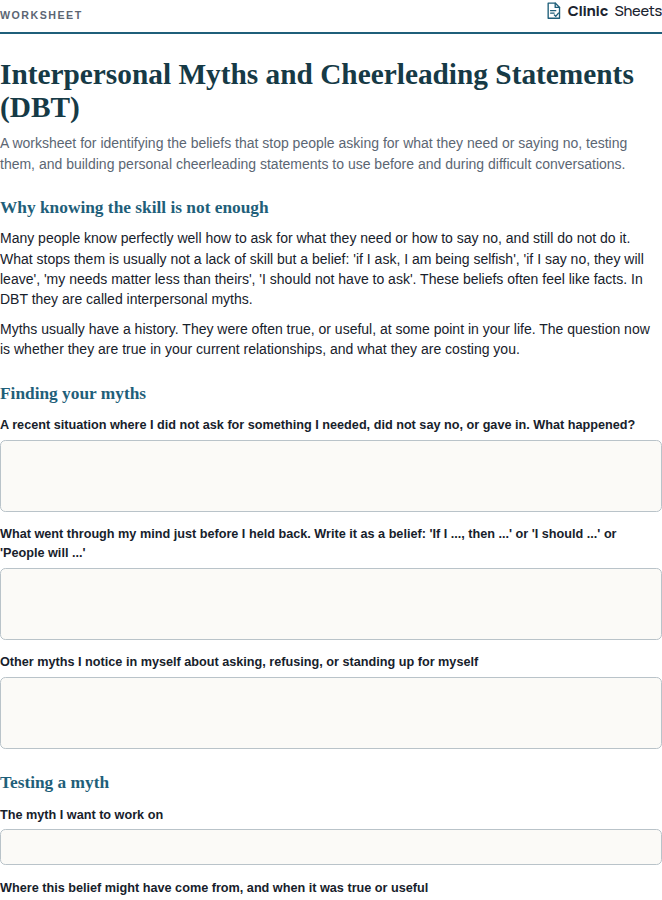
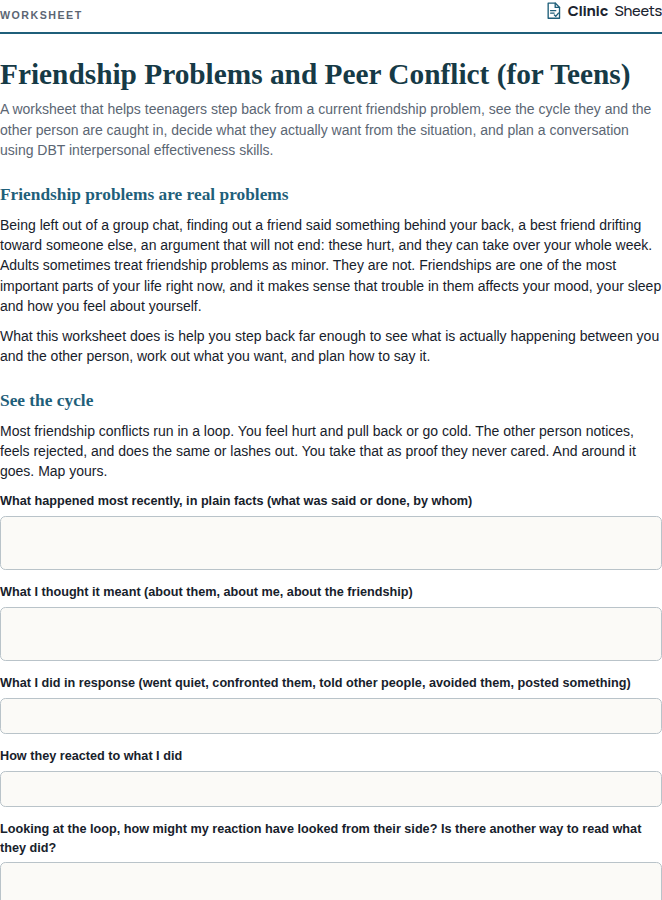
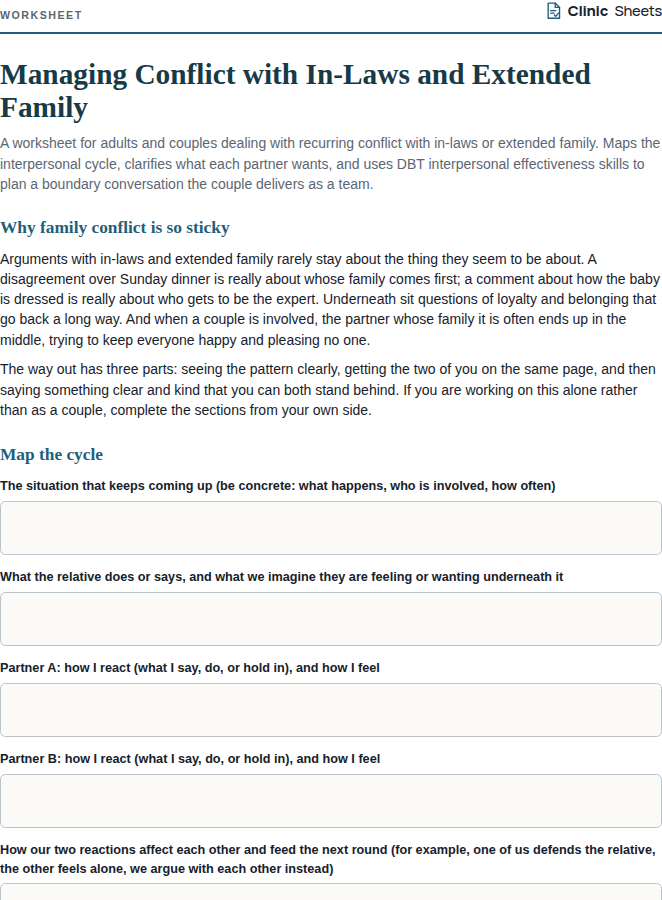
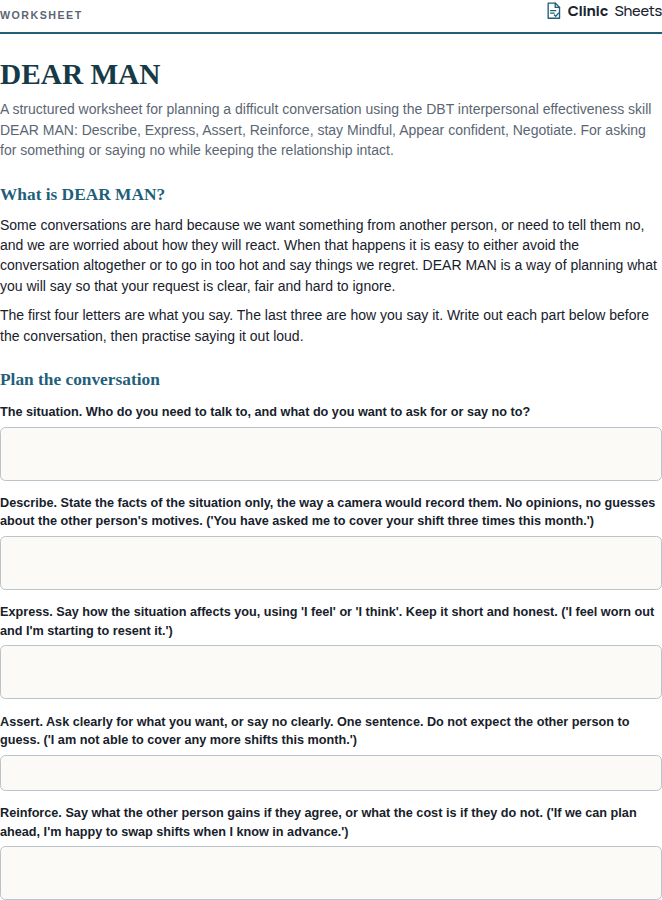
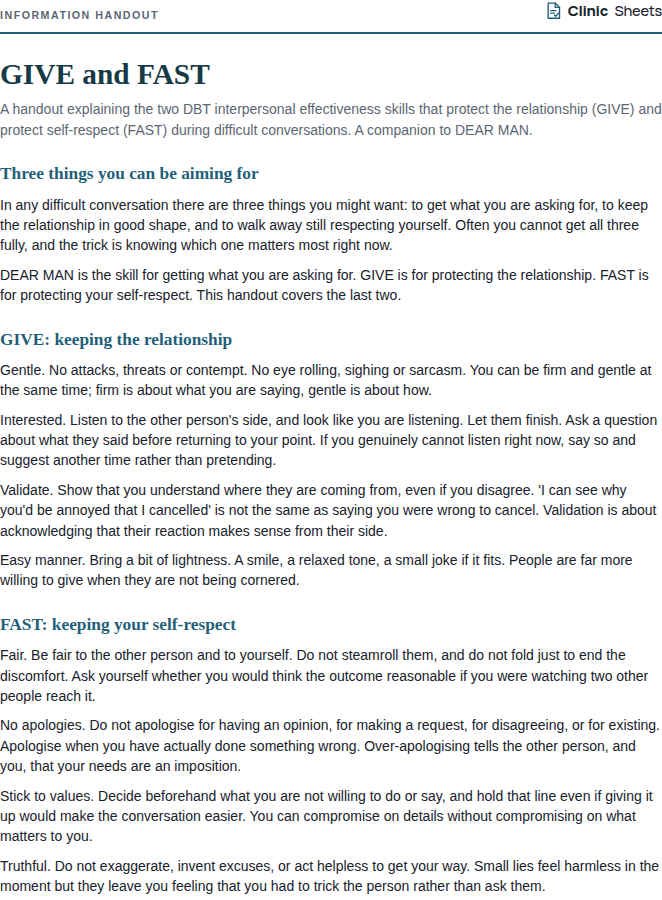
This guide brings together assertiveness training in the tradition of Alberti and Emmons, cognitive work on the beliefs that block assertion following Fennell's approach to low self-esteem, and the interpersonal effectiveness skills from Linehan's dialectical behaviour therapy, which provide a clear structure for asking for what you want, saying no, and keeping both the relationship and your self-respect intact. The sequence is: understanding boundaries, mapping where they are crossed, identifying and testing the beliefs that stop you, learning the difference between passive, aggressive and assertive responses, practising asking and refusing with a structured script, handling the other person's reaction, and sustaining boundaries over time. Each skill includes a practice field.
The professional version adds guidance on boundaries in relationships with a history of control or abuse, where assertion may carry real risk and safety planning must come first, and on cultural and family contexts in which the client's difficulty reflects real constraints rather than distorted beliefs.
How to use it
- Assess the relationships in which boundaries are most difficult and screen for coercive control or abuse; where present, safety takes precedence over assertiveness work.
- Assign the first two sections and the mapping fields, then review the specific situations the client identifies. Use one or two as running examples.
- Work on the beliefs section in session, treating each belief as a prediction to be tested, and design small assertive experiments to test it.
- Teach the structured asking and refusing scripts and rehearse them in role play, with the clinician playing a range of responses, before the client uses them in real situations.
- Prepare the client for pushback and guilt, which are expected, and review each real attempt in the following session for both outcome and self-respect.
- Build the maintenance plan around the early signs of resentment and overextension, which are the usual indicators that a boundary has slipped.
References
- Linehan, M. M. (2015). DBT Skills Training Manual (2nd ed.). Guilford Press.
- Alberti, R. E., & Emmons, M. L. (2017). Your Perfect Right: Assertiveness and Equality in Your Life and Relationships (10th ed.). Impact Publishers.
- Fennell, M. (1999). Overcoming Low Self-Esteem: A Self-Help Guide Using Cognitive Behavioral Techniques. Robinson.