Progressive Muscle Relaxation (Audio Script)
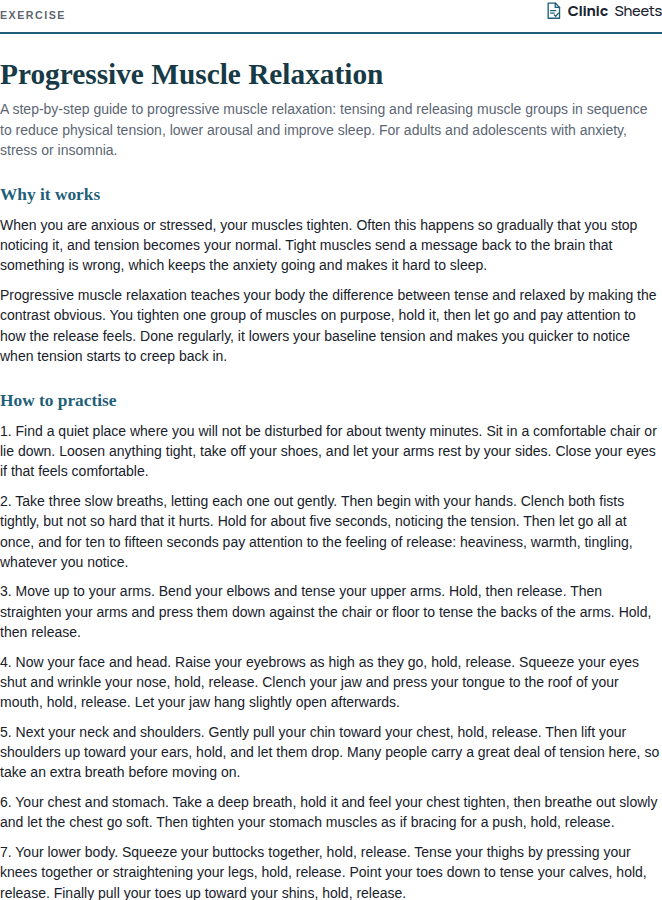
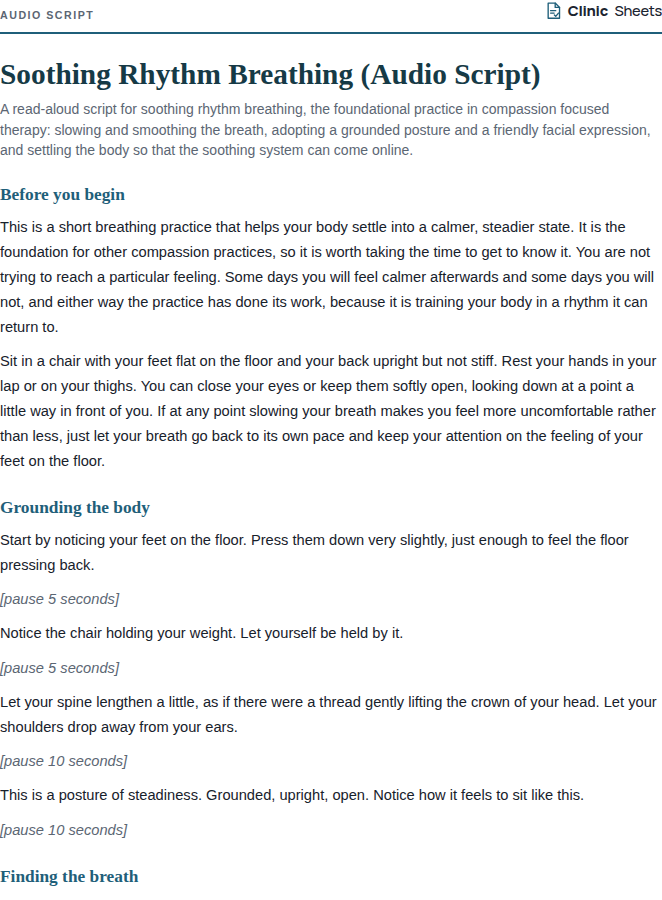
A read-aloud script for a guided progressive muscle relaxation session of around twenty minutes, working through the major muscle groups with tense-and-release cycles, suitable for recording or reading live to adults and adolescents with anxiety, stress or sleep difficulties.
About this resource
Progressive muscle relaxation (PMR) was developed by Edmund Jacobson in the 1920s and 1930s and abbreviated for clinical use by Bernstein and Borkovec. The method teaches the person to recognise the difference between tension and relaxation in specific muscle groups by deliberately tensing each group for a few seconds and then releasing it, attending closely to the sensations that follow. With practice, the person learns to detect rising tension earlier and to release it voluntarily, and the overall level of physiological arousal falls. PMR is a component of many anxiety treatment packages, is used as a stand-alone intervention for stress and tension, and is a common part of sleep programmes, where it is typically practised before bed rather than in bed.
This script follows the abbreviated sixteen-muscle-group sequence, grouped for a session of roughly twenty minutes, moving from the hands and arms through the face, neck and shoulders, torso, and legs. Each group is tensed for about five to seven seconds and released for twenty to thirty seconds, with the script directing attention to the contrast. Pauses are marked in square brackets. The script is written in the present tense and second person for recording.
The professional version adds notes on contraindications and modifications (clients should not tense muscles that are injured, in spasm or painful, and those with certain medical conditions should be advised to tense gently or skip a group), on the tendency for some anxious clients to experience relaxation-induced anxiety, and on how to shorten the sequence to a four-group version once the full version is well learned.
How to use it
- Explain the rationale in session and demonstrate the tense-release cycle on one or two muscle groups so the client knows how much tension to use: firm but not straining, about two-thirds of maximum.
- Check for injuries, pain conditions, or medical issues that would make tensing a group unwise, and tell the client to skip or reduce tension in those areas.
- Record the script or read it live in session at a slow, even pace, then give the client the recording for daily practice, ideally once or twice a day in a quiet place.
- Ask the client to rate tension before and after each practice on a 0 to 10 scale and to note where tension is held most. Review the ratings in session.
- Once the full sequence is well learned, usually after two to three weeks of practice, teach the shortened version and then release-only relaxation, so the skill can be used quickly in daily life.
References
- Jacobson, E. (1938). Progressive Relaxation (2nd ed.). University of Chicago Press.
- Bernstein, D. A., & Borkovec, T. D. (1973). Progressive Relaxation Training: A Manual for the Helping Professions. Research Press.
- Bernstein, D. A., Borkovec, T. D., & Hazlett-Stevens, H. (2000). New Directions in Progressive Relaxation Training: A Guidebook for Helping Professionals. Praeger.