Progressive Muscle Relaxation
A step-by-step guide to progressive muscle relaxation: tensing and releasing muscle groups in sequence to reduce physical tension, lower arousal and improve sleep. For adults and adolescents with anxiety, stress or insomnia.
About this resource
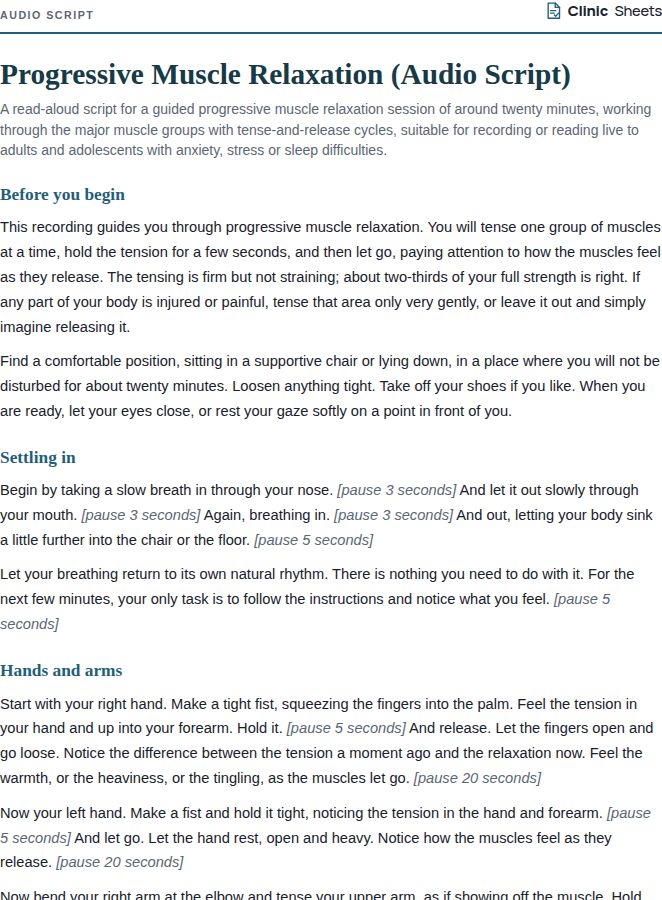
Progressive muscle relaxation (PMR) was developed by Edmund Jacobson in the 1920s and 1930s and later abbreviated by Bernstein and Borkovec into the form used in most clinical settings today. The method is simple: the person deliberately tenses a muscle group for a few seconds, then releases it and attends to the contrast between tension and relaxation. Working through the body in sequence trains two things at once, a lower resting level of muscle tension and a sharper ability to notice tension when it begins to build, so that it can be released before it escalates.
PMR has a substantial evidence base as a component of treatment for generalised anxiety, tension headache, insomnia and stress-related complaints, and it is one of the relaxation methods included in applied relaxation. It suits clients who find purely mental techniques difficult, because it gives the mind a concrete physical task. It is not a treatment for panic disorder on its own and can be counter-productive if used as a safety behaviour during exposure; the professional version discusses this distinction.
The professional version includes a full muscle-group script for reading aloud in session, notes on adapting the sequence for clients with pain or injury, guidance on shortening the practice over time toward a cue-controlled version, and suggestions for pairing PMR with sleep hygiene work in insomnia.
How to use it
- Explain the rationale: chronic tension keeps the body in a state of alert, and learning to release it lowers overall arousal. Ask the client where they hold tension.
- Lead the full sequence in session the first time, at a slow pace, so the client learns the rhythm of tense, hold, release, notice.
- Ask the client to practise once a day for two weeks, ideally at the same time, and to keep the log. Twenty minutes is ideal; ten is acceptable.
- Check for any muscle groups that cause pain or discomfort and omit or modify them. Clients with injuries should tense gently or simply focus on releasing.
- Once the full sequence is familiar, teach the shortened version (four larger groups) and then release-only practice, so that the skill can be used in daily situations.
- If the client is using PMR to avoid feared sensations during exposure or panic work, discuss this and agree when it is and is not appropriate to use.
References
- Jacobson, E. (1938). Progressive Relaxation (2nd ed.). University of Chicago Press.
- Bernstein, D. A., Borkovec, T. D., & Hazlett-Stevens, H. (2000). New Directions in Progressive Relaxation Training: A Guidebook for Helping Professionals. Praeger.
- Manzoni, G. M., Pagnini, F., Castelnuovo, G., & Molinari, E. (2008). Relaxation training for anxiety: A ten-years systematic review with meta-analysis. BMC Psychiatry, 8, 41.
- Öst, L.-G. (1987). Applied relaxation: Description of a coping technique and review of controlled studies. Behaviour Research and Therapy, 25(5), 397-409.