Soothing Rhythm Breathing (Audio Script)
A read-aloud script for soothing rhythm breathing, the foundational practice in compassion focused therapy: slowing and smoothing the breath, adopting a grounded posture and a friendly facial expression, and settling the body so that the soothing system can come online.
About this resource
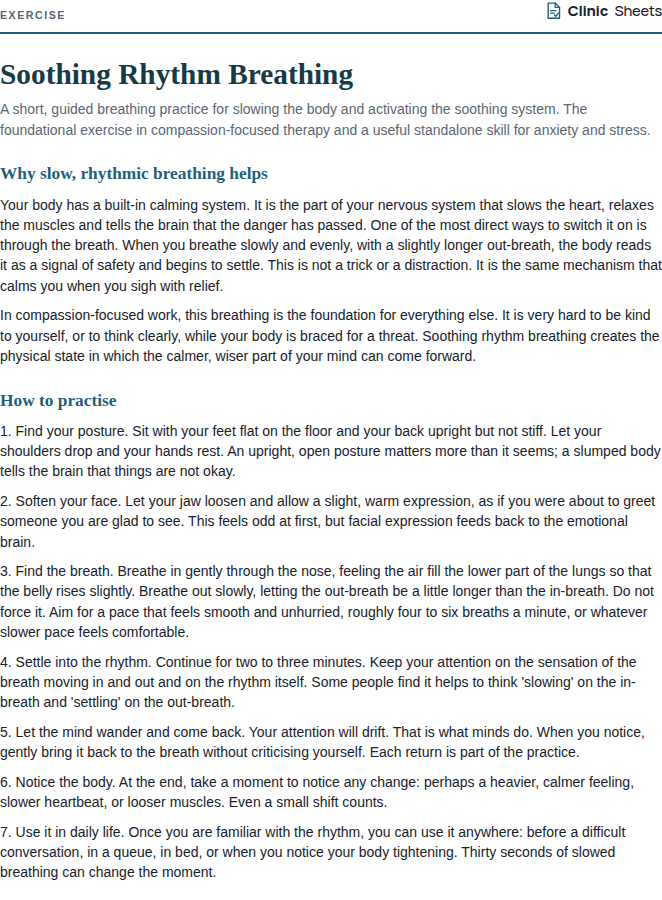
Soothing rhythm breathing is the first practice taught in compassion focused therapy (CFT), developed by Paul Gilbert. CFT describes three broad emotion-regulation systems: a threat system, a drive system, and a soothing or affiliative system associated with contentment, safeness and connection. Many clients with high shame and self-criticism have a well-developed threat system and very little access to soothing. Slowing the breath, steadying the body and softening the face are simple ways to stimulate the parasympathetic nervous system and give the client a felt sense of what the soothing system is like, before the more demanding imagery and compassionate-self practices are introduced.
The script follows Gilbert's standard sequence: grounded posture, attention to the breath, slowing the breath to a rhythm the body finds comfortable (typically around five or six breaths a minute, but the client's own comfortable pace matters more than a number), a friendly facial expression and a half smile, and a period of simply resting in the rhythm. It deliberately frames the practice as a way of preparing the mind for compassion, not as a relaxation technique to be evaluated by how relaxed the client feels afterwards.
The professional version adds notes on clients who find slowing the breath aversive (for example, panic-prone or trauma-affected clients who become more anxious when they attend to the body), on keeping the practice short at first, and on using the same rhythm as the anchor for later CFT imagery exercises.
How to use it
- Introduce the three-systems model first so the client understands why they are learning to breathe this way. The practice makes much more sense once the client can see that their soothing system is underused.
- Read at a slow pace and breathe with the script yourself; the client will tend to follow your rhythm. Aim for about eight to ten minutes.
- Do not prescribe an exact breathing rate. Invite the client to find the slower rhythm their body settles into. Some clients will do four breaths a minute, others eight, and both are fine.
- If a client becomes more anxious when attending to the breath, shorten the practice, keep the eyes open, and emphasise the posture and facial expression elements over the breath. Some clients do better focusing on the out-breath only.
- Ask for daily practice of a few minutes, and use the same rhythm as the starting point for safe place imagery and compassionate self work in later sessions.
References
- Gilbert, P. (2009). The Compassionate Mind: A New Approach to Life's Challenges. Constable.
- Gilbert, P. (2010). Compassion Focused Therapy: Distinctive Features. Routledge.
- Kirby, J. N., Tellegen, C. L., & Steindl, S. R. (2017). A meta-analysis of compassion-based interventions: Current state of knowledge and future directions. Behavior Therapy, 48(6), 778-792.