Burnout Recovery Plan
A structured worksheet for planning recovery from burnout: taking stock of energy and demands, clarifying what matters, setting boundaries at work, rebuilding restorative habits, and committing to specific, reviewable goals. Draws on CBT and ACT.
About this resource
Recovery from burnout rarely comes from a single change. It usually requires reducing the demands that are within the person's control, negotiating the ones that are not, rebuilding the recovery activities that have been squeezed out, and revising the internal rules that made the overload possible. This worksheet organises that work into a sequence. It begins with an honest audit of where energy goes and what drains it, moves to values clarification so that changes are anchored in what the person actually cares about rather than in what they feel they should do, and ends with concrete, time-limited goals.
The values component is drawn from acceptance and commitment therapy. Burned-out clients have often lost touch with why they chose their work in the first place; reconnecting with those reasons, and noticing where the current pattern has drifted away from them, provides motivation for change that guilt and exhaustion cannot. The goal-setting component uses standard behavioural principles: small, specific, scheduled and reviewed. Boundaries are treated as behavioural experiments, since many clients predict catastrophe if they say no and need to test that prediction.
The professional version includes prompts for discussing changes with a manager or occupational health, guidance on when to recommend time off work versus a graded reduction, and notes on the common relapse pattern in which a client recovers, feels guilty about the reduced output, and quietly reinstates the old workload.
How to use it
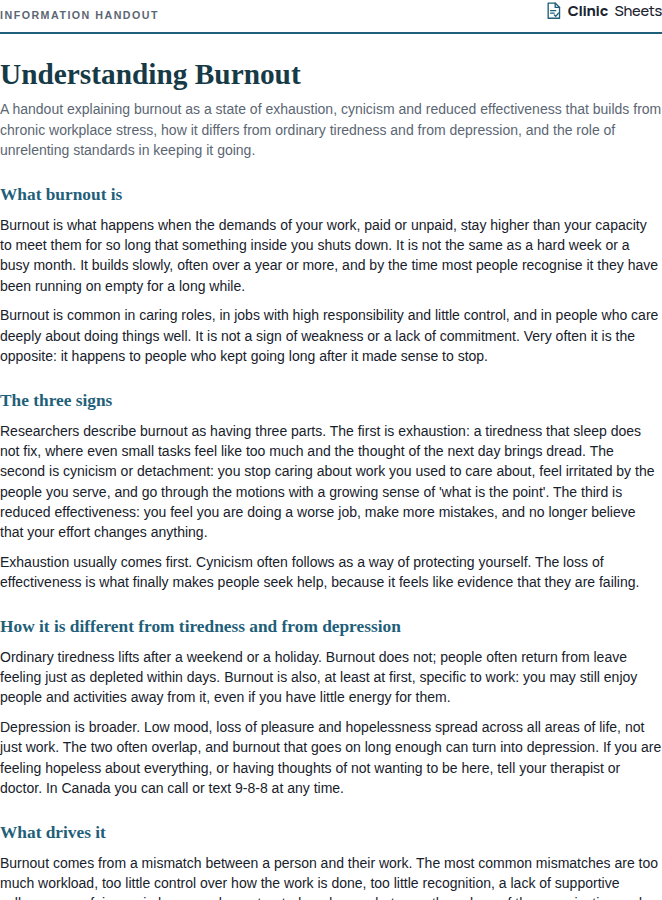
- Use after the client understands burnout and its drivers (see Understanding Burnout). The plan works best when the client is no longer in acute crisis and has some capacity to think about change.
- Complete the energy audit together. Ask the client to be specific about hours and tasks rather than general impressions.
- Spend time on the values section. Ask what drew the client to this work, what they would want a colleague to say about them, and where the current pattern has drifted from that.
- Frame each boundary as an experiment with a prediction, and review the outcome at the next session.
- Set no more than three goals for the first two weeks. Success with small goals rebuilds the sense of effectiveness that burnout has eroded.
- Schedule a review date and revisit the plan. Adjust rather than abandon it if goals were not met; ask what got in the way.
References
- Maslach, C., & Leiter, M. P. (2016). Understanding the burnout experience: Recent research and its implications for psychiatry. World Psychiatry, 15(2), 103-111.
- Hayes, S. C., Strosahl, K. D., & Wilson, K. G. (2012). Acceptance and Commitment Therapy: The Process and Practice of Mindful Change (2nd ed.). Guilford Press.
- Sonnentag, S., & Fritz, C. (2007). The Recovery Experience Questionnaire: Development and validation of a measure for assessing recuperation and unwinding from work. Journal of Occupational Health Psychology, 12(3), 204-221.
- Ahola, K., Toppinen-Tanner, S., & Seppänen, J. (2017). Interventions to alleviate burnout symptoms and to support return to work among employees with burnout: Systematic review and meta-analysis. Burnout Research, 4, 1-11.