Origins of My Schemas
A schema therapy worksheet that helps a client trace a persistent, painful life pattern back to the early experiences and unmet emotional needs that shaped it, so the pattern can be understood with compassion rather than treated as a character flaw.
About this resource
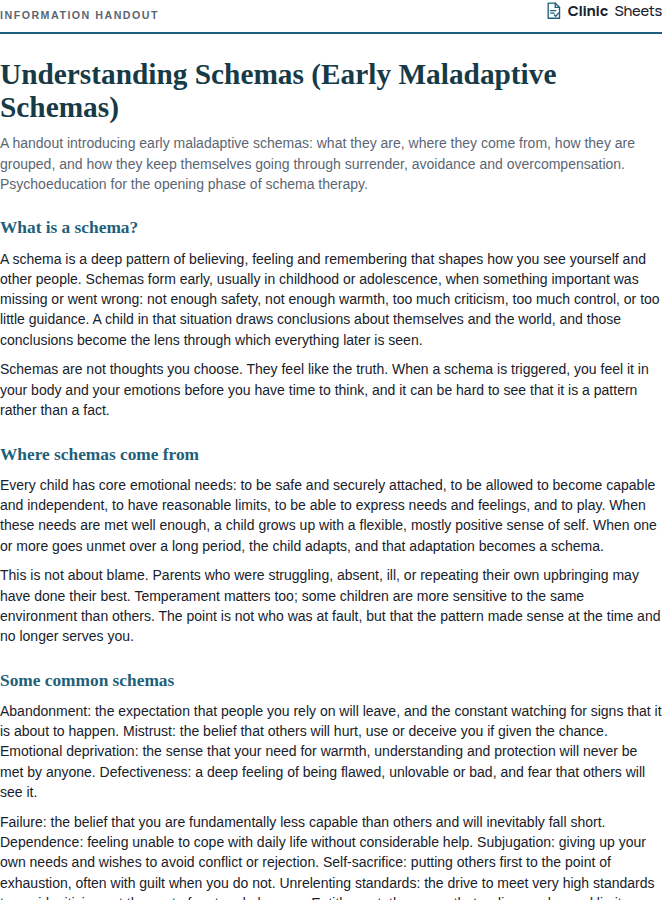
In Young's schema therapy, early maladaptive schemas are broad, enduring themes about oneself and one's relationships that develop in childhood or adolescence and are repeated throughout life. Young, Klosko and Weishaar describe them as arising when core emotional needs are not adequately met: the need for secure attachment to others, for autonomy and a sense of competence, for freedom to express needs and emotions, for spontaneity and play, and for realistic limits and self-control. Temperament shapes how strongly a given environment leaves its mark, and the same experiences can produce different schemas in different children.
This worksheet supports the assessment and education phase of schema therapy. The client identifies one schema or life pattern, describes the childhood and adolescent experiences that seem to have shaped it, names the need that was not met, and notices how the pattern shows up now. The aim is not to assign blame to parents or caregivers but to make sense of the pattern, which reduces shame and creates the emotional distance needed for later change work such as imagery rescripting, chair work and behavioural pattern-breaking.
The professional version includes guidance on pacing this work, on what to do when the client cannot recall much of childhood, and on managing the sadness or anger that often surfaces when a client sees for the first time how an unmet need has echoed through their adult life.
How to use it
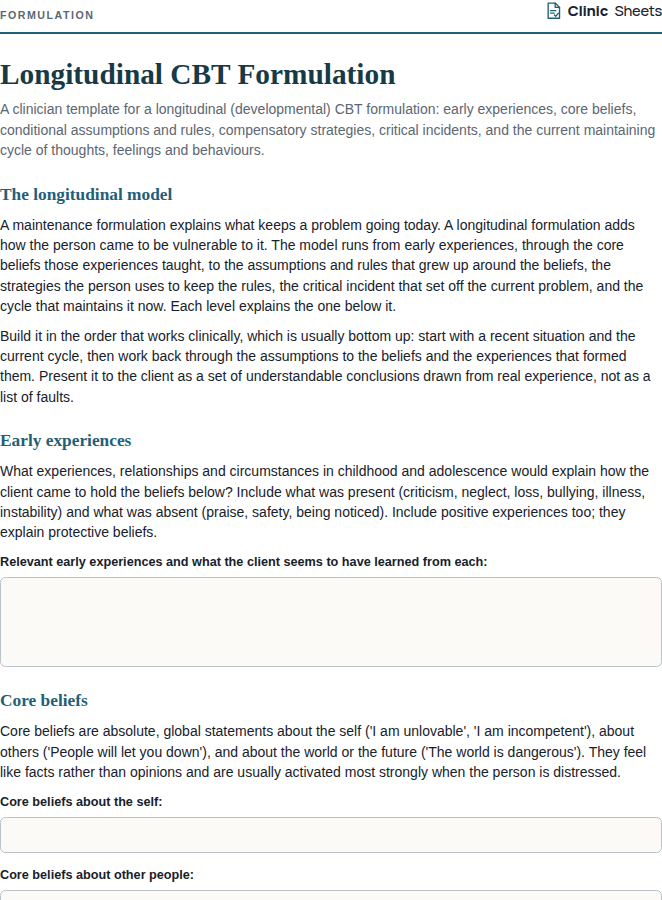
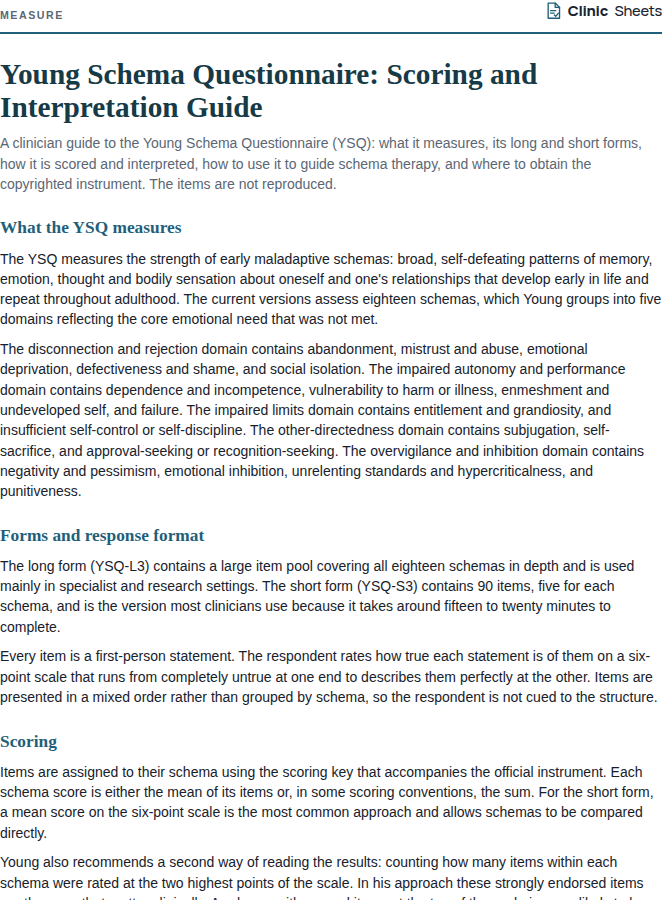
- Use this worksheet after the client has been introduced to the idea of schemas and, ideally, after a schema inventory such as the Young Schema Questionnaire has highlighted one or two prominent schemas. Choose one schema to work on at a time.
- Complete the first pass together in session. Clients often move quickly from a memory to self-criticism; slow this down and keep returning to the question of what the child in the memory needed.
- If the client recalls little of childhood, work from what they do know: the family atmosphere, how emotions were handled, what was praised or punished, how they were treated by peers. A schema can be traced through general patterns as well as specific events.
- Watch for strong emotion. Sadness and anger toward caregivers are common and appropriate. Validate the feeling, keep the focus on the child's unmet need, and do not push toward forgiveness or resolution in this session.
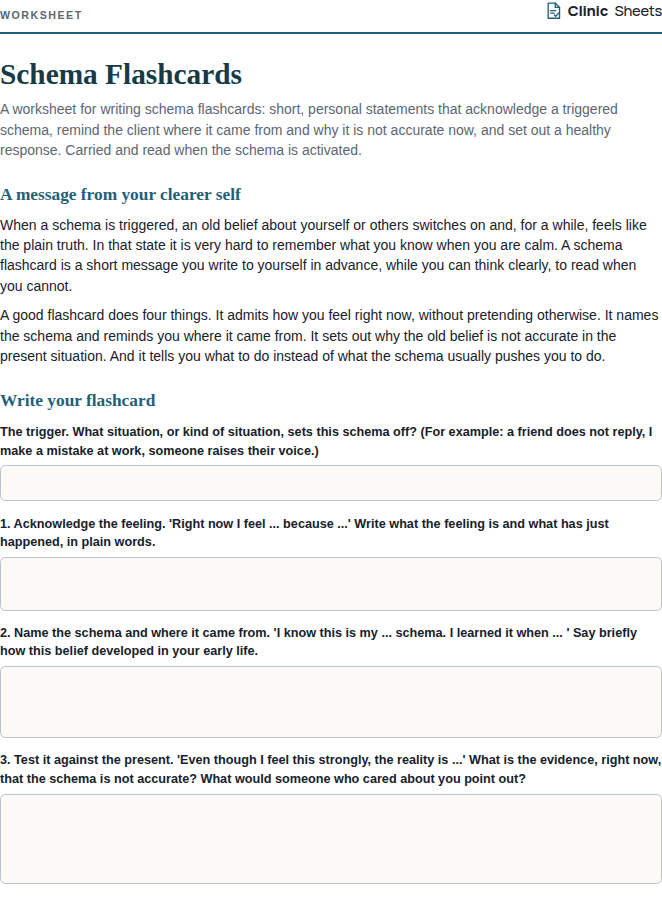
- Link the origins to the present. The final fields ask how the schema shows up now and what the client does in response (surrender, avoidance or overcompensation). This becomes the map for later change work.
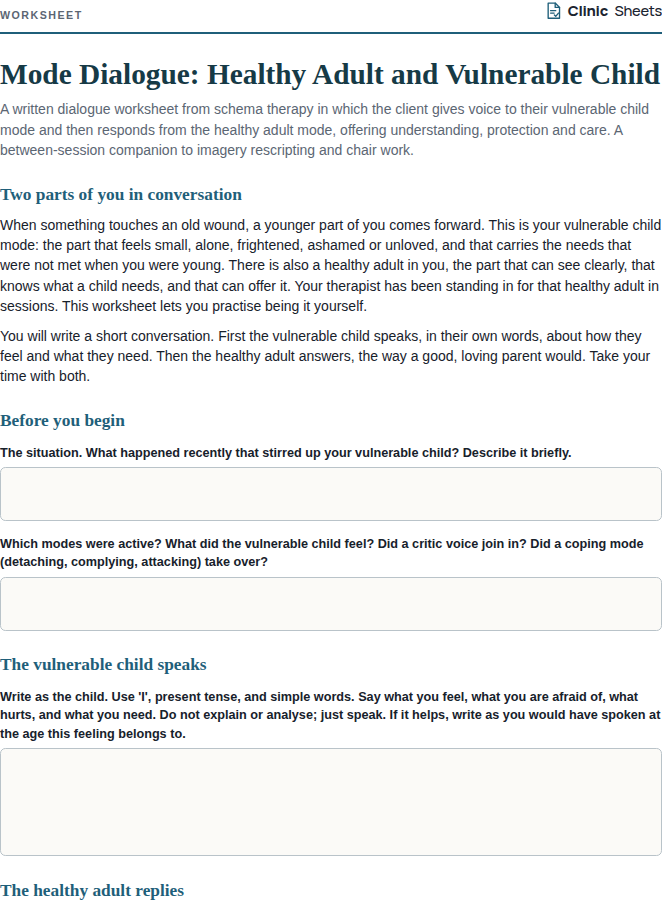
- Return to the completed worksheet during imagery or chair work, and revisit it near the end of therapy so the client can see how their relationship with the pattern has changed.
References
- Young, J. E., Klosko, J. S., & Weishaar, M. E. (2003). Schema Therapy: A Practitioner's Guide. Guilford Press.
- Young, J. E., & Klosko, J. S. (1994). Reinventing Your Life. Plume.
- Arntz, A., & Jacob, G. (2013). Schema Therapy in Practice: An Introductory Guide to the Schema Mode Approach. Wiley-Blackwell.