Managing a Difficult Boss or Colleague
A worksheet for working through a difficult relationship with a manager or co-worker: mapping the interaction pattern, separating what can be changed from what cannot, and planning one assertive conversation using DBT interpersonal effectiveness skills.
About this resource
A difficult boss or colleague is one of the most common sources of work stress, and one of the hardest to address because the client cannot simply leave the relationship. Clients often arrive with a long list of grievances and a sense of powerlessness. The CBT contribution is to map the interaction as a cycle in which both people's behaviour maintains the other's, without implying that the client is to blame for someone else's conduct, and to identify the client's own interpretations and responses as the part that is within reach. The DBT contribution is a concrete method for asking for change or setting a limit while preserving the relationship and the client's self-respect.
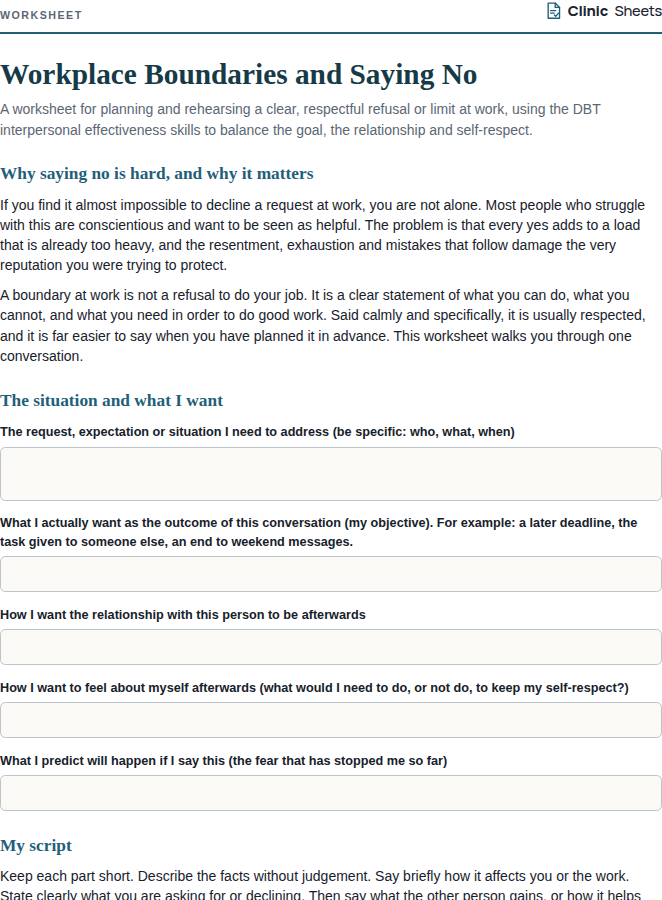
This worksheet takes the client through a specific recent incident, the thoughts and feelings it produced, how they responded and what happened next. It then asks them to separate what is within their control from what is not, and to plan one conversation using the DEAR MAN structure from Linehan's interpersonal effectiveness module (Describe, Express, Assert, Reinforce, stay Mindful, Appear confident, Negotiate). It ends with a plan for the case where the conversation does not work.
The professional version notes the distinction between an ordinary difficult relationship and workplace bullying or harassment, which needs documentation and formal channels rather than only interpersonal skills, and flags that clients with longstanding assertiveness difficulties or a history of being mistreated may need core belief work alongside the practical planning.
How to use it
- Start with one specific, recent incident rather than the whole history. Specific incidents can be analysed; 'she is always like this' cannot.
- When mapping the cycle, be clear that understanding your own part is about finding leverage, not about accepting blame for the other person's behaviour.
- Teach DEAR MAN explicitly and role-play the planned conversation in session, with you playing the difficult person. Rehearse the most likely pushback.
- Help the client choose realistic goals for the conversation. Getting a colleague to stop interrupting in meetings is achievable; getting them to like you may not be.
- Screen for bullying, harassment or discrimination. If present, discuss documentation, HR or union routes, and the client's rights, alongside the interpersonal work.
References
- Linehan, M. M. (2015). DBT Skills Training Manual (2nd ed.). Guilford Press.
- Beck, J. S. (2020). Cognitive Behavior Therapy: Basics and Beyond (3rd ed.). Guilford Press.
- Alberti, R., & Emmons, M. (2017). Your Perfect Right: Assertiveness and Equality in Your Life and Relationships (10th ed.). New Harbinger.