Young Schema Questionnaire: Scoring and Interpretation Guide
A clinician guide to the Young Schema Questionnaire (YSQ): what it measures, its long and short forms, how it is scored and interpreted, how to use it to guide schema therapy, and where to obtain the copyrighted instrument. The items are not reproduced.
About this resource
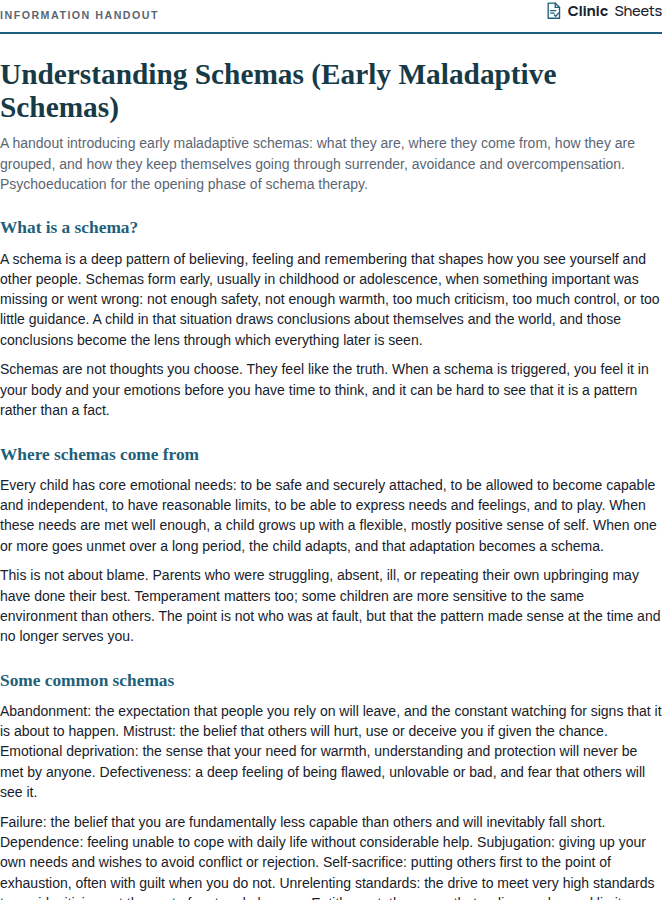
The Young Schema Questionnaire is the standard self-report inventory of early maladaptive schemas developed by Jeffrey Young to support schema therapy. It exists in a long form and a short form; the current versions are the YSQ-L3 and the YSQ-S3, both organised around the eighteen schemas described in Young, Klosko and Weishaar's practitioner text. Each item is a first-person statement that the respondent rates for how well it describes them, and items belonging to the same schema are averaged or summed to give a schema score.
The YSQ is copyrighted by Jeffrey Young and the Schema Therapy Institute, so this resource does not list any items. It explains the structure, scoring conventions, published psychometric findings that the authors of this guide are confident of, and how the questionnaire fits into the assessment phase of schema therapy, where it is best used as a conversation starter rather than a diagnostic instrument. It closes with the limitations and with directions for obtaining the official version.
The professional version adds guidance on reviewing results collaboratively, on the difference between a high score and a clinically active schema, and on combining the YSQ with the client's history and in-session observation to reach a working schema formulation.
How to use it
- Give the questionnaire after the first one or two sessions, once the client understands what a schema is and why you are asking. Explain that there are no right answers and that high scores are common in people seeking therapy.
- Score each schema and identify the three to five that are most elevated. Pay particular attention to items rated at the top of the scale, which Young treats as more clinically meaningful than a moderate average.
- Review the results with the client, schema by schema. Ask for examples from their life that fit each elevated schema and notice which ones produce the strongest emotional reaction in the room; these are the schemas most likely to be active.
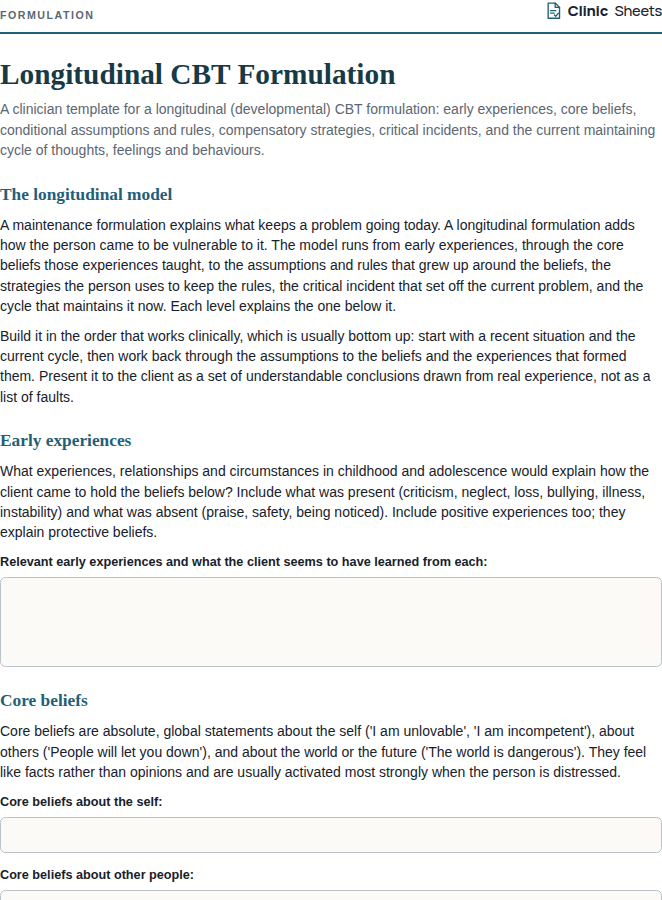
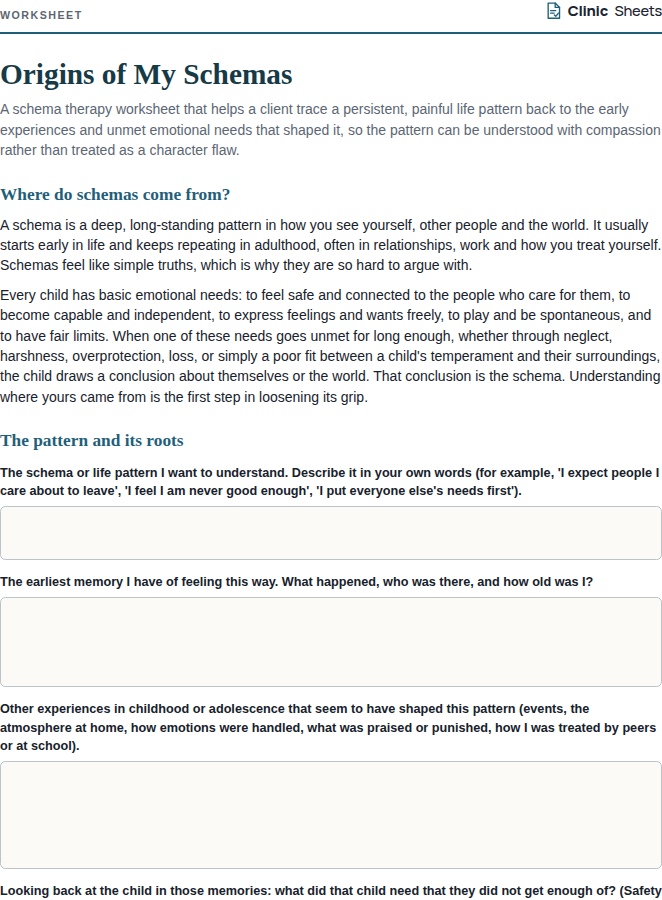
- Combine the questionnaire with a developmental history, the Origins of My Schemas worksheet, and observation of the client's coping style in session before settling on a formulation. Do not let the questionnaire alone decide the treatment focus.
- Re-administer at the end of therapy or at long follow-up intervals. Schema scores change slowly, so session-by-session use is not appropriate; use symptom measures for that purpose.
References
- Young, J. E., Klosko, J. S., & Weishaar, M. E. (2003). Schema Therapy: A Practitioner's Guide. Guilford Press.
- Schmidt, N. B., Joiner, T. E., Young, J. E., & Telch, M. J. (1995). The Schema Questionnaire: Investigation of psychometric properties and the hierarchical structure of a measure of maladaptive schemas. Cognitive Therapy and Research, 19(3), 295-321.
- Arntz, A., & Jacob, G. (2013). Schema Therapy in Practice: An Introductory Guide to the Schema Mode Approach. Wiley-Blackwell.