Problem Solving Steps for Kids
A five-step problem-solving worksheet for children: say the problem, think of lots of ideas, think about what would happen with each, pick one and try it, then check how it went. For frustration, anger and everyday stuck moments.
About this resource
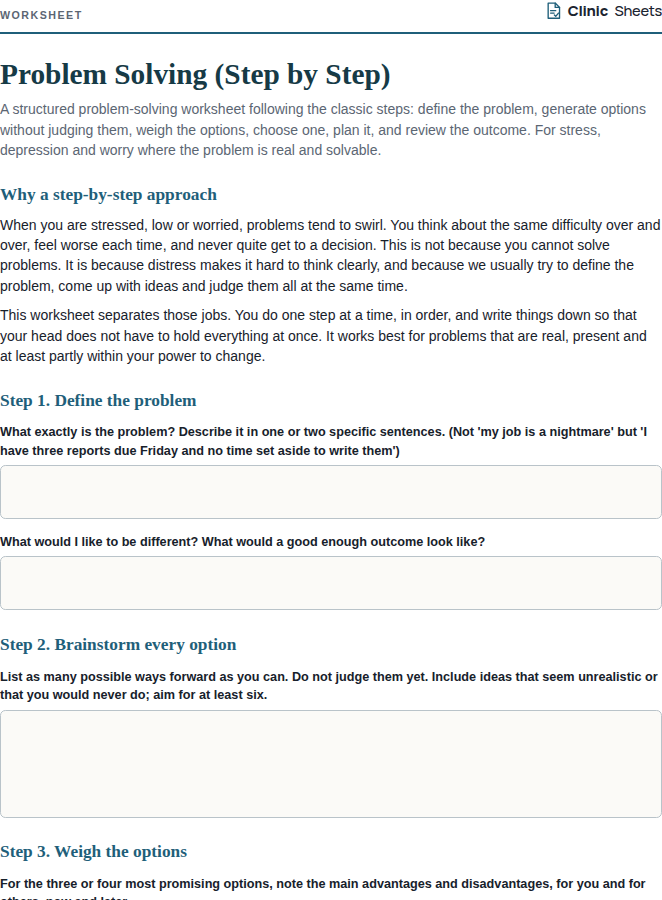
Children who get angry or overwhelmed often do so because they see only one way out of a problem, and it is usually not a good one. Problem-solving skills training teaches a structured sequence: define the problem, generate many possible solutions without judging them, think through the likely consequences of each, choose one and carry it out, then evaluate. Kazdin's work on cognitive problem-solving skills training with aggressive and oppositional children showed that this sequence, practised repeatedly on real problems, reduces conflict and improves behaviour, and it is a standard component of CBT for anger and stress in children.
This worksheet puts the sequence into five child-sized steps. The 'lots of ideas' step matters most and is the one children (and adults) skip: the rule is that every idea goes on the list, even silly ones, because the silly ones loosen up thinking and make the good ones easier to find. The 'what would happen' step gives the child a way to compare ideas without an adult telling them which is best. The final 'how did it go' step turns a failed attempt into information rather than a reason to give up.
The professional version suggests starting with low-stakes practice problems (what to do when a sibling has the remote, what to do when you have lost your homework) before applying the steps to the child's hot-button situations, and warns against rushing to a solution before the child has generated their own list. It also notes that the steps only work when the child is calm enough to think, so they pair naturally with a calming plan.
How to use it
- Explain the five steps using a small, non-emotional practice problem. Walk through the whole sequence once so the child sees the shape.
- Move to a real, recent problem the child brought or a parent reported. Define it in one clear sentence together.
- Brainstorm ideas. Your job is to keep the list going and to add a deliberately silly idea if the child stalls. Do not evaluate until the list has at least four or five items.
- Have the child predict what would happen for each idea, then choose one. Plan concretely when and how they will try it.
- Review at the next session. If it worked, celebrate. If it did not, go back to the list and pick the next idea. Repeat until the steps become automatic.
References
- Kazdin, A. E., Siegel, T. C., & Bass, D. (1992). Cognitive problem-solving skills training and parent management training in the treatment of antisocial behavior in children. Journal of Consulting and Clinical Psychology, 60(5), 733-747.
- D'Zurilla, T. J., & Nezu, A. M. (2007). Problem-Solving Therapy: A Positive Approach to Clinical Intervention (3rd ed.). Springer.
- Stallard, P. (2019). Think Good, Feel Good: A CBT Workbook for Children and Young People (2nd ed.). Wiley.