Understanding Depression (for Teens)
A straightforward explanation for teenagers of what depression is, how it differs from ordinary low mood, and how withdrawing from activity keeps it going. Sets up behavioural activation and CBT.
About this resource
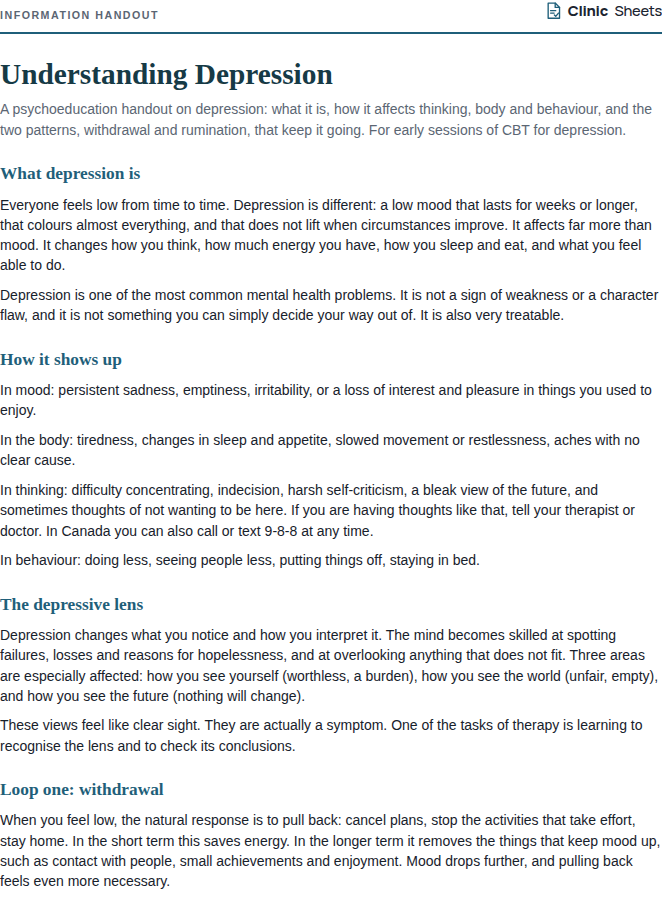
Adolescent depression often looks different from the adult picture. Irritability, boredom, sleeping much more or much less, dropping out of activities and falling behind at school can be more visible than sadness, and young people frequently do not have a word for what is happening to them. This handout gives them one. It explains depression as a recognisable and treatable condition, describes how it affects mood, thinking, energy and behaviour, and introduces the cycle in which withdrawal from activity deepens low mood.
The handout draws on the behavioural activation model, in which reduced activity and loss of rewarding experience maintain depression, and on the cognitive model, in which negative automatic thoughts about self, world and future bias interpretation. Both are presented in everyday language with adolescent-relevant examples.
The professional version adds guidance on discussing depression without pathologising normal adolescent moodiness, on asking about self-harm and suicidal thoughts as part of routine assessment, and on involving parents or caregivers in a way the young person can accept.
How to use it
- Use early in treatment, after assessment, as the first piece of psychoeducation. Read it with the young person rather than handing it over.
- As you read the section on how depression shows up, ask which parts fit. Validate that irritability and flatness are as much a part of depression as sadness.
- Draw the withdrawal cycle on paper using the young person's own recent example: what they stopped doing, and what happened to their mood and energy afterwards.
- Complete the reflection fields together. The list of things they used to enjoy becomes the starting point for activity scheduling.
- Assess for suicidal thoughts and self-harm as a matter of routine, separately from this handout, and complete a safety plan if indicated.
References
- Clarke, G. N., Lewinsohn, P. M., & Hops, H. (1990). Adolescent Coping with Depression Course: Leader's Manual for Adolescent Groups. Kaiser Permanente Center for Health Research.
- Martell, C. R., Dimidjian, S., & Herman-Dunn, R. (2010). Behavioral Activation for Depression: A Clinician's Guide. Guilford Press.
- Stallard, P. (2019). Think Good, Feel Good: A Cognitive Behavioural Therapy Workbook for Children and Young People (2nd ed.). Wiley.