Understanding Depression in Later Life
A handout for older adults explaining how depression presents in later life, why it is neither a normal part of ageing nor a personal failing, how withdrawal and reduced activity keep it going, and what treatment involves. CBT and behavioural activation informed.
About this resource
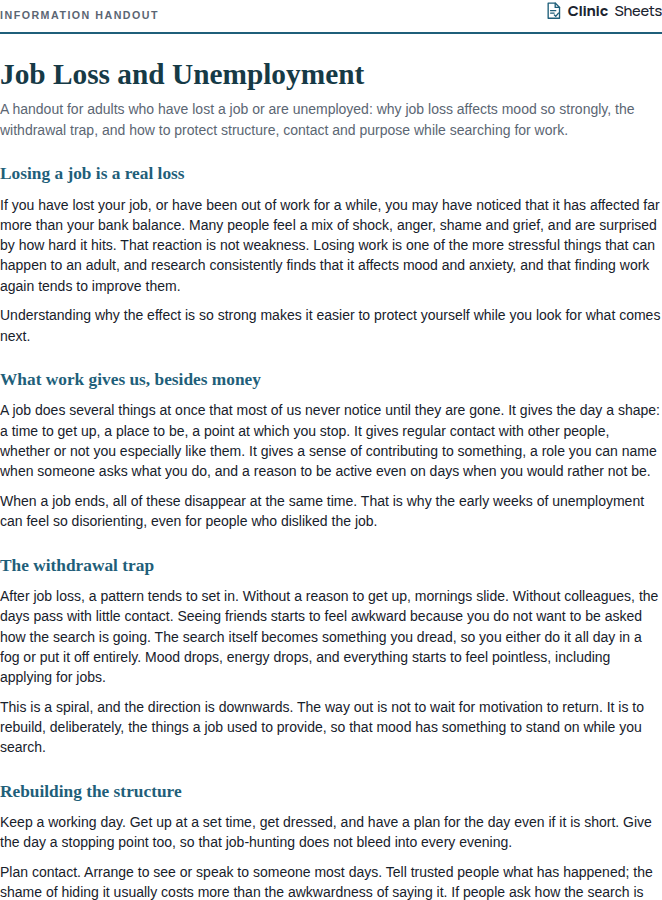
Depression in older adults is common, under-recognised and highly treatable. It is often missed because it is mistaken for normal ageing, grief, or the effects of physical illness, and because older adults themselves may not describe low mood: they are more likely to report fatigue, poor sleep, aches, loss of appetite, poor concentration or memory worries, and to attribute these to age. Fiske, Wetherell and Gatz (2009) review the evidence that late-life depression is distinct in its presentation and its contributing factors, which frequently include physical illness, bereavement, loss of role, and reduced mobility or social contact.
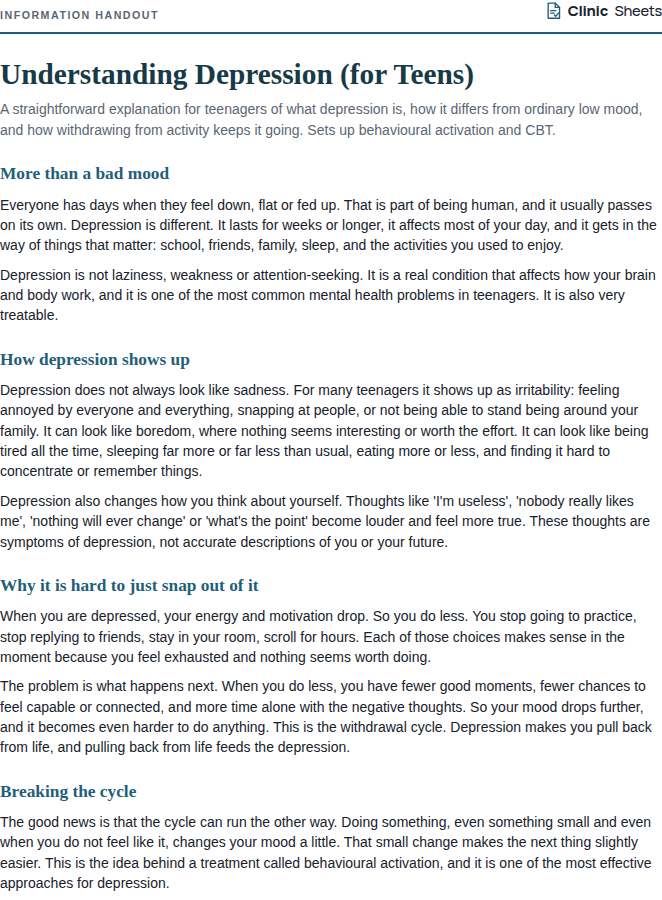
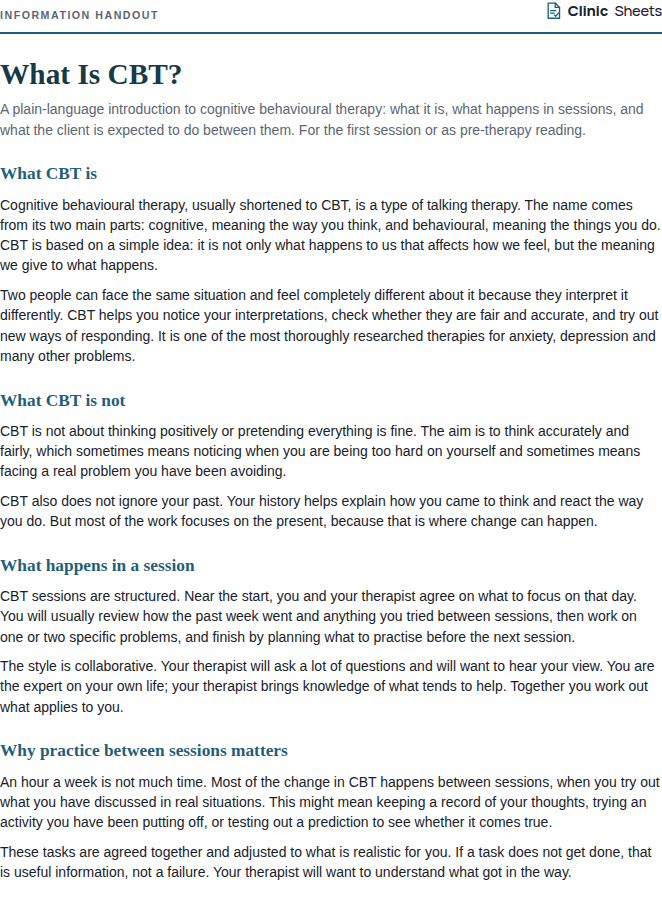
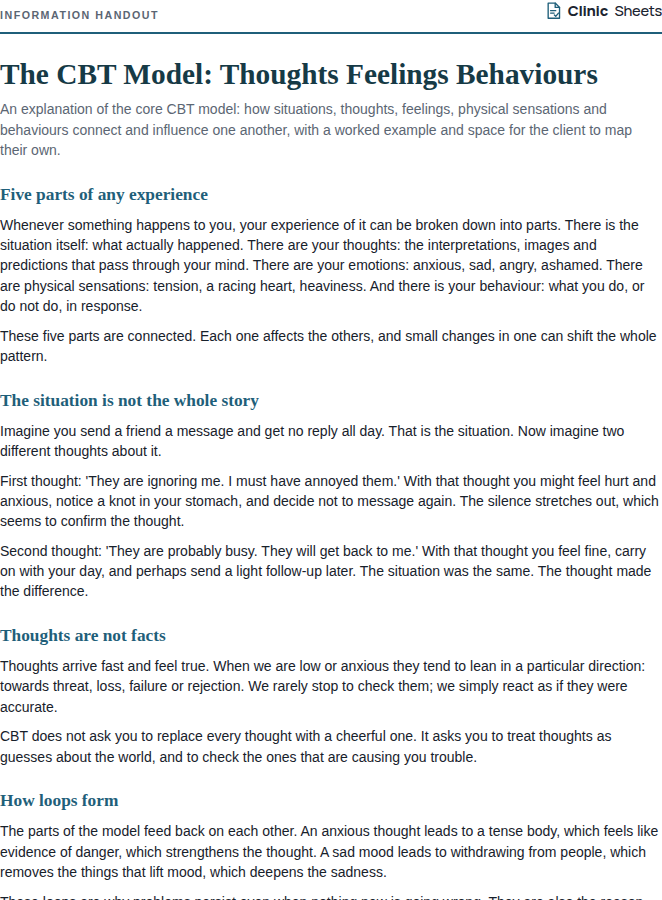
The behavioural model is especially useful in this population. Losses and health changes reduce the activities that gave life structure, pleasure and meaning; withdrawal follows, mood drops, and lower mood further reduces activity. Behavioural activation (Martell, Dimidjian and Herman-Dunn, 2010) targets this cycle directly and is well suited to older adults because it is concrete and does not depend on introspection. Laidlaw and colleagues (2003) describe adaptations of CBT for older people, including attention to cohort beliefs about mental illness and to the reality of physical limitations.
This handout is written to respect the reader's experience and to counter the beliefs that most often prevent older adults from accepting treatment: that depression is to be expected at their age, that it reflects weakness, and that nothing can be done. The professional version adds guidance on screening for cognitive impairment and medical contributors, on suicide risk assessment in older men, and on adapting behavioural activation to physical limitations.
How to use it
- Use after assessment, including screening for medical contributors and cognitive change, and once the client has agreed that low mood is worth addressing.
- Read the section on how depression shows up in later life together and ask which features the client recognises. Many will identify physical symptoms before mood.
- Draw the withdrawal cycle using the client's own losses and changes. Emphasise that the cycle, not the person, is the problem.
- Address the belief that depression is normal at this age directly and respectfully; ask the client whether they believe this and where the idea came from.
- Use the reflection fields to begin activity monitoring and identify one or two activities to reintroduce, and follow with a structured activity scheduling resource.
- Ask directly about thoughts of death or suicide. Older adults, particularly men, are at elevated risk and rarely volunteer these thoughts.
References
- Fiske, A., Wetherell, J. L., & Gatz, M. (2009). Depression in older adults. Annual Review of Clinical Psychology, 5, 363-389.
- Laidlaw, K., Thompson, L. W., Dick-Siskin, L., & Gallagher-Thompson, D. (2003). Cognitive Behaviour Therapy with Older People. Wiley.
- Martell, C. R., Dimidjian, S., & Herman-Dunn, R. (2010). Behavioral Activation for Depression: A Clinician's Guide. Guilford Press.