Willingness Scale and Acceptance Practice
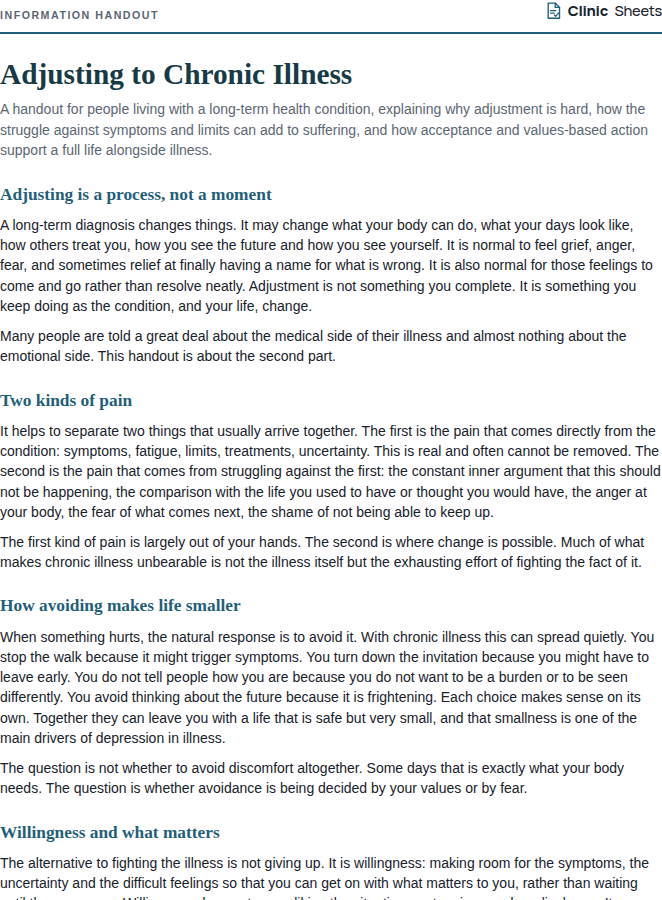
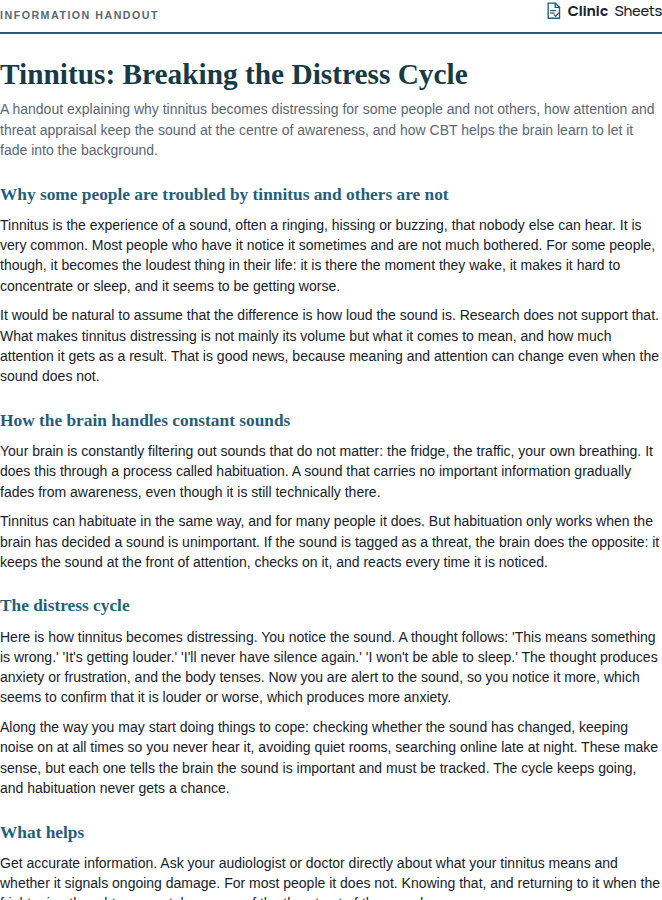
A worksheet that separates how intense a difficult experience is from how willing you are to have it, and guides a short acceptance practice for making room for that experience. For anxiety and for chronic pain or illness, where control efforts often backfire.
About this resource
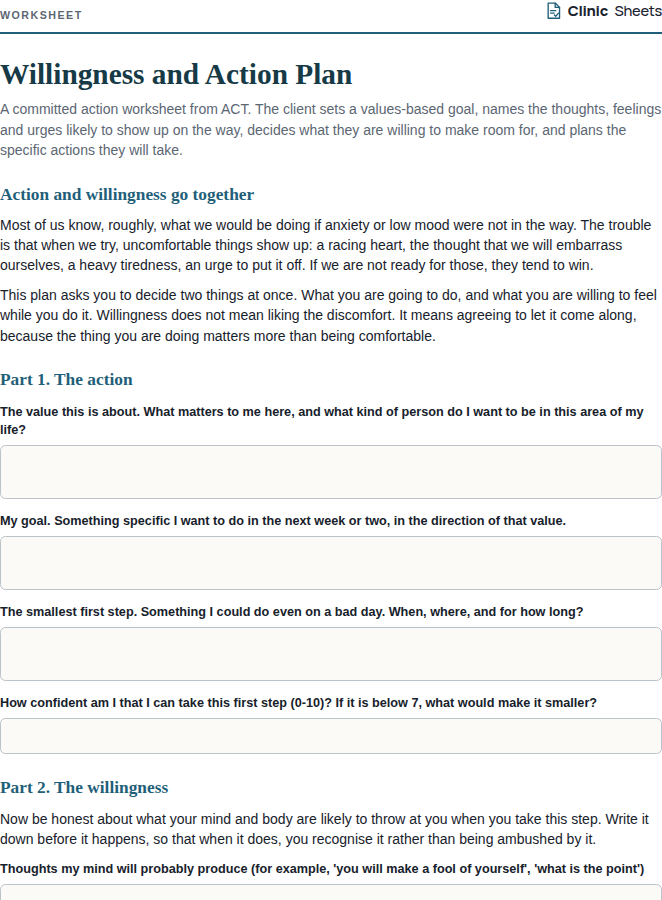
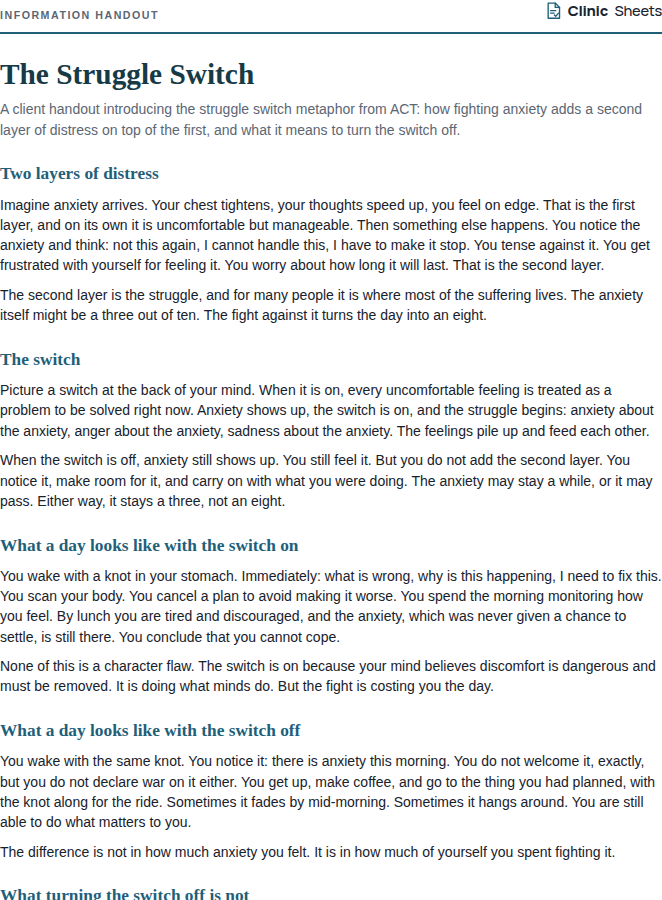
In acceptance and commitment therapy, willingness means allowing an unwanted thought, feeling or sensation to be present, as it is, without struggling to change it, while continuing to act on one's values. It is the alternative to experiential avoidance. A useful teaching point, sometimes presented in ACT as two dials, is that the intensity of a difficult experience and one's willingness to have it are separate. People typically try to turn down intensity, which is largely outside their control, and neglect willingness, which is entirely within it. Low willingness tends to amplify suffering: anxiety about anxiety, frustration about pain, and the exhausting effort of control.
This worksheet makes the two dimensions explicit with two ratings, then guides a brief acceptance practice adapted from ACT's physicalising and expansion exercises: observing the experience, describing it, breathing into it, and making room for it. It is well suited to chronic pain and long-term illness, where the sensation cannot be removed, and to anxiety, where attempts to remove it fuel it. The worksheet does not ask the client to like the experience or to stop wanting it to change; only to stop fighting it in this moment.
The professional version adds notes on introducing the two-dial idea, on distinguishing willingness from resignation, and on selecting a first target that is uncomfortable but not overwhelming.
How to use it
- Introduce the distinction between intensity and willingness with a simple drawing of two dials. Ask the client which dial they have been trying to turn, and how that has gone.
- Choose a target experience with the client. For a first attempt, pick something moderate: a background ache, a low-level worry, rather than the worst episode.
- Guide the acceptance practice aloud in session the first time, using the steps in the client section. Slow down at the 'make room' step; this is where willingness happens.
- Ask the client to rate willingness before and after. Intensity may or may not change; emphasise that either outcome is fine and that willingness is the skill being trained.
- Assign the practice for use two or three times before the next session, when the target experience is present. Review the log and troubleshoot attempts that turned into another way of trying to make the feeling go away.
- Link willingness to values: ask what the client would be free to do if they were not spending energy fighting this experience.
References
- Hayes, S. C., Strosahl, K. D., & Wilson, K. G. (2012). Acceptance and Commitment Therapy: The Process and Practice of Mindful Change (2nd ed.). Guilford Press.
- Harris, R. (2019). ACT Made Simple: An Easy-to-Read Primer on Acceptance and Commitment Therapy (2nd ed.). New Harbinger.
- Dahl, J., Wilson, K. G., Luciano, C., & Hayes, S. C. (2005). Acceptance and Commitment Therapy for Chronic Pain. Context Press.
- Eifert, G. H., & Forsyth, J. P. (2005). Acceptance and Commitment Therapy for Anxiety Disorders. New Harbinger.