Building Self-Compassion: A Guide
A complete client guide to building self-compassion using compassion focused therapy: the three emotion regulation systems, why self-criticism keeps shame going, soothing rhythm breathing, compassionate imagery, developing the compassionate self, compassionate letter writing, and working with fears of self-compassion.
About this resource
Compassion focused therapy (CFT), developed by Paul Gilbert, was designed for people with high levels of shame and self-criticism who understood the logic of cognitive therapy but did not feel any relief from it. The model draws on evolutionary psychology and affective neuroscience to describe three emotion regulation systems: a threat system oriented to detecting danger, a drive system oriented to seeking rewards, and a soothing system oriented to safeness, contentment and connection. People who are chronically self-critical tend to have an overactive threat system and an underdeveloped soothing system, so that their own inner voice functions as an attacker rather than an ally. CFT aims to build the capacity for self-soothing and to bring a compassionate orientation to the self and to suffering.
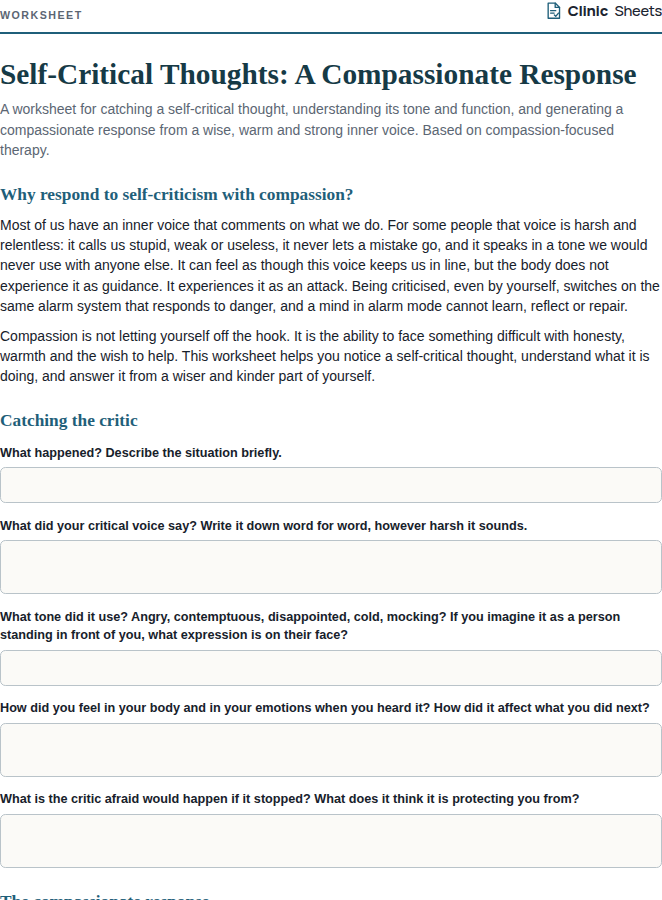
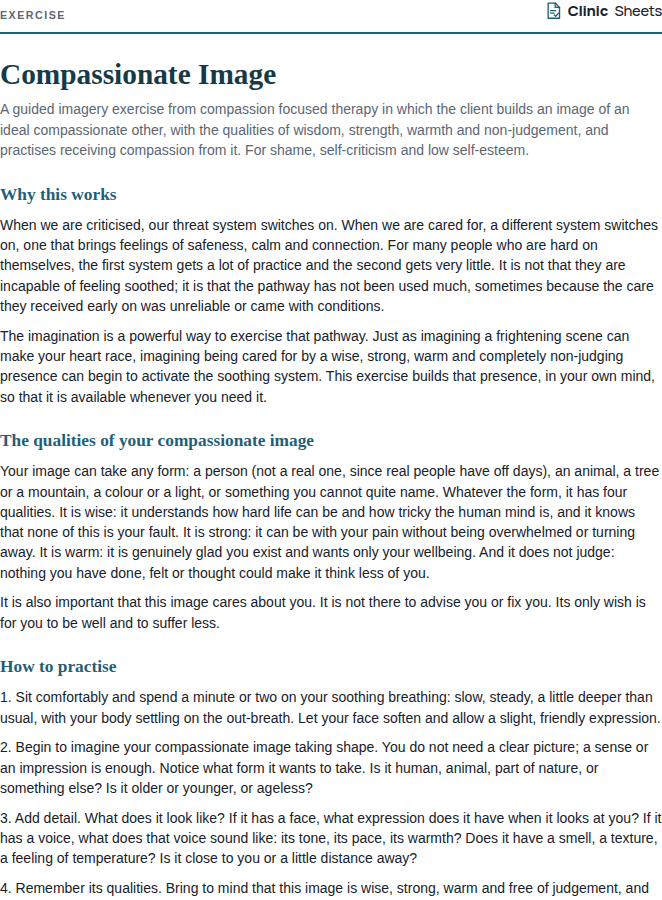
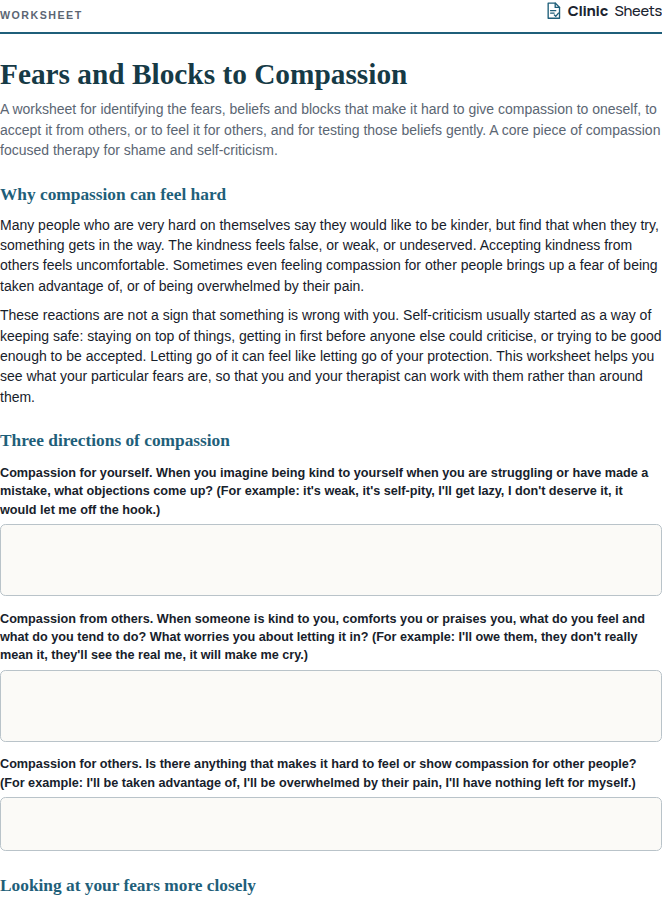
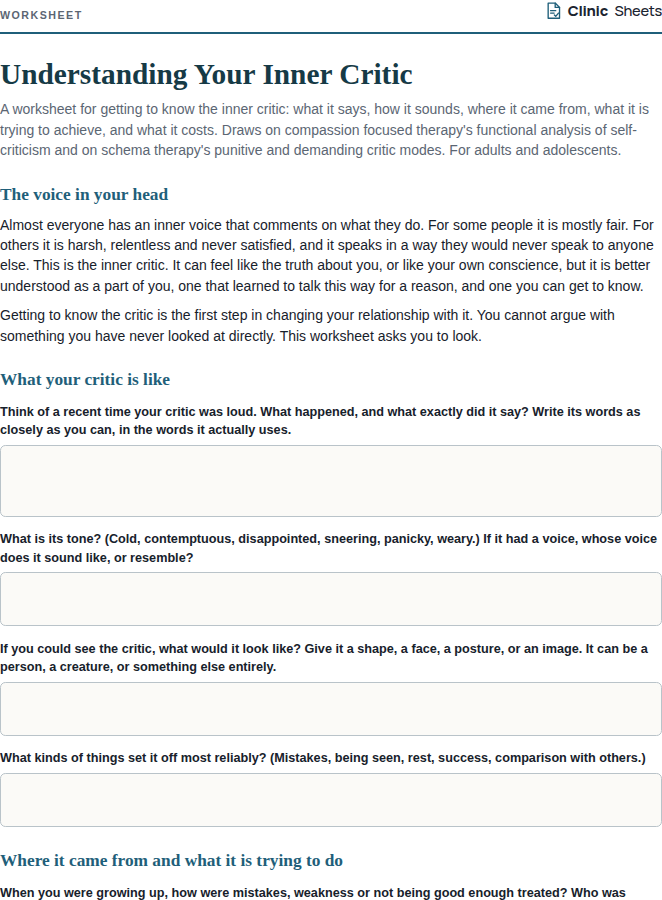
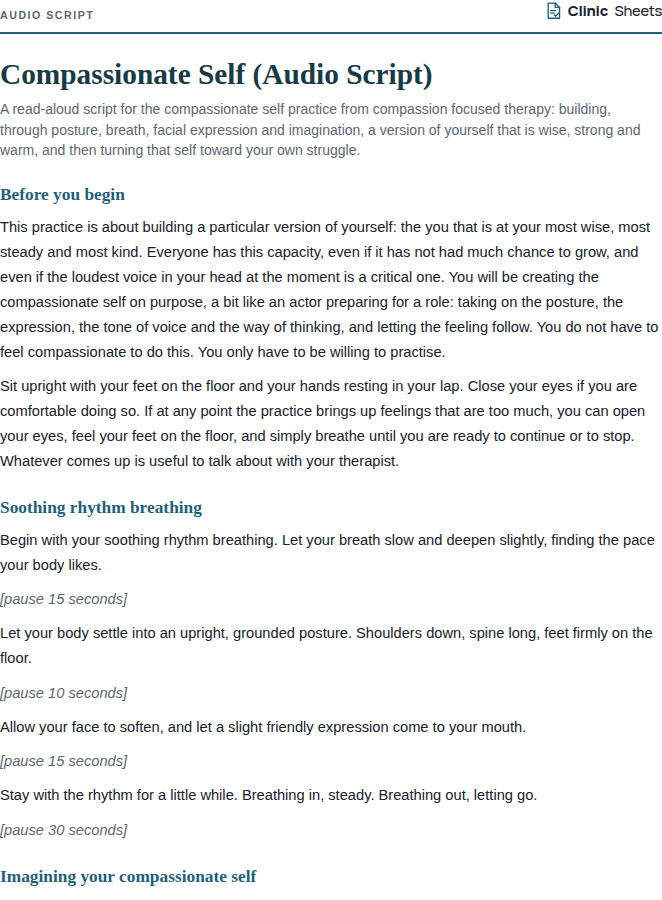
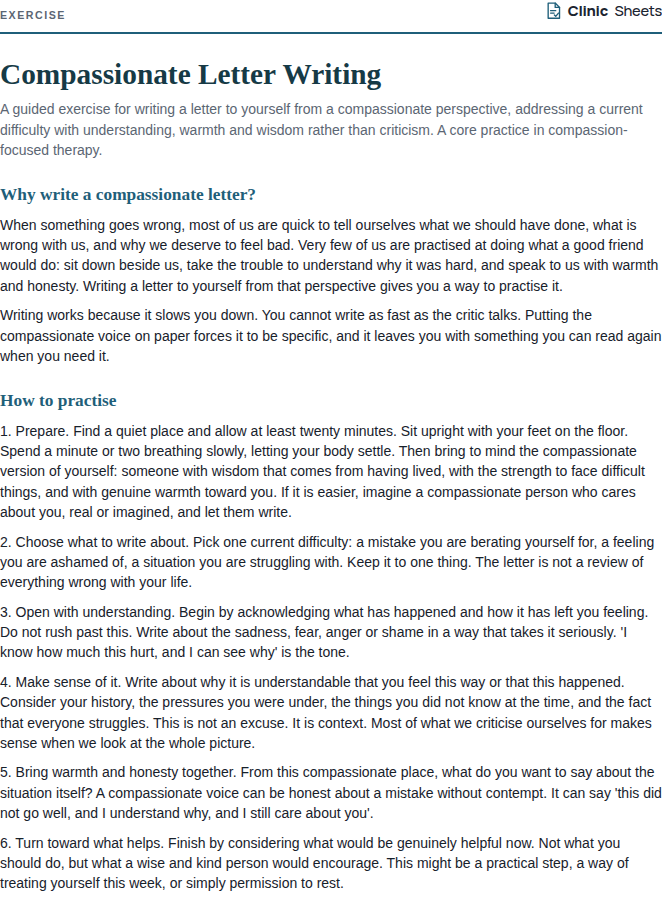
This guide takes the client through the core CFT sequence: understanding the three systems and mapping their own balance, seeing self-criticism as a threat-based safety strategy rather than a character flaw, learning soothing rhythm breathing and compassionate imagery to activate the soothing system, cultivating the compassionate self through practice, applying it through compassionate letter writing, and identifying fears and blocks that make compassion feel unsafe. Kristin Neff's account of self-compassion as self-kindness, common humanity and mindfulness is drawn on where it complements Gilbert's model.
The professional version adds guidance on pacing (many clients find compassion work frightening and need to build tolerance gradually), on working with the functions of self-criticism before trying to reduce it, and on distinguishing self-compassion from self-pity, self-indulgence and letting oneself off the hook, which are the objections clients most often raise.
How to use it
- Introduce the three-systems model in session, drawing it out with the client and asking them to estimate the relative size of each system in their own life. Assign the first two sections.
- Explore the function of self-criticism collaboratively before asking the client to reduce it. Ask what they fear would happen if they stopped, and treat the answer as a belief to be examined.
- Teach soothing rhythm breathing in session and assign short daily practice. Expect some clients to find it unsettling; go slowly and normalise this.
- Build the compassionate self and compassionate image over several sessions, always with the qualities of wisdom, strength, warmth and non-judgement, before applying them to difficult material.
- Use compassionate letter writing as between-session practice once the compassionate self is reasonably accessible. Review letters in session for tone as well as content.
- Return to fears of compassion whenever practice stalls; they are usually the reason.
References
- Gilbert, P. (2009). The Compassionate Mind: A New Approach to Life's Challenges. Constable.
- Gilbert, P. (2010). Compassion Focused Therapy: Distinctive Features. Routledge.
- Gilbert, P. (2014). The origins and nature of compassion focused therapy. British Journal of Clinical Psychology, 53(1), 6-41.
- Neff, K. D. (2003). Self-compassion: An alternative conceptualization of a healthy attitude toward oneself. Self and Identity, 2(2), 85-101.