Compassionate Image
A guided imagery exercise from compassion focused therapy in which the client builds an image of an ideal compassionate other, with the qualities of wisdom, strength, warmth and non-judgement, and practises receiving compassion from it. For shame, self-criticism and low self-esteem.
About this resource
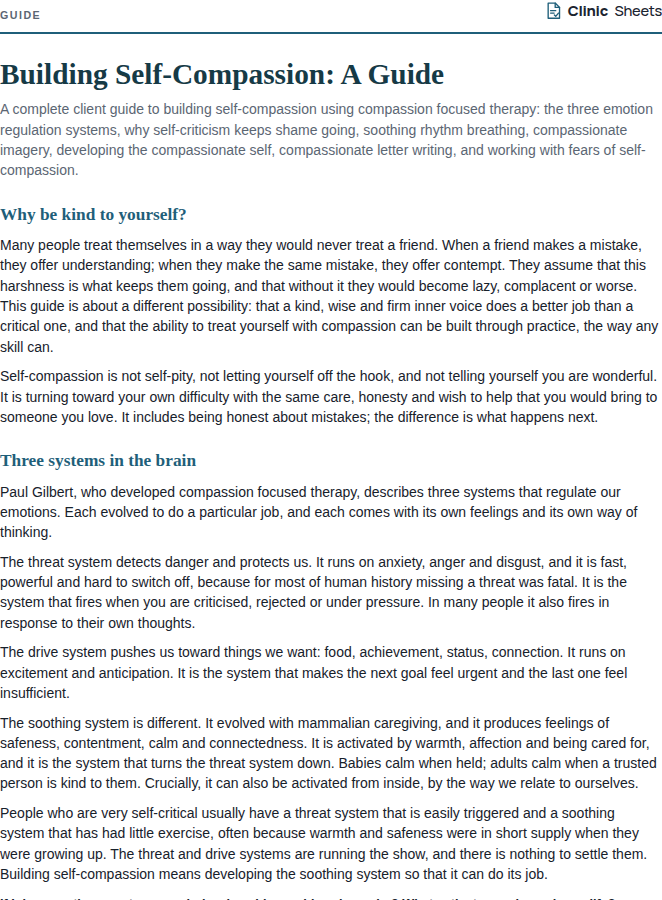
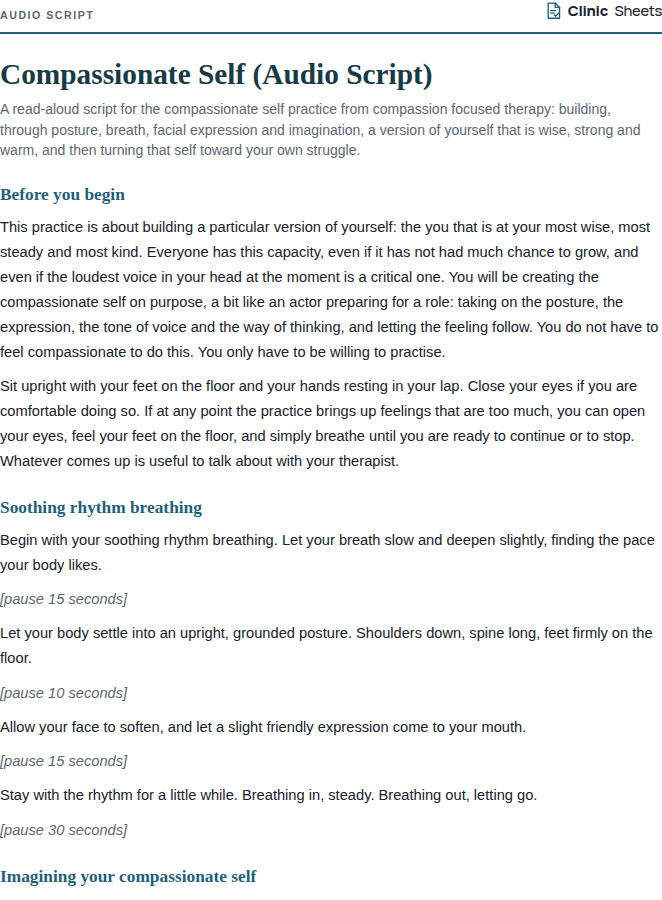
Compassion focused therapy, developed by Paul Gilbert, holds that many people with high shame and self-criticism have a well-developed threat system and an under-developed soothing system. They can readily generate criticism, but they find it very difficult to generate feelings of safeness, warmth and being cared for, often because such feelings were rare, unreliable or conditional in early life. Compassionate imagery is one of the core practices of compassionate mind training, and the compassionate image (sometimes called the ideal compassionate other) is a way of stimulating the soothing system through the imagination when it cannot yet be reached directly.
The client is invited to create, in detail, an image of a being whose only wish is for their wellbeing, and who embodies the CFT qualities of compassion: wisdom (understanding how hard life and the human mind can be), strength and authority (able to bear distress without being overwhelmed), warmth, and complete non-judgement. The image may be a person, an animal, a figure from nature, a light, or something abstract. It is not a memory of a real person, since real people are imperfect and the image needs to be reliable. The exercise then practises receiving compassion from this image, which for many clients is the difficult part.
The professional version includes guidance on preparation (soothing rhythm breathing first), on the very common experience of finding the exercise hard, upsetting or blank, which Gilbert describes as a fear of compassion and which is itself a treatment target, and on adapting the image for clients with trauma histories.
How to use it
- Teach soothing rhythm breathing and a safe place image before this exercise, so the client has some access to the soothing system to build on.
- Explain the four qualities the image should have (wisdom, strength, warmth, non-judgement) and that the image is created rather than remembered. Ask whether the client has any early sense of what form it might take, and accept anything, including 'I have no idea'.
- Guide the exercise aloud, slowly, in session. Spend time on sensory detail: appearance, voice, how it looks at the client. Then guide the shift to receiving: how it feels to be seen with kindness by this image.
- Debrief carefully. Ask what came easily and what was hard. Blocks (blankness, discomfort, tears, 'I don't deserve it') are expected and are the material of therapy, not a sign that the exercise failed.
- Ask the client to practise for five to ten minutes daily, using the log. The image often develops and becomes more vivid over weeks.
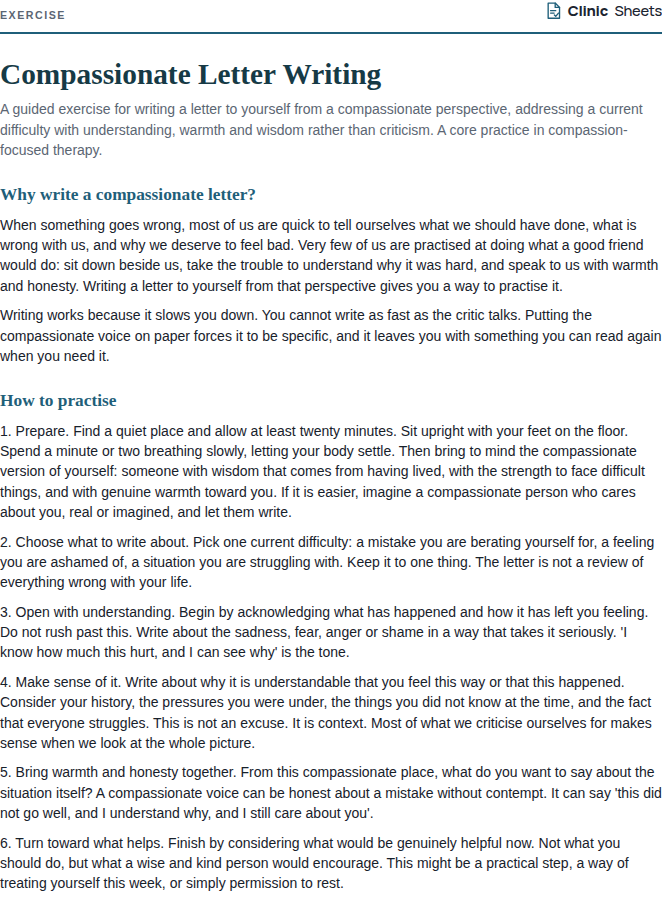
- In later sessions, use the image as a resource: 'What would your compassionate image say about this?' and as a basis for compassionate letter writing.
References
- Gilbert, P. (2009). The Compassionate Mind: A New Approach to Life's Challenges. Constable.
- Gilbert, P. (2010). Compassion Focused Therapy: Distinctive Features. Routledge.
- Gilbert, P., & Irons, C. (2005). Focused therapies and compassionate mind training for shame and self-attacking. In P. Gilbert (Ed.), Compassion: Conceptualisations, Research and Use in Psychotherapy (pp. 263-325). Routledge.
- Irons, C., & Beaumont, E. (2017). The Compassionate Mind Workbook: A Step-by-Step Guide to Developing Your Compassionate Self. Robinson.