Understanding Your Inner Critic
A worksheet for getting to know the inner critic: what it says, how it sounds, where it came from, what it is trying to achieve, and what it costs. Draws on compassion focused therapy's functional analysis of self-criticism and on schema therapy's punitive and demanding critic modes. For adults and adolescents.
About this resource
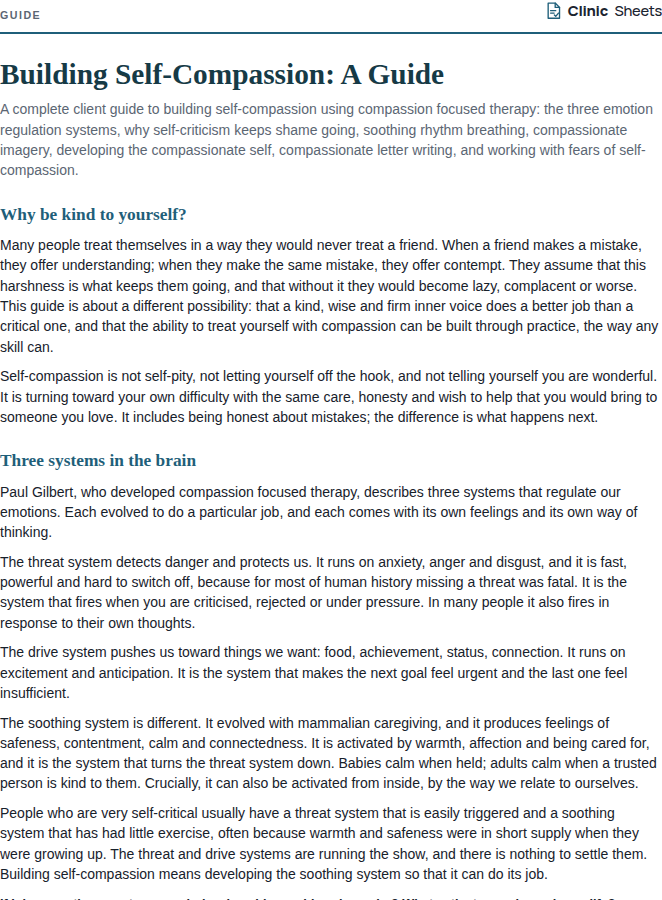
Self-criticism is a transdiagnostic process linked to depression, shame, low self-esteem and poor treatment response. Compassion focused therapy treats the inner critic not as a set of distorted thoughts to be corrected but as an internal relationship: a part of the person that attacks, and a part that receives the attack. Gilbert distinguishes self-criticism that aims to correct and improve from self-criticism that aims to hate and punish, and emphasises understanding the critic's function (what it fears would happen if it stopped) before trying to change it. Schema therapy describes similar phenomena in mode terms: the demanding critic mode, which sets impossible standards, and the punitive critic mode, which attacks and condemns, both typically internalised from early caregivers or environments.
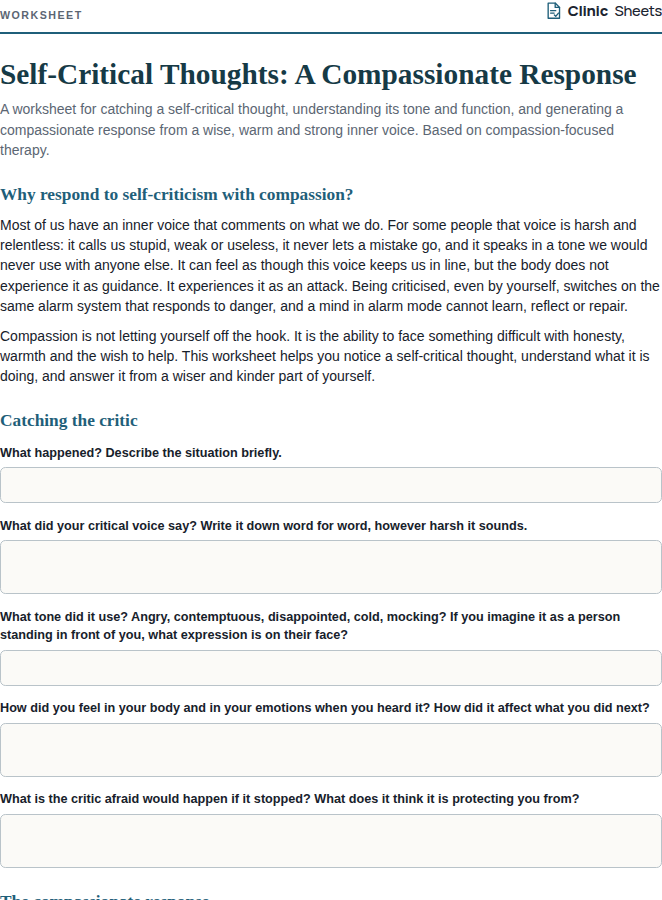
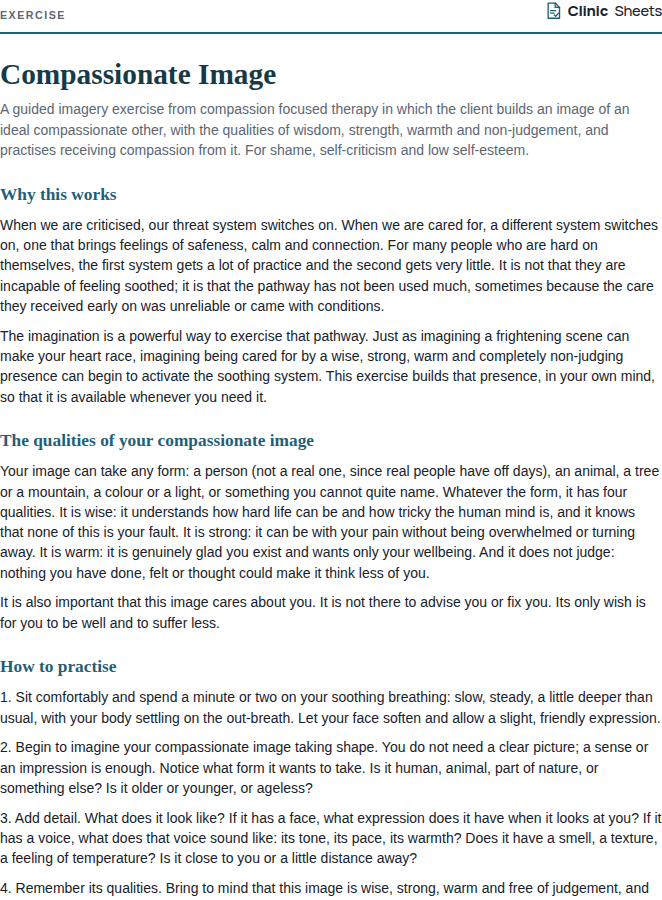
This worksheet brings the two frameworks together in a form clients can complete themselves. It asks them to characterise the critic (its words, tone, and even an image of it), to trace its origins, to identify what it is trying to do and what it fears, and to weigh its costs. This groundwork is what makes later work possible, whether that is building a compassionate self to respond to the critic, or a mode dialogue in which the healthy adult answers it. Adolescents often find externalising the critic (giving it a shape and a voice) both relieving and clarifying.
The professional version includes notes on distinguishing the critic from the client's own values, on the common discovery that the critic sounds like a specific person, and on managing the shame that can arise when a client hears their own self-talk written down.
How to use it
- Introduce the idea that self-criticism is a relationship inside the person, with an attacker and a receiver, rather than simply a set of thoughts. Ask whether that fits the client's experience.
- Begin the worksheet in session using a recent example of the critic in action. Help the client write the critic's words verbatim; the tone and the specific phrases matter.
- Explore the critic's origins with curiosity, not blame. Ask whose voice it resembles and what the client learned about mistakes, weakness and being good enough.
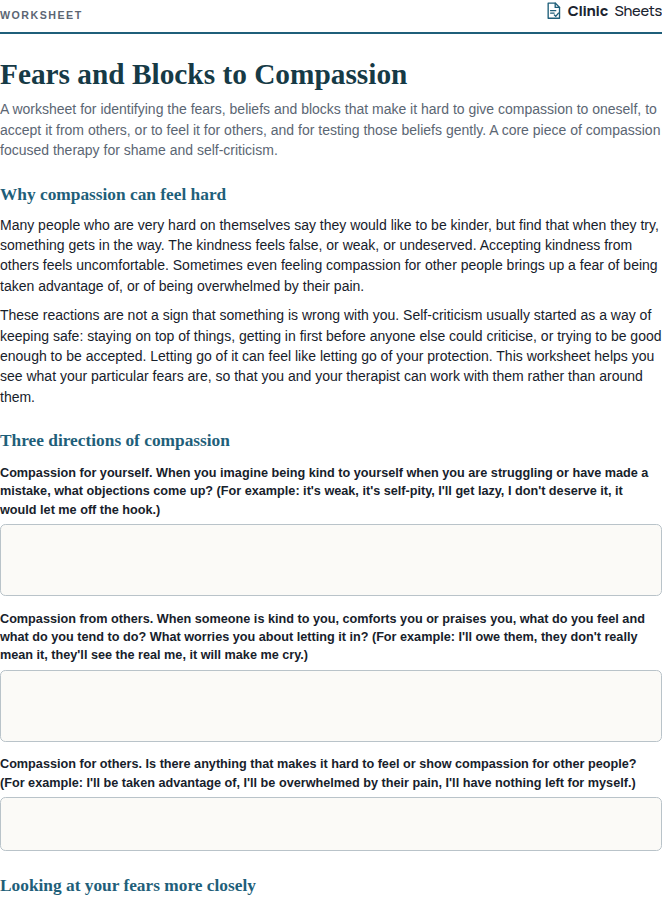
- Spend time on function. Ask the client what the critic is afraid would happen if it fell silent. Common answers: I'd become lazy, arrogant, unacceptable, or I'd be caught out by someone else's criticism. Validate that the critic is trying to protect them, however badly.
- Weigh the costs together and ask whether the critic has actually achieved what it set out to. This usually opens the door to considering a different inner voice.
- Follow with compassionate self practice or a healthy adult mode dialogue, using the completed worksheet as the material.
References
- Gilbert, P. (2010). Compassion Focused Therapy: Distinctive Features. Routledge.
- Gilbert, P., & Procter, S. (2006). Compassionate mind training for people with high shame and self-criticism: Overview and pilot study of a group therapy approach. Clinical Psychology and Psychotherapy, 13(6), 353-379.
- Young, J. E., Klosko, J. S., & Weishaar, M. E. (2003). Schema Therapy: A Practitioner's Guide. Guilford Press.
- Arntz, A., & Jacob, G. (2013). Schema Therapy in Practice: An Introductory Guide to the Schema Mode Approach. Wiley-Blackwell.