Fears and Blocks to Compassion
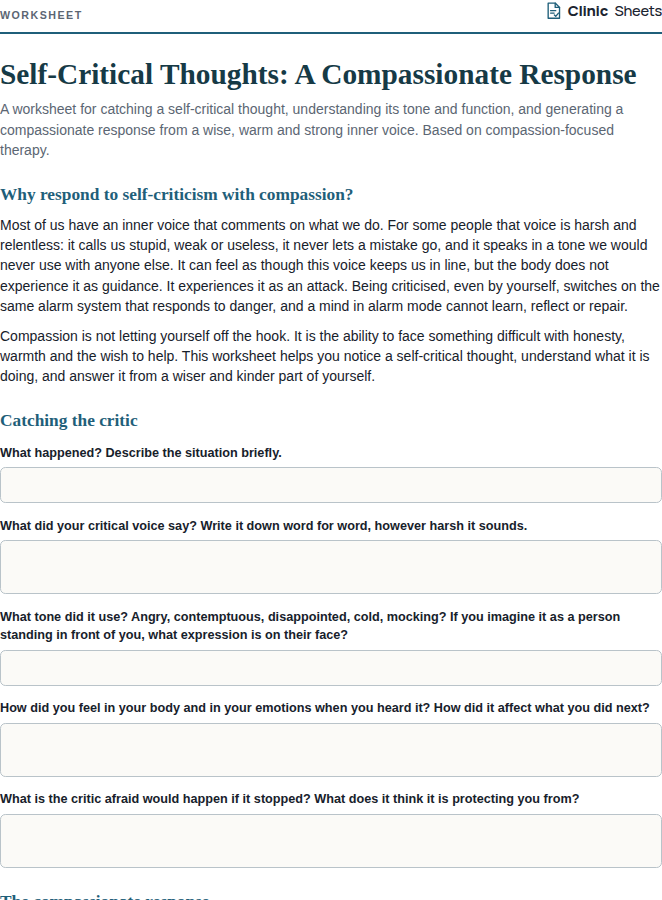
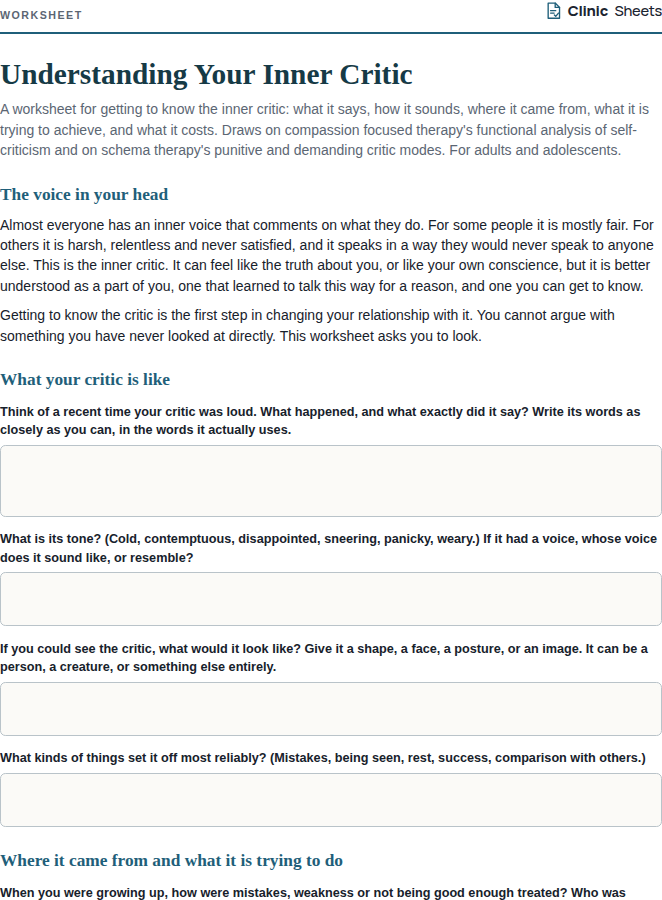
A worksheet for identifying the fears, beliefs and blocks that make it hard to give compassion to oneself, to accept it from others, or to feel it for others, and for testing those beliefs gently. A core piece of compassion focused therapy for shame and self-criticism.
About this resource
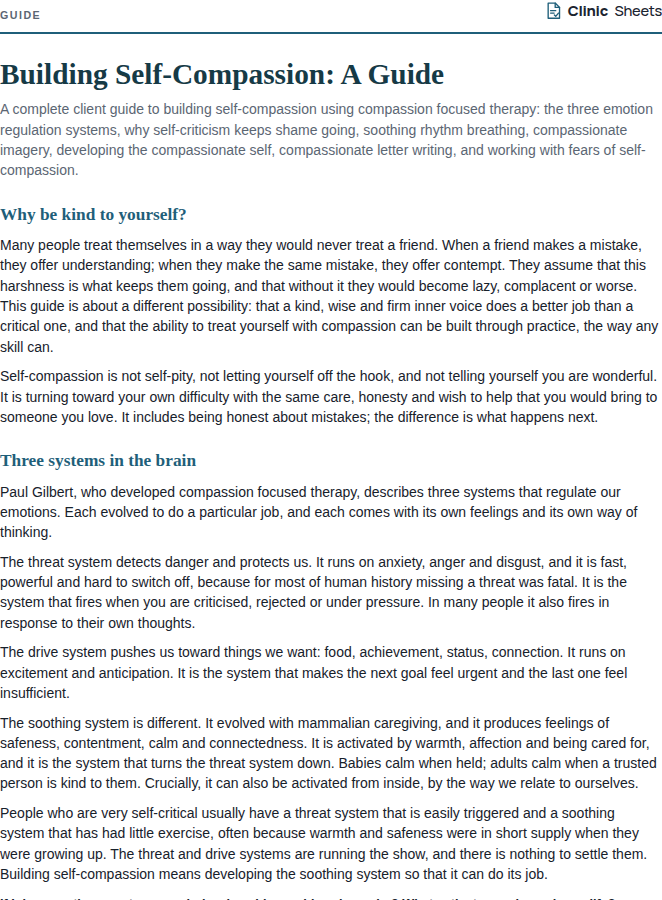
A central finding in compassion focused therapy is that people with high shame and self-criticism are often not simply lacking self-compassion; they actively fear or resist it. Gilbert and colleagues describe three directions of compassion (for others, from others, and for oneself) and have shown that fears in each direction can be measured and are associated with depression, anxiety, self-criticism and poorer response to treatment. Common fears include the belief that self-compassion is weak, indulgent or selfish, that it will lead to lowered standards, that one does not deserve it, that accepting kindness from others makes one vulnerable or indebted, and that opening to compassion will release grief that has been held back.
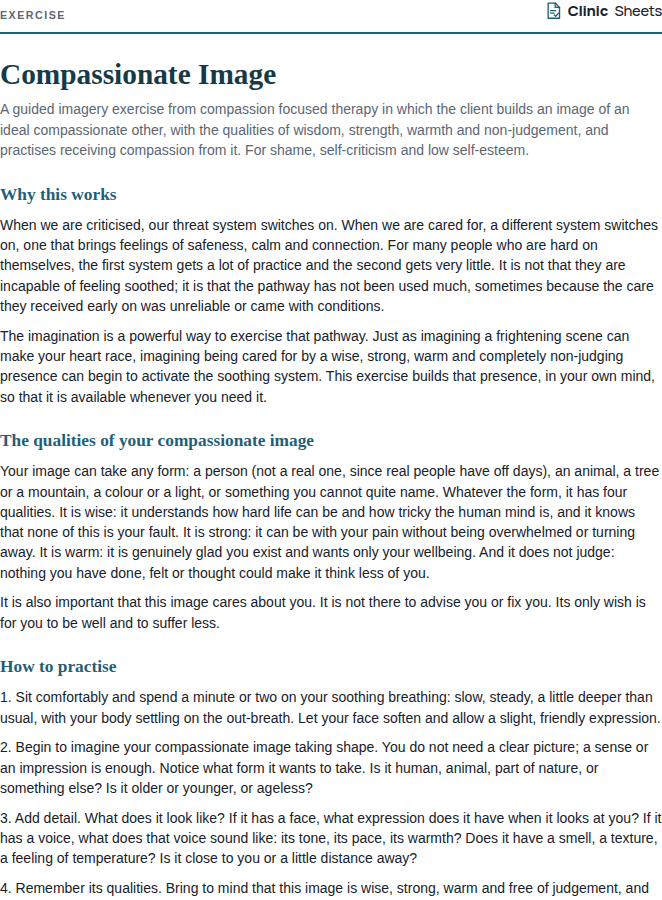
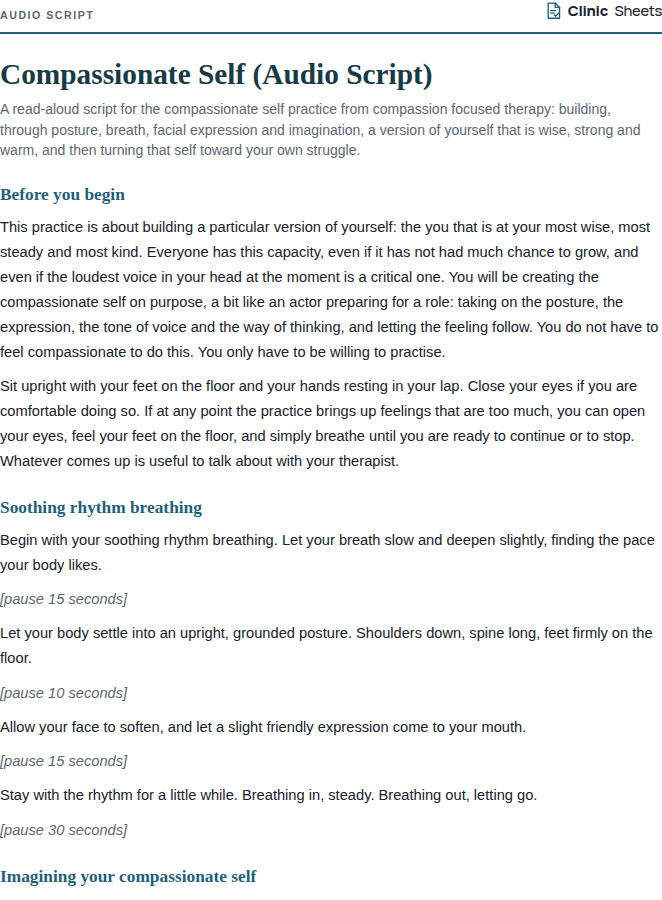
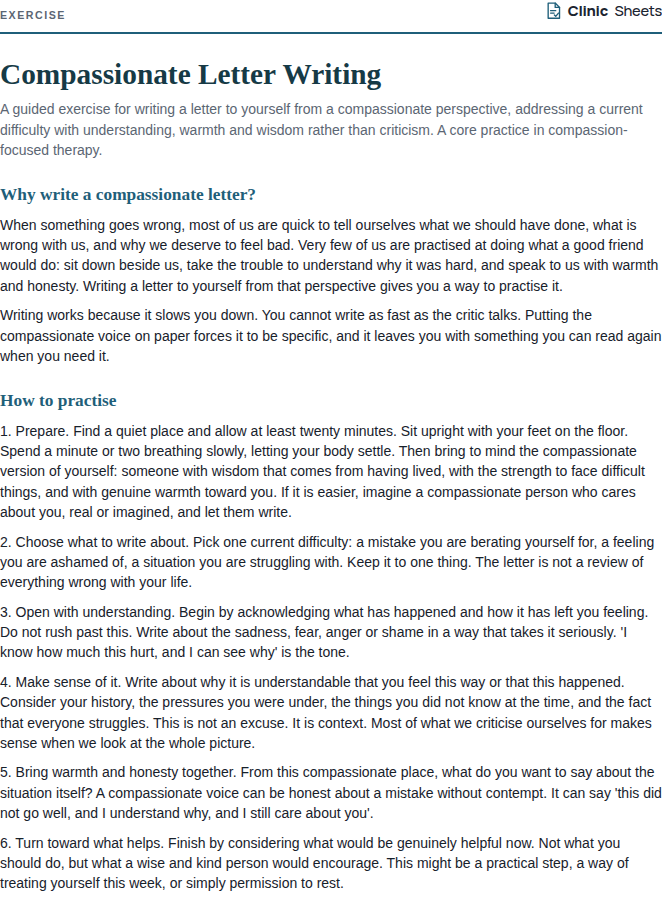
These fears make sense. Self-criticism often developed as a way of staying safe: keeping oneself in line, pre-empting others' criticism, or driving performance. Giving it up can feel dangerous. Unless the fears are made explicit and worked with, compassion practices tend to stall or provoke distress. This worksheet asks the client to identify their own fears in each direction, to trace where they may have come from, and to consider their costs and their accuracy. It is a preparation for, and a companion to, compassionate imagery and compassionate self practice.
The professional version includes notes on the typical origins of these fears, on the difference between compassion and the things clients often confuse it with (self-pity, letting oneself off, weakness), and on pacing when a client's block is connected to grief or trauma.
How to use it
- Use early in CFT, after explaining the three emotion systems and before, or alongside, the first compassionate imagery exercises. If a client has already tried imagery and found it hard, this worksheet helps make sense of why.
- Work through the three directions in session, starting with whichever is easiest for the client. For most self-critical clients, compassion for others is easiest and self-compassion is hardest; occasionally receiving from others is the hardest of all.
- For each fear, ask what it protects against and where the client learned it. Validate the fear's origins before questioning its current accuracy.
- Clarify what compassion is and is not. Compassion in CFT involves strength and courage as well as warmth; it is not self-pity, not lowering standards, and not letting oneself off the hook.
- Ask the client to complete the remaining sections between sessions and bring it back. Use identified fears as targets for behavioural experiments in later sessions, such as accepting a compliment without deflecting.
- Revisit the worksheet after several weeks of compassion practice to see which fears have softened.
References
- Gilbert, P., McEwan, K., Matos, M., & Rivis, A. (2011). Fears of compassion: Development of three self-report measures. Psychology and Psychotherapy: Theory, Research and Practice, 84(3), 239-255.
- Gilbert, P. (2010). Compassion Focused Therapy: Distinctive Features. Routledge.
- Gilbert, P. (2014). The origins and nature of compassion focused therapy. British Journal of Clinical Psychology, 53(1), 6-41.
- Irons, C., & Beaumont, E. (2017). The Compassionate Mind Workbook: A Step-by-Step Guide to Developing Your Compassionate Self. Robinson.