Coping Skills Toolbox (for Teens)
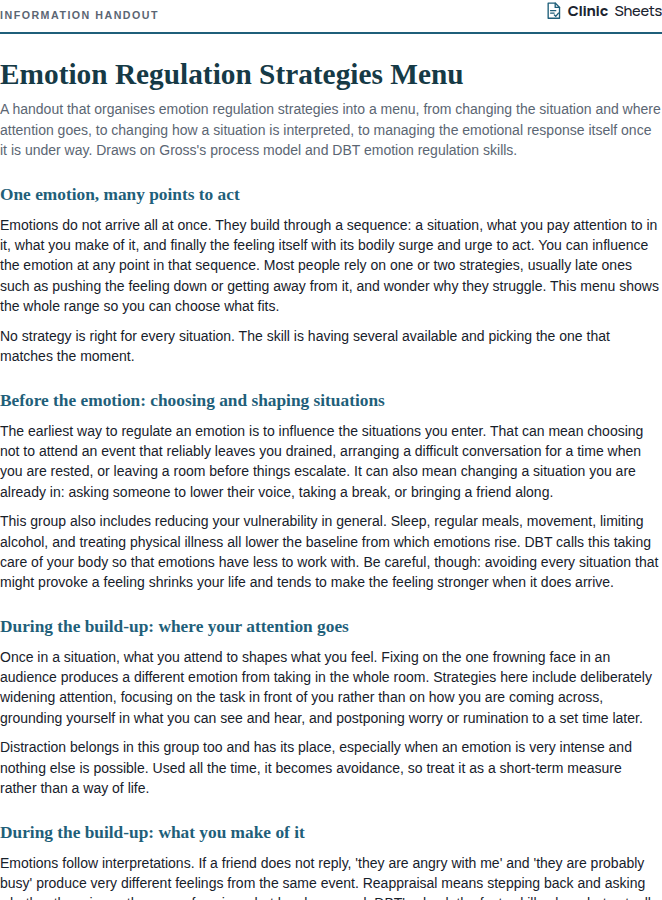
A worksheet that helps adolescents build a personal set of coping skills for intense emotions and stressful moments, organised by what the skill is for. Draws on DBT distress tolerance and emotion regulation skills adapted for teens.
About this resource
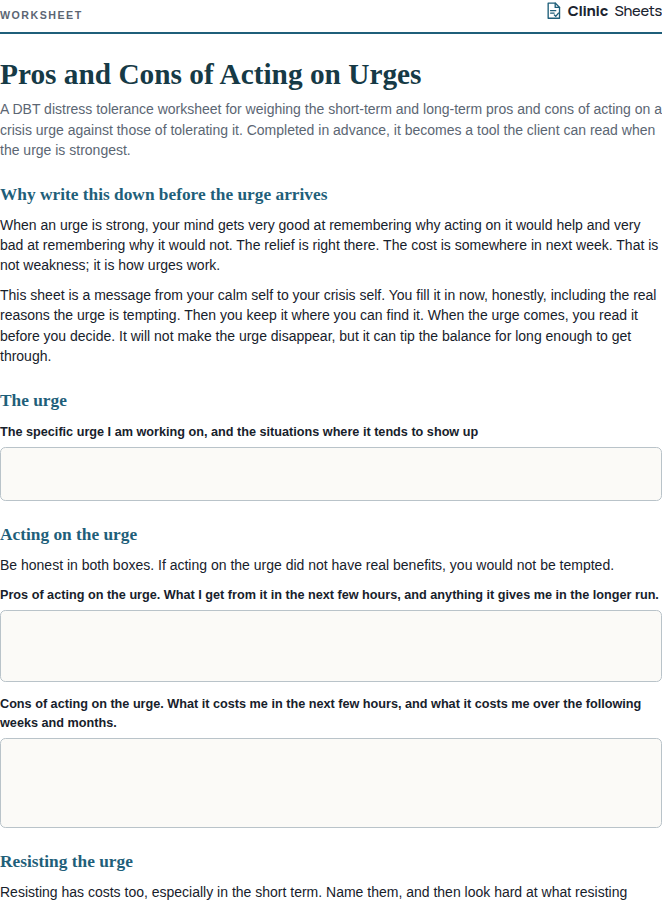
Adolescents in emotional distress often know a few coping strategies but cannot retrieve them when they are needed, or reach for whatever is quickest regardless of its cost. A coping skills toolbox addresses both problems: it is built in advance, when the teen is calm, and it is organised by purpose so that in the moment they can ask 'what do I need right now?' rather than 'what should I do?'
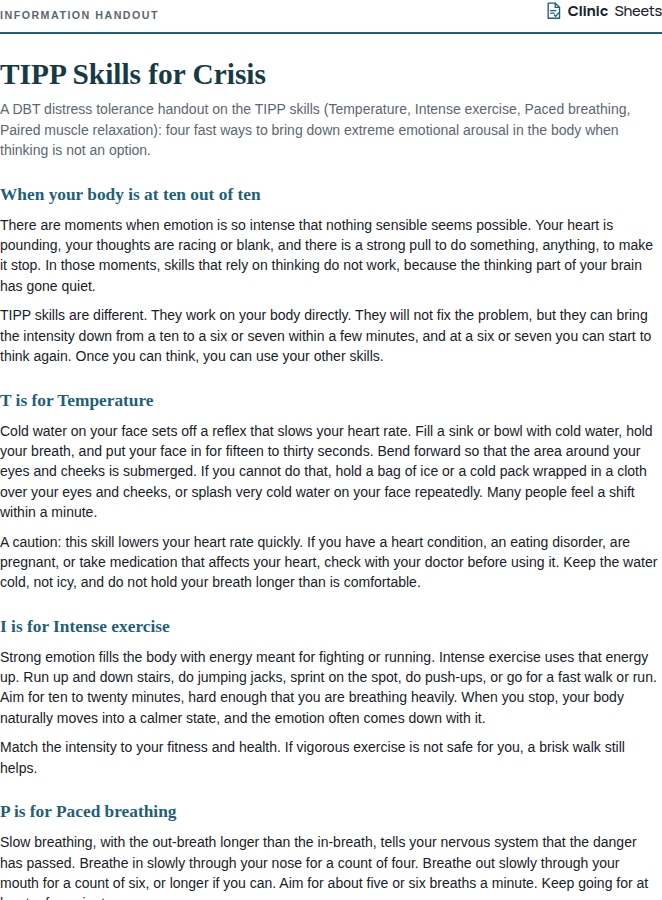
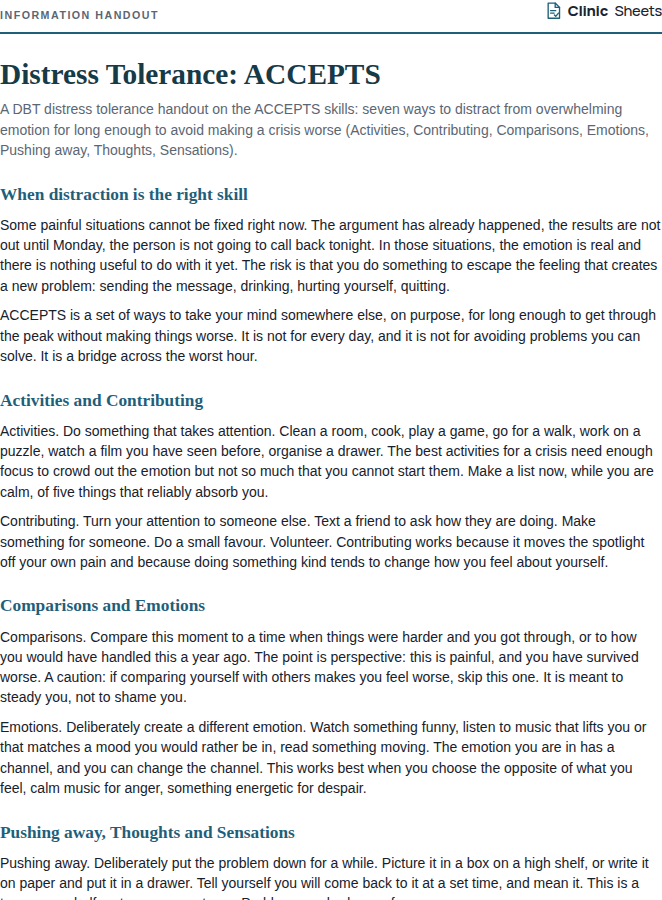
The structure follows the DBT distinction between crisis survival skills, which get a person through an intense moment without making it worse, and skills for changing or tolerating emotion over the longer term. The DBT skills programme for adolescents (Rathus and Miller, 2015) includes distraction, self-soothing through the senses, and physiological strategies such as intense exercise or cold water as crisis survival skills, alongside mindfulness and opposite action. This worksheet asks the teen to identify their own examples in each category rather than presenting a list, because a skill the teen has chosen is far more likely to be used.
The professional version adds guidance on distinguishing helpful distraction from avoidance, on strategies that carry a cost (substance use, self-harm, restricting food) and how to discuss them without lecturing, and on making the toolbox physically available, for example as a note on the teen's phone.
How to use it
- Complete the worksheet in session, not as homework. Teens produce a much richer list with a collaborator, and the conversation surfaces strategies with hidden costs.
- Start by asking what the teen already does when upset, including things they may not be proud of. Sort these into helpful, neutral and costly without judgement.
- Work through each category. Aim for at least two or three options per category, and check that each one is something the teen could actually do in the settings where they get upset (at school, at night, on the bus).
- Ask the teen to put the finished list somewhere they will see it: phone notes, a photo, a card in a bag.
- Review at the next session. Which skills were tried? Which worked? Revise the list; it is a living document.
References
- Rathus, J. H., & Miller, A. L. (2015). DBT Skills Manual for Adolescents. Guilford Press.
- Linehan, M. M. (2015). DBT Skills Training Manual (2nd ed.). Guilford Press.