Urge Surfing
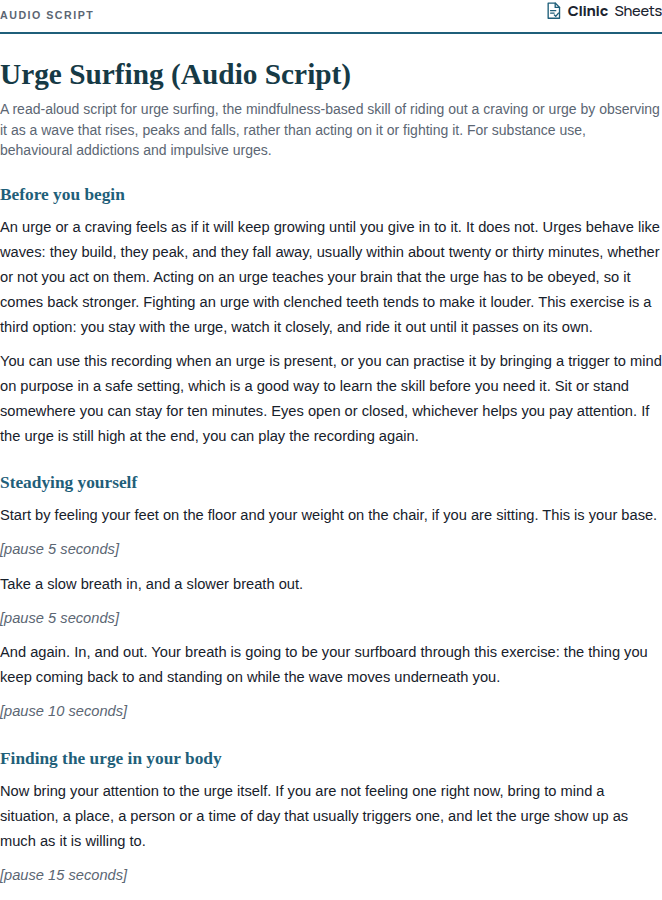
A mindfulness exercise for riding out a craving or urge without acting on it, by observing the urge as a wave that rises, peaks and falls. Useful in substance use, binge eating, self-harm urges and other impulsive behaviours.
About this resource
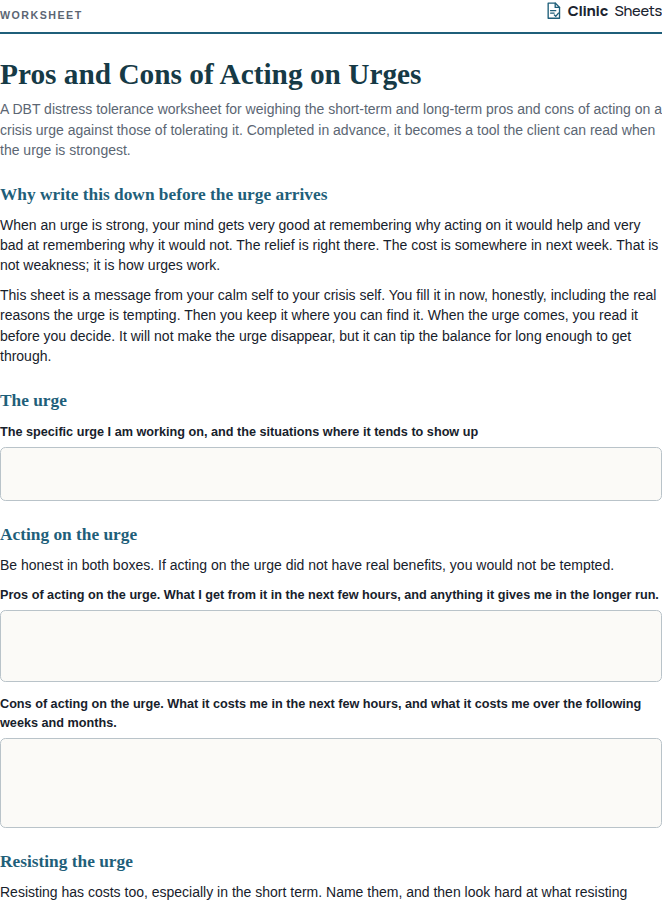
Urge surfing was developed by Alan Marlatt within the mindfulness-based relapse prevention tradition. Its central observation is that urges are time-limited. Left alone, a craving typically builds, peaks and subsides within twenty to thirty minutes, much like a wave. Acting on the urge reinforces the belief that it can only be ended by giving in; fighting the urge tends to make it feel larger. Urge surfing offers a third option: staying with the urge, observing it with curiosity, and letting it pass on its own.
The exercise draws on the same attentional skills used in mindfulness of breath and body. The client locates the urge in the body, notices its qualities as sensation rather than as a command, and tracks how it changes over time. Each time an urge is surfed rather than acted on, the client gathers evidence that urges are survivable and that they lose strength without reinforcement.
Use it after the client has some basic grounding in mindfulness and can identify the physical signature of their urges. It fits naturally alongside a triggers and cravings log and a relapse prevention plan. The professional version includes a script for guiding the exercise in session, guidance on choosing a suitably moderate urge for the first practice, and notes on common obstacles, such as clients who use the exercise as a way of suppressing the urge rather than observing it.
How to use it
- Introduce the wave metaphor and ask the client to describe the last few cravings they experienced: how they began, how long they lasted, what they did. Draw out the pattern that urges peak and pass.
- Practise the exercise in session first, using either a mild current urge or a vivid memory of a recent one. Guide it slowly, allowing at least ten minutes.
- Ask the client to practise at home with moderate urges before attempting strong ones. Strong urges are best met with the relapse prevention plan until the skill is established.
- Review the practice log each session. Look for the client's own observations about how the urge changed, and reinforce the learning that it passed without action.
- Watch for suppression. If the client reports trying to push the urge away or distract from it, revisit the difference between observing and fighting.
References
- Marlatt, G. A., & Donovan, D. M. (Eds.). (2005). Relapse Prevention: Maintenance Strategies in the Treatment of Addictive Behaviors (2nd ed.). Guilford Press.
- Bowen, S., Chawla, N., & Marlatt, G. A. (2011). Mindfulness-Based Relapse Prevention for Addictive Behaviors: A Clinician's Guide. Guilford Press.
- Linehan, M. M. (2015). DBT Skills Training Manual (2nd ed.). Guilford Press.