Coping with Cravings
A handout explaining what a craving is, how it rises and falls, and a set of skills for getting through one without using: urge surfing, delay and distraction, changing the situation, and talking back to permission-giving thoughts.
About this resource
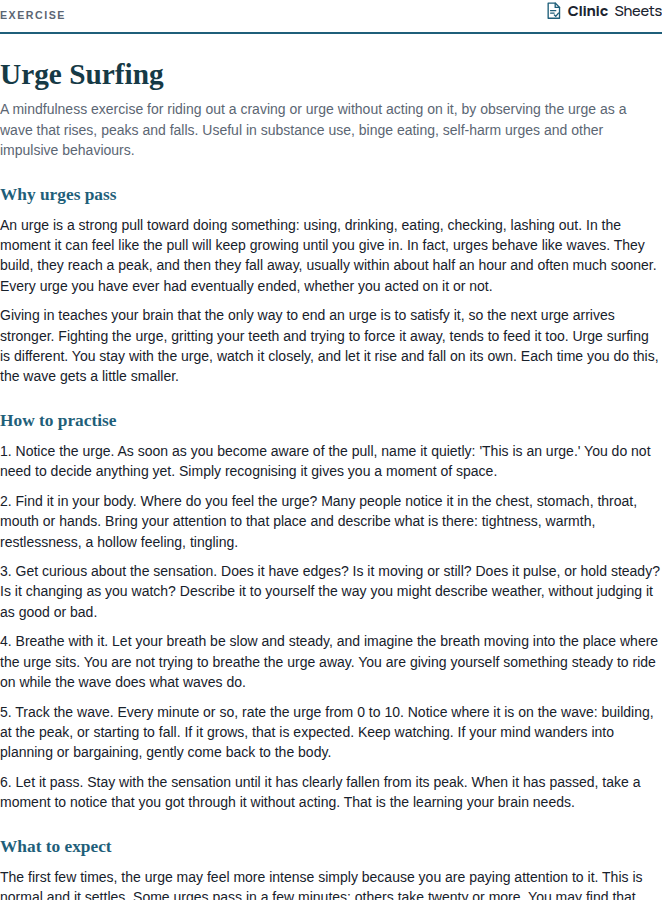
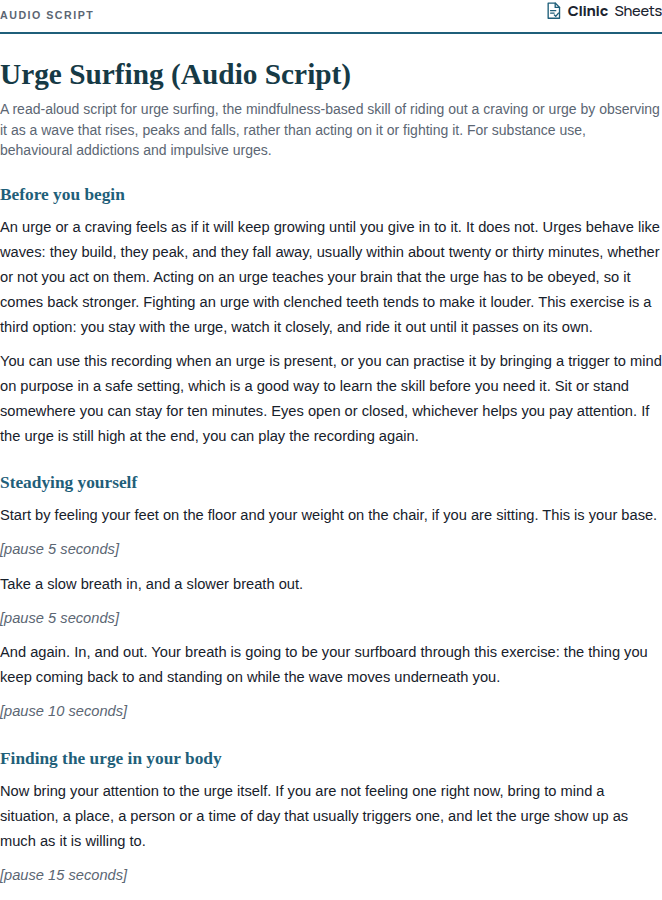
Cravings are the most immediate obstacle to change in any addictive behaviour, and clients often experience them as overwhelming, endless and irresistible. Cognitive behavioural coping skills approaches, developed in the Project MATCH manual and in Carroll's work, teach that cravings are time-limited responses to internal and external cues, that they peak and pass regardless of whether the person uses, and that a repertoire of concrete coping responses can be learned and rehearsed. Mindfulness-based relapse prevention, drawing on Marlatt's urge surfing, adds a different stance: rather than fighting the urge, the person observes it with curiosity as a wave of bodily sensation and thought, and rides it out.
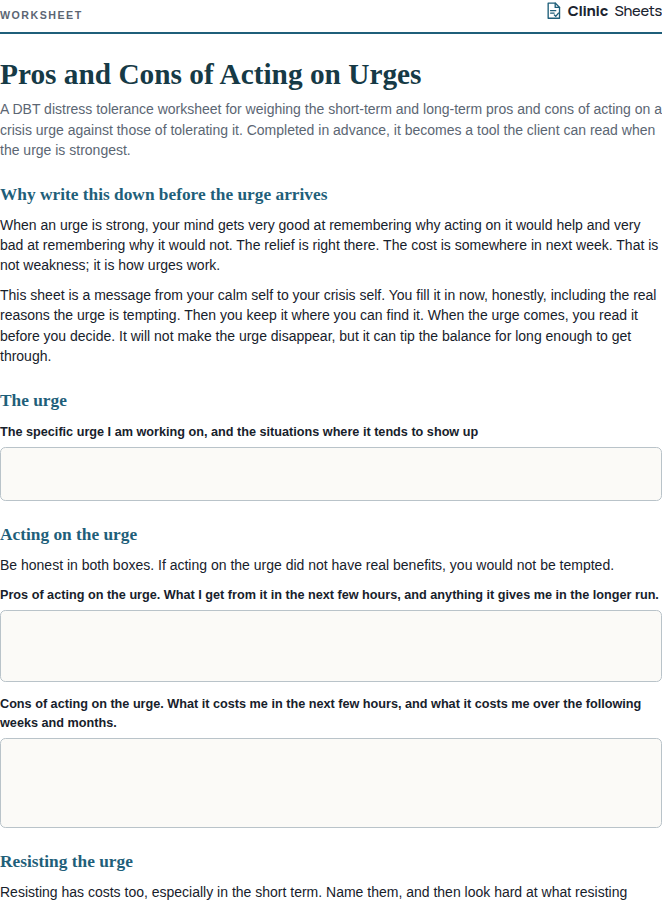
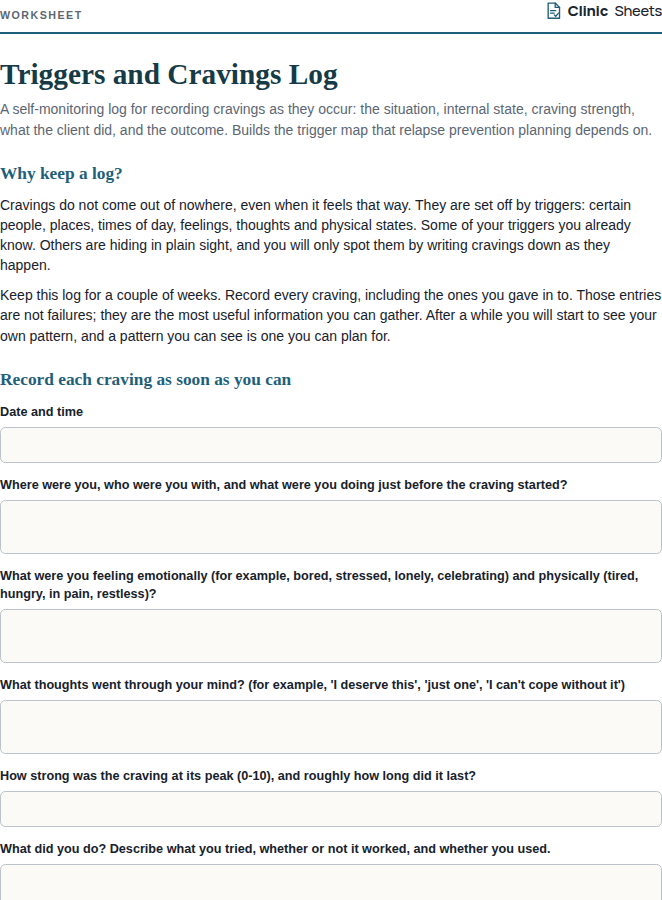
This handout combines both. It explains the anatomy of a craving, corrects the beliefs that make cravings feel dangerous (that they will keep growing, that they can only be ended by using), and offers a menu of skills: urge surfing, delay and distraction, leaving or changing the situation, reaching out, and challenging the permission-giving thoughts that turn an urge into a decision. It ends with a short craving record for practice between sessions. It applies to alcohol, drugs, nicotine, gambling, food and other compulsive behaviours.
The professional version adds notes on functional analysis of cravings, on the distinction between cue-triggered and mood-triggered urges, and on rehearsing skills in session using imaginal cue exposure.
How to use it
- Introduce the handout once the client has committed to reducing or stopping, and before the first high-risk period.
- Ask the client to describe their last strong craving in detail: the trigger, the sensations, the thoughts, how long it lasted and what ended it. Use this to illustrate the rise-and-fall pattern.
- Practise urge surfing in session, using a mild imagined cue, so the client has experienced the technique before needing it.
- Have the client choose three skills from the menu and write down exactly how they will use each one. Generic intentions do not survive a real craving.
- Review the craving record at each session and reinforce every craving that passed without use, regardless of how it was managed.
References
- Kadden, R., Carroll, K., Donovan, D., et al. (1992). Cognitive-behavioral coping skills therapy manual: A clinical research guide for therapists treating individuals with alcohol abuse and dependence (Project MATCH Monograph Series, Vol. 3). National Institute on Alcohol Abuse and Alcoholism.
- Carroll, K. M. (1998). A cognitive-behavioral approach: Treating cocaine addiction (Therapy Manuals for Drug Addiction, Manual 1). National Institute on Drug Abuse.
- Bowen, S., Chawla, N., & Marlatt, G. A. (2011). Mindfulness-based relapse prevention for addictive behaviors: A clinician's guide. Guilford Press.
- Marlatt, G. A., & Donovan, D. M. (Eds.). (2005). Relapse prevention: Maintenance strategies in the treatment of addictive behaviors (2nd ed.). Guilford Press.