Urge Surfing (Audio Script)
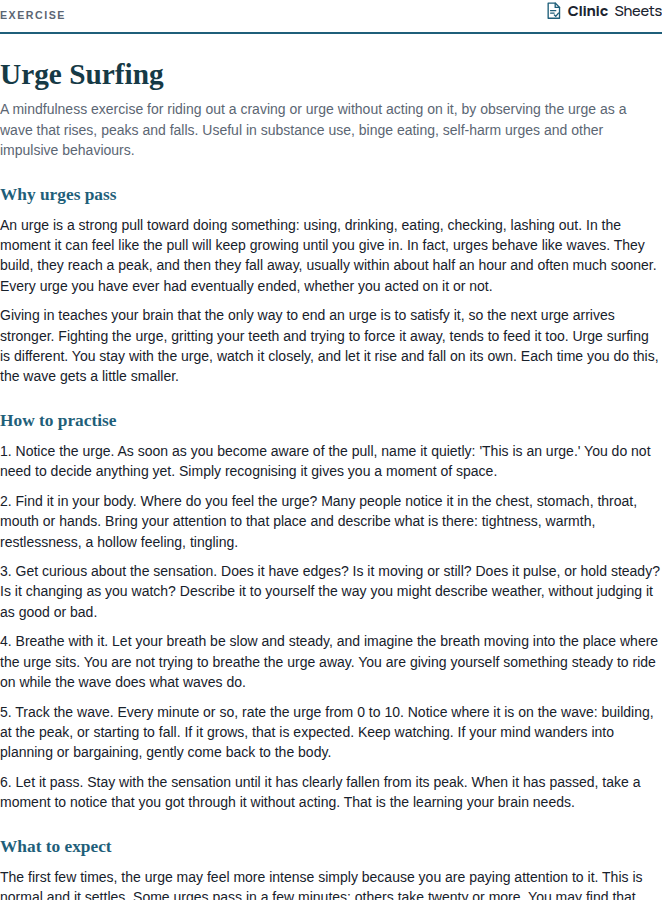
A read-aloud script for urge surfing, the mindfulness-based skill of riding out a craving or urge by observing it as a wave that rises, peaks and falls, rather than acting on it or fighting it. For substance use, behavioural addictions and impulsive urges.
About this resource
Urge surfing was developed by Alan Marlatt within relapse prevention for addictive behaviours and is now a core skill in mindfulness-based relapse prevention (MBRP). It is also taught in DBT as a distress tolerance and mindfulness skill for urges to act impulsively. The underlying observation is simple: urges are time-limited. Like a wave, a craving builds, peaks and subsides, usually within twenty or thirty minutes, whether or not the person acts on it. Giving in to the urge teaches the brain that the urge must be obeyed; fighting it with white-knuckle resistance tends to amplify it. Surfing it means staying with the urge, observing it with curiosity as a set of bodily sensations and thoughts, and letting it pass on its own.
The script guides the client to locate the urge in the body, describe its sensations in detail, notice how they change moment to moment, use the breath as the surfboard that keeps them steady, and watch the urge crest and fall. It includes a brief section on the thoughts that accompany urges (I need this, I can't stand it, just this once) and treats them as part of the wave rather than as instructions.
The script runs about ten minutes. It is best learned first with a mild urge, or by deliberately bringing a trigger to mind in session, before it is used in the face of a strong craving. The professional version adds notes on pairing the skill with a written craving log, on clients who dissociate or become more agitated with body focus, and on the honest limit of the skill: it is one tool within a relapse prevention plan, not a replacement for removing triggers, building support and changing high-risk routines.
How to use it
- Teach the wave concept first, ideally with the client's own data: ask them to recall a craving they did not act on and what happened to it over the following half hour.
- Practise in session with a mild or imagined urge before assigning it for real cravings. Cue exposure in session (looking at a photo, describing a trigger situation) can generate a manageable urge to surf.
- Read at a steady pace. The client should be sitting or standing with eyes open or closed as they prefer. Ten minutes covers most urges past their peak, but tell the client they can repeat the recording if the wave is still high.
- Debrief: where the urge was felt, how intense it was at the start and the end (0-10), what thoughts came, and what it was like to watch rather than act. Track these in a craving log between sessions.
- Place the skill within a broader relapse prevention plan. Urge surfing is for urges that arrive despite good planning; it is not a reason to keep walking into high-risk situations.
References
- Marlatt, G. A., & Gordon, J. R. (Eds.). (1985). Relapse Prevention: Maintenance Strategies in the Treatment of Addictive Behaviors. Guilford Press.
- Bowen, S., Chawla, N., & Marlatt, G. A. (2011). Mindfulness-Based Relapse Prevention for Addictive Behaviors: A Clinician's Guide. Guilford Press.
- Linehan, M. M. (2015). DBT Skills Training Manual (2nd ed.). Guilford Press.