Schema Diary
A structured diary for recording a schema-triggering situation, the schema and mode that were activated, the coping response, and a healthy adult perspective. The schema therapy counterpart to the CBT thought record.
About this resource
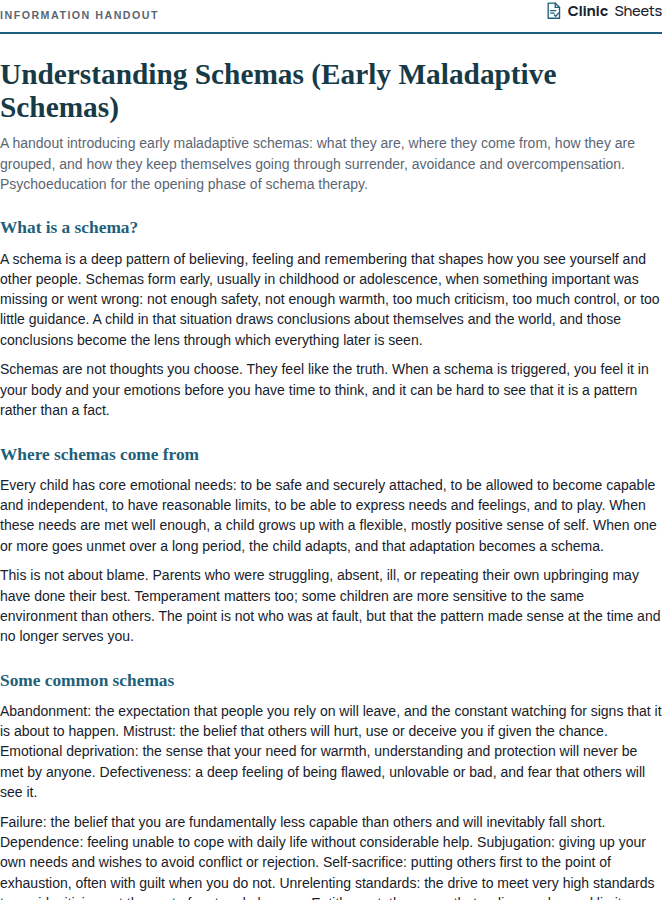
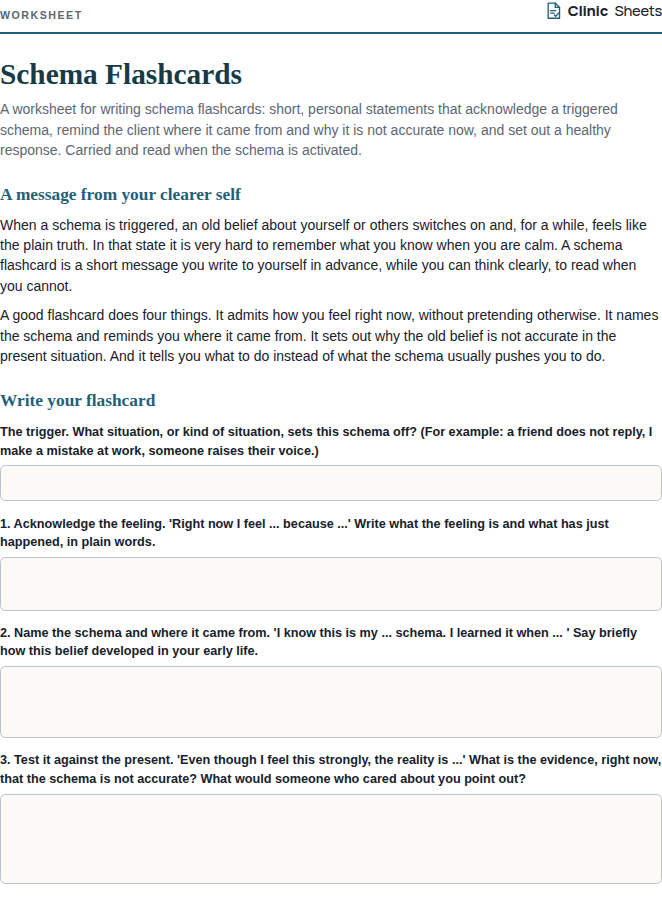
The schema diary is one of the main cognitive tools in schema therapy. Where a standard thought record examines a single automatic thought, the schema diary asks the client to identify which enduring schema was activated by a situation, what the schema led them to feel and believe, which coping style they fell into, and what a healthy adult perspective on the same situation would be. Over time the diary builds a body of evidence that the schema is a pattern rather than an accurate reading of reality, and it strengthens the healthy adult mode by giving it regular practice.
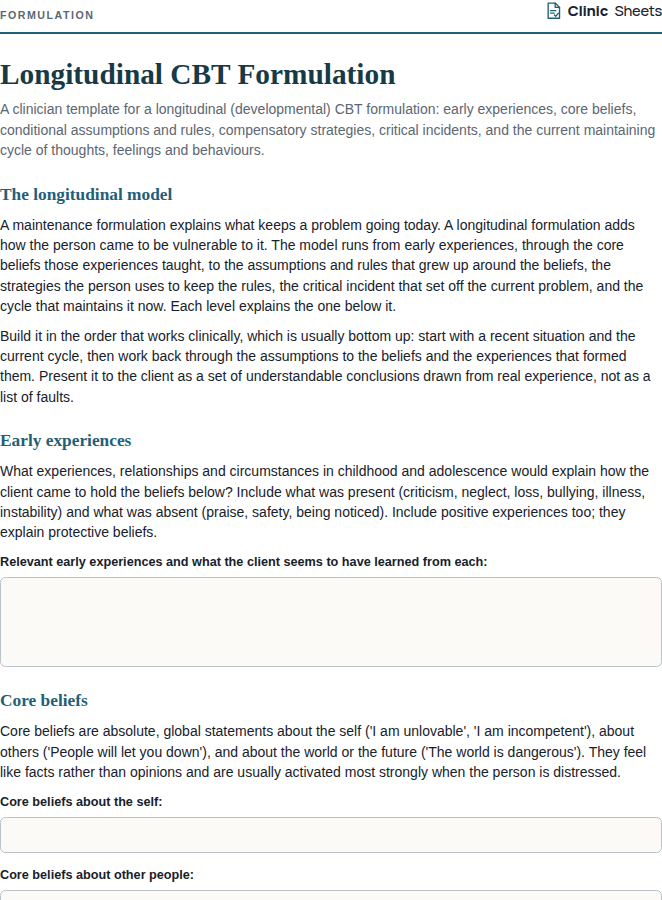
This version follows the structure described by Young, Klosko and Weishaar and adds explicit prompts for modes, since most current practice uses the mode model. It asks the client to rate how strongly the schema was believed at the time and again after writing the healthy adult response, so that shifts can be tracked. It also asks about the origin of the schema in that instance, which keeps the link between present distress and past experience alive between sessions.
Use it once schemas and modes have been introduced and the client can name their own two or three main schemas. The professional version adds a worked example, guidance for clients who cannot access a healthy adult perspective at all, a variant for use after ruptures in the therapeutic relationship, and notes on using the diary to prepare for imagery rescripting.
How to use it
- Complete the first diary in session using a recent event the client has already described. Model the healthy adult response yourself if the client cannot generate one.
- Emphasise that the aim is not to argue with the feeling but to separate the schema's interpretation from the facts of the situation and to respond to the vulnerable child with care.
- Ask for one or two diaries a week, completed as soon as possible after a triggering situation. Review them at the start of each session.
- When the healthy adult section is thin, ask what the client would say to a friend, or what their therapist would say. Over time the aim is for the client to internalise that voice.
- Use the coping style entry to build awareness of the client's default. Ask what a different response, even a small one, might have looked like.
- Watch for the critic appearing in the diary as self-blame for having been triggered. Name it and treat it as data.
References
- Young, J. E., Klosko, J. S., & Weishaar, M. E. (2003). Schema Therapy: A Practitioner's Guide. Guilford Press.
- Arntz, A., & Jacob, G. (2013). Schema Therapy in Practice: An Introductory Guide to the Schema Mode Approach. Wiley-Blackwell.
- van Vreeswijk, M., Broersen, J., & Nadort, M. (Eds.). (2012). The Wiley-Blackwell Handbook of Schema Therapy: Theory, Research, and Practice. Wiley-Blackwell.