Sleep Wind-Down (Audio Script)
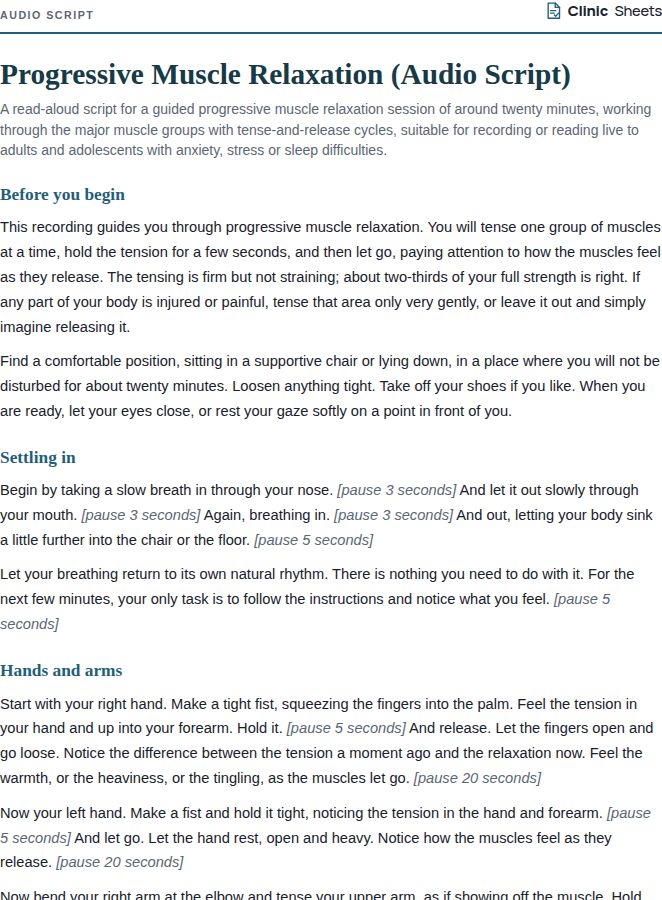
A read-aloud script for a pre-sleep wind-down combining slow breathing, a progressive body release and a mindful, low-effort attitude toward sleep. Designed to sit alongside CBT for insomnia without becoming another way of trying to make sleep happen.
About this resource
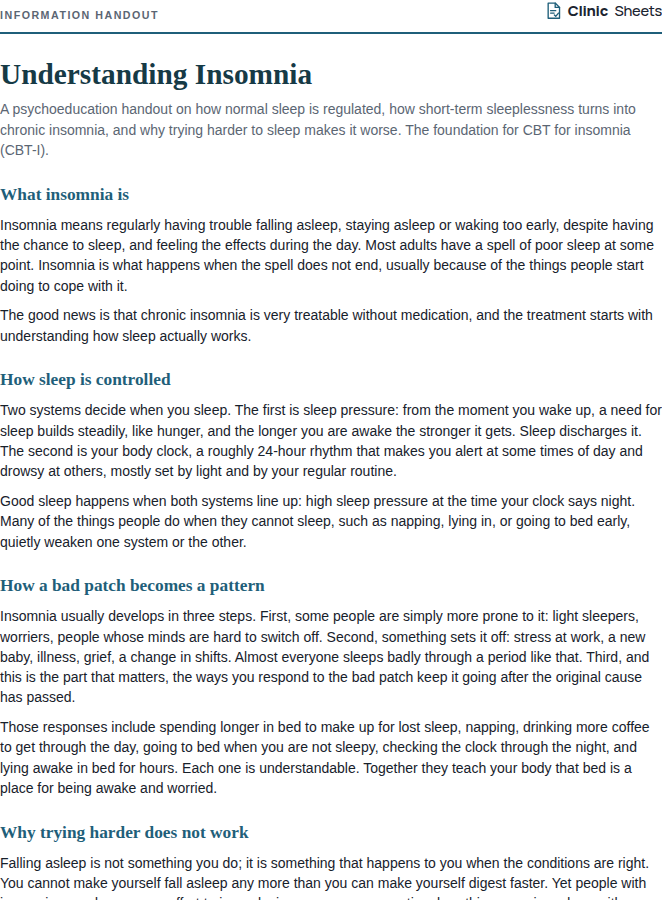
Relaxation and mindfulness practices are useful adjuncts in cognitive behavioural therapy for insomnia (CBT-I), but they carry a well-known risk. People with insomnia typically try very hard to sleep, and the harder they try, the more aroused they become. Espie and colleagues describe this as the attention-intention-effort pathway: attention to sleep, an explicit intention to sleep, and effortful strategies to bring it about all interfere with a process that works only when it is automatic. A relaxation exercise used as a sleep technique, with the client monitoring whether it is working, becomes one more form of sleep effort.
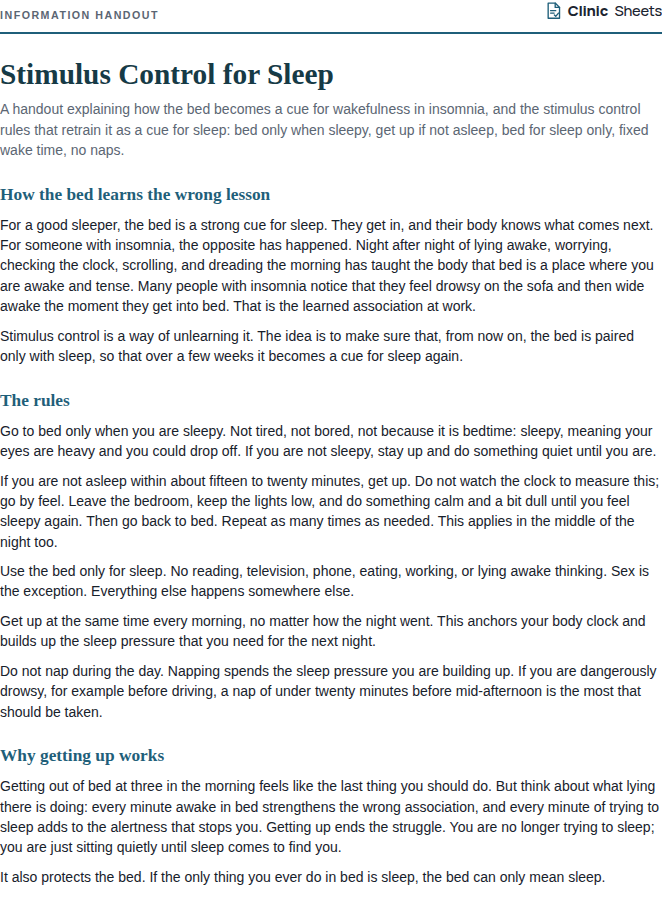
This script is therefore built around letting go of the goal of sleep. It combines slow breathing, a progressive release of tension through the body, and a decentred stance toward thoughts, and it repeatedly frames rest itself as the aim. It also honours stimulus control: the script tells the client that if they are still wide awake and frustrated at the end, it is fine to get up for a while and come back to bed when sleepy, which is the standard CBT-I instruction rather than lying in bed trying harder.
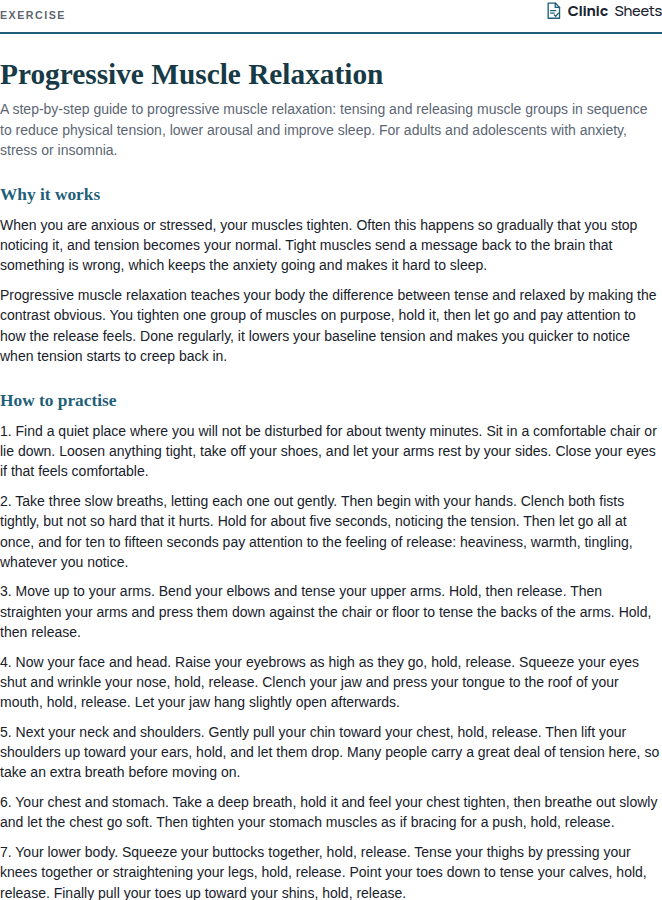
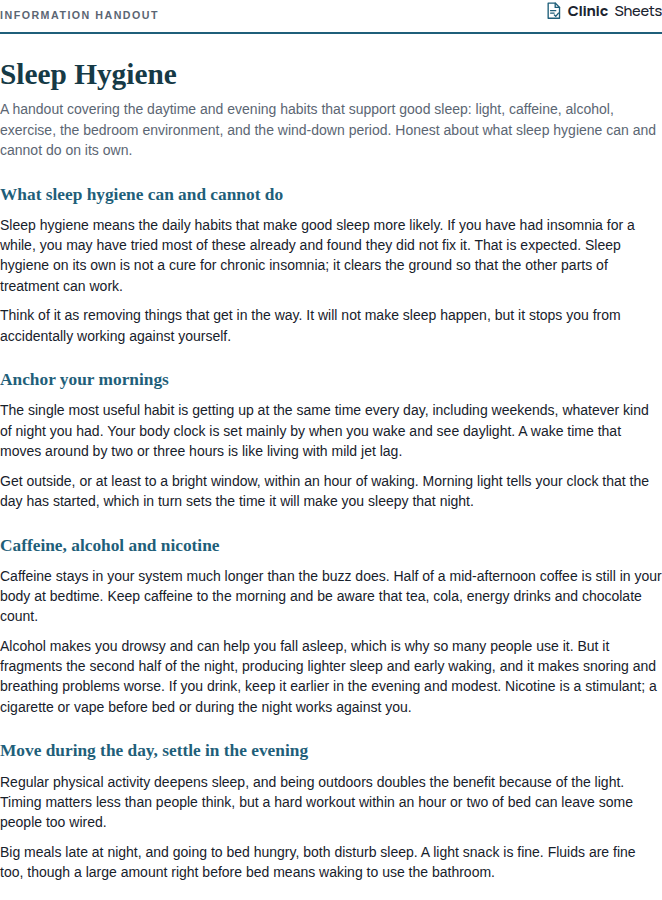
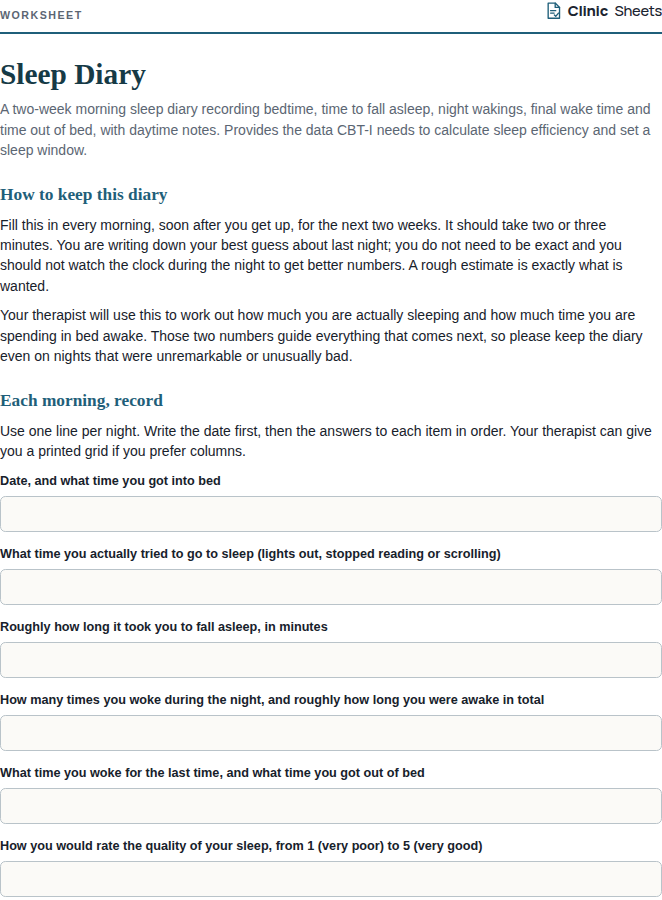
The script runs about twelve to fifteen minutes and is best used in bed with the lights off, or in a dim room as the last step of a wind-down routine. It is not a substitute for the core CBT-I components (sleep restriction or sleep scheduling, stimulus control, and cognitive work on unhelpful beliefs about sleep), and the professional version says so plainly. The professional version also adds guidance on the paradox of relaxation for sleep, on clients who become hypervigilant during body scans, and on how to present the recording so that it is not adopted as a sleep aid the client comes to depend on.
How to use it
- Introduce this as part of a wind-down routine within CBT-I, after the client has started sleep scheduling and stimulus control, not as a stand-alone sleep remedy.
- Explain the effort paradox before giving the recording: the recording is for resting and letting the body settle, and sleep is welcome to arrive on its own but is not the goal. Ask the client not to rate the recording by whether they fell asleep.
- Advise using it once in bed with the lights off, or in a dim room immediately beforehand. If the client is still alert and frustrated afterwards, they follow the usual stimulus control rule: get up, do something quiet in dim light, and return when sleepy.
- Review after a week. If the client reports lying awake monitoring for sleep during or after the recording, revisit the rationale and consider using the recording earlier in the evening instead, or dropping it in favour of the core components.
- Watch for dependence. If the client says they cannot sleep without the recording, treat that as a sleep-related safety behaviour and plan to fade it.
References
- Espie, C. A., Broomfield, N. M., MacMahon, K. M. A., Macphee, L. M., & Taylor, L. M. (2006). The attention-intention-effort pathway in the development of psychophysiologic insomnia: A theoretical review. Sleep Medicine Reviews, 10(4), 215-245.
- Harvey, A. G. (2002). A cognitive model of insomnia. Behaviour Research and Therapy, 40(8), 869-893.
- Morin, C. M., & Espie, C. A. (2003). Insomnia: A Clinical Guide to Assessment and Treatment. Kluwer Academic/Plenum.
- Bootzin, R. R., & Epstein, D. R. (2011). Understanding and treating insomnia. Annual Review of Clinical Psychology, 7, 435-458.