STOP Skill (DBT)
A handout on the DBT crisis survival skill STOP: Stop, Take a step back, Observe, Proceed mindfully. A four-step way to avoid acting on an impulse in the heat of the moment.
About this resource
STOP is one of the crisis survival skills in the distress tolerance module of Marsha Linehan's DBT skills training, added in the second edition of the skills manual. It is designed for the moment just before a person acts on an urge they will later regret: sending the angry message, walking out, using, self-harming, or lashing out. The acronym gives four steps in order: Stop (do not move, freeze, do not react), Take a step back (physically or mentally, take a breath, let go of the immediate reaction), Observe (notice what is happening inside and outside), and Proceed mindfully (act with awareness, considering goals and what will make things better or worse).
The skill works because the gap between urge and action is where choice lives. Strong emotion narrows attention and pushes toward immediate action; STOP inserts a pause that lets the prefrontal 'thinking' processes catch up. It is deliberately simple so that it can be recalled when the client is dysregulated and cannot access more complex skills.
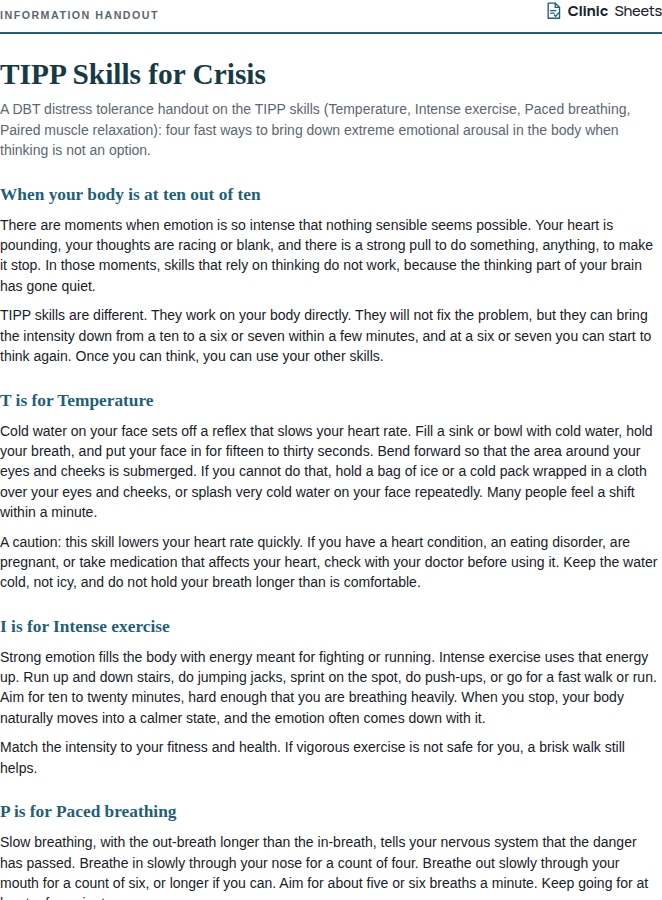
The professional version adds guidance on rehearsing the skill with recent examples, pairing it with TIPP skills when arousal is too high for the pause to hold, and using chain analysis afterwards to see where STOP could have been used.
How to use it
- Teach STOP early in distress tolerance, using a recent situation where the client acted on an urge and regretted it. Walk through what each step would have looked like at that moment.
- Emphasise that the first step is literal: stop moving. Practise it in session with a mild prompt, such as a hypothetical provocative text message.
- Link Observe to mindfulness skills the client already has. The goal is to notice, not to analyse.
- For Proceed mindfully, use the question 'what will help me reach my goal, and what will make things worse?' as the deciding test. This connects to wise mind.
- Review use of the skill each week. Where the client could not stop, consider whether arousal was too high and whether TIPP skills should come first.
References
- Linehan, M. M. (2015). DBT Skills Training Manual (2nd ed.). Guilford Press.
- Linehan, M. M. (2015). DBT Skills Training Handouts and Worksheets (2nd ed.). Guilford Press.
- Rathus, J. H., & Miller, A. L. (2015). DBT Skills Manual for Adolescents. Guilford Press.